
Can I have an ESA in a no-pet apartment?
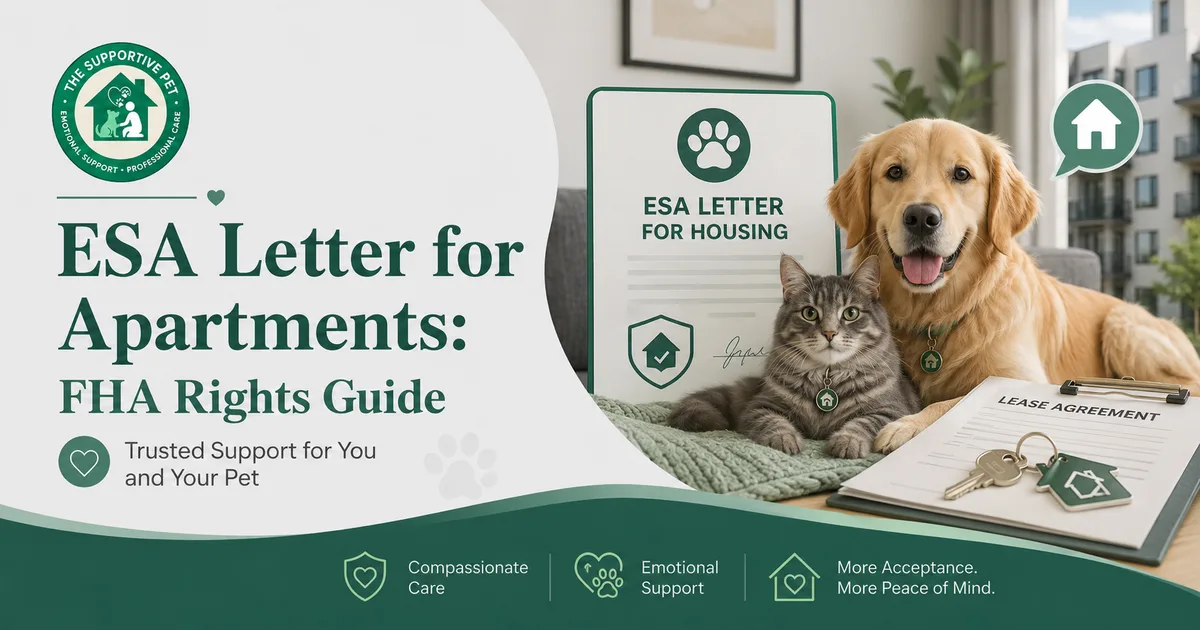
Yes. The Fair Housing Act requires landlords to provide reasonable accommodation for tenants with disabilities - including allowing an emotional support animal in a no-pet building. A valid ESA letter from a licensed mental health professional is the documentation you need to invoke this right. The landlord's "no pets" policy does not override your FHA accommodation rights.
Medical Disclaimer: This article is for informational purposes only and does not constitute medical or legal advice. Consult a qualified mental health professional before making decisions about your care. If you or someone you know is in crisis, call or text 988 (Suicide & Crisis Lifeline, available 24/7).
The "no pets" policy does not apply to ESAs
Under the Fair Housing Act, an emotional support animal is not a pet - it is a disability accommodation. This distinction is critical: no-pet policies in apartment leases and building rules apply to pets, not to ESAs. Landlords who apply no-pet policies to valid ESA requests are violating federal law.
This protection covers apartments, condominiums, townhomes, and most other rental housing. The main exceptions are owner-occupied buildings with four or fewer units, and single-family homes rented without a broker.
How to use your ESA letter in an apartment
Once you have a valid ESA letter, the process is straightforward:
- Submit a formal written request. Do not just walk in and say "I have an ESA letter." Put the request in writing - email is fine. State that you have a disability and need a reasonable accommodation to keep your ESA.
- Attach your ESA letter. Include the full letter with the clinician's name, license number, and signature visible.
- Reference the Fair Housing Act. Explicitly citing the FHA signals that you know your rights and take the request seriously.
- Keep copies of everything. If the landlord denies your request or retaliates, your documentation trail matters.
What landlords can and cannot ask
Landlords can:
- Request a letter from a licensed mental health professional
- Verify the clinician's license through the state licensing board
- Ask for general information about the type and size of the animal
- Ask whether the animal is needed because of a disability (but not what the disability is)
Landlords cannot:
- Demand your specific psychiatric diagnosis or medical records
- Require more documentation than a valid ESA letter provides
- Charge pet fees, deposits, or monthly pet rent for an ESA
- Apply blanket breed or weight restrictions without individualized assessment
"The most common mistake tenants make is treating the ESA conversation as asking for a favor. It is not a favor - it is a legal accommodation request. Your landlord has obligations under federal law."
- Chetna Giri, Head of Legal & Compliance
If your landlord refuses
If your landlord denies your reasonable accommodation request without a legally valid basis, you have options. File a complaint with HUD at hud.gov/complaint (free), contact your state fair housing agency, or consult a disability rights attorney. Many FHA cases settle before formal proceedings. See our detailed guide on what to do when your landlord denies your ESA.
Ready to get the documentation you need? Learn more about ESA letters for housing.
Your complete FHA rights as an ESA owner in an apartment
The Fair Housing Act gives you specific, enforceable rights as a tenant with an ESA. Understanding these precisely prevents landlords from using confusion or delay tactics:
- Right to waive no-pet policies: Your landlord's no-pet lease clause does not apply to emotional support animals. ESAs are not classified as "pets" under the FHA - they are assistance animals.
- Right to waive pet deposits: Landlords cannot charge a pet deposit, pet fee, or monthly pet surcharge for your ESA. You remain liable for any actual damage your animal causes, but you cannot be charged a preemptive fee.
- Right to waive breed and size restrictions: Breed bans and weight limits do not apply to ESAs. A landlord cannot deny your Rottweiler or 80-pound dog as an ESA based on breed alone.
- Right to a timely response: Landlords must respond to your accommodation request within a reasonable time - HUD guidance suggests 10 business days.
- Right to the interactive process: If your landlord has questions about your letter, they must engage in a good-faith dialogue - not simply deny and stop communicating.
What landlords can legally ask - and what they cannot
Landlords are permitted to ask two things when you submit an ESA accommodation request:
- Confirmation that you have a disability (your ESA letter provides this)
- Confirmation that your disability creates a need for the emotional support animal (your ESA letter provides this too)
What landlords cannot ask or require:
- Your specific diagnosis or detailed medical history
- Your full medical records or treatment notes
- A third-party "ESA certification" or registration number
- That you use a specific form or questionnaire instead of your clinician's letter
- Additional fees or deposits of any kind for the ESA
- Proof of training (ESAs do not require training)
If a landlord demands any of these, document it in writing and consult a fair housing attorney or file a HUD complaint.
How to submit your ESA accommodation request: step by step
A well-structured accommodation request is harder for a landlord to deny and creates a clear paper trail if you need to escalate.
Step 1: Write a formal accommodation request email
Subject: Reasonable Accommodation Request - Emotional Support Animal
Body: State that you have a disability and are requesting accommodation to keep an emotional support animal in your unit. Note that you are attaching documentation from your licensed mental health professional as required by the Fair Housing Act. Do not disclose your diagnosis in the email - just the existence of the disability and the documentation.
Step 2: Attach your ESA letter
Attach your ESA letter as a PDF. Make sure it includes your clinician's license number, license type, state of licensure, their signature, and the date.
Step 3: Keep copies of everything
Save the email, the attachment, and every subsequent communication. If your landlord responds verbally, follow up in writing: "Following our conversation on [date], I understand you are [reviewing/approving/denying] my accommodation request."
Step 4: Follow up if you don't hear back
If 10 business days pass without a response, send a polite follow-up. Note the original date of your request. Silence is not acceptance - you need written confirmation of approval.
What to do if your apartment complex denies your ESA
If you receive a denial, first verify the reason in writing. Legitimate reasons for denial are narrow - ask specifically why your request was denied. Then:
- Contact The Supportive Pet's support team - we provide free landlord dispute support and will reach out to your landlord directly to clarify your FHA rights
- File a complaint with HUD - complaints can be filed at hud.gov or by calling 1-800-669-9777. HUD investigates fair housing violations at no cost to you
- Contact your state fair housing agency - many states have their own fair housing offices that can investigate independently
- Consult a fair housing attorney - many work on contingency for clear FHA violations
At The Supportive Pet, every letter includes a 365-day acceptance guarantee. If your letter is rejected and we cannot resolve the dispute, you receive a full refund. Start your application at our pricing page.
Does your ESA letter cover all apartments?
The FHA covers most rental housing. The exceptions are narrow:
- Single-family homes sold or rented without a real estate broker, if the owner owns no more than three properties
- Owner-occupied buildings with four or fewer units
- Housing operated by religious organizations or private clubs for members only
In practice, most apartment complexes, condos, HOAs, student housing, and standard rental properties are fully covered. If you are unsure whether your building qualifies for an exemption, a fair housing attorney can advise you in a free consultation.
Frequently Asked Questions
Can I have an ESA in a no-pet apartment?
Yes. The Fair Housing Act requires landlords to provide reasonable accommodation for tenants with disabilities - including allowing an emotional support animal in a no-pet building. A valid ESA letter from a licensed mental health professional is the documentation you need to invoke this right. The landlord's "no pets" policy does not override your FHA accommodation rights.
What do I say to my apartment complex about my ESA?
Submit a formal written reasonable accommodation request to your landlord or property manager. State that you have a disability, that your ESA provides therapeutic support related to your disability, and attach your ESA letter. You do not need to disclose your specific diagnosis. Reference the Fair Housing Act explicitly. Written requests carry more legal weight than verbal ones.
Can my apartment complex charge me a pet deposit for my ESA?
No. Under the FHA, a landlord cannot charge a pet deposit, pet fee, or monthly pet rent for an ESA. An ESA is a disability accommodation - not a pet. However, you remain responsible for any actual damage your ESA causes to the property, which can be handled through the standard security deposit process.
What if my apartment lease says no pets?
A no-pets clause in your lease does not prevent you from requesting an ESA accommodation under the FHA. Your ESA right is a separate legal protection that exists regardless of what your lease says. Submit a reasonable accommodation request with your ESA letter - the FHA supersedes conflicting lease terms in most circumstances.
See our articles highlighted in Google Search
Add The Supportive Pet as a preferred source - your results, your way.