
What is an ESA letter?
An ESA letter is a written document from a licensed mental health professional stating that you have a mental health disability and that your pet provides therapeutic benefit for that condition. It is a clinical recommendation - not a registration or certification - and it grants housing protections under the Fair Housing Act.
Medical Disclaimer: This article is for informational purposes only and does not constitute medical or legal advice. Consult a qualified mental health professional before making decisions about your care. If you or someone you know is in crisis, call or text 988 (Suicide & Crisis Lifeline, available 24/7).
What exactly is an ESA letter?
An Emotional Support Animal (ESA) letter is a written document from a licensed mental health professional that states you have a mental health disability and that your pet provides therapeutic benefit for that condition. It is not a registration, not a certification, and not a government-issued document - it is a clinical recommendation from a licensed professional who has evaluated your case.
The letter must come from a licensed professional in your state: a psychiatrist (MD), psychologist (PhD or PsyD), licensed clinical social worker (LCSW), licensed professional counselor (LPC), or licensed marriage and family therapist (LMFT). The clinician must be licensed specifically in the state where you currently reside - an out-of-state clinician's letter does not meet the standard HUD guidance establishes.
What distinguishes a legitimate ESA letter from the fraudulent products that flood the online market is a single critical element: a real clinical evaluation. A licensed professional must actually review your case, assess whether your condition qualifies, and make a professional judgment about whether documentation is appropriate. A quiz, a form submission, or an automated system is not a clinical evaluation.
What legal protections does an ESA letter provide?
A valid ESA letter primarily provides housing protections under two federal laws:
- Fair Housing Act (FHA): Landlords must provide reasonable accommodations for your ESA, even in no-pet buildings. They cannot charge pet deposits, pet fees, or monthly pet rent. Breed and weight restrictions cannot be applied. This is the core protection most ESA owners invoke.
- Rehabilitation Act of 1973 / Fair Housing Amendments Act: These extend similar protections to federally funded housing - including public housing, Section 8 housing, and university dormitories. Most colleges are subject to these protections alongside the FHA.
What an ESA letter does not provide: As of January 2021, airlines are no longer required to allow ESAs in the cabin. The Department of Transportation issued a final rule permitting airlines to treat ESAs as regular pets. Most major US carriers - Delta, United, American, Southwest, JetBlue - now require ESA owners to pay standard pet fees. Only Psychiatric Service Dogs (PSDs) retain air travel rights under the Air Carrier Access Act. See our 2026 airline guide for details.
Do you actually need an ESA letter?
Whether you need a letter depends primarily on your housing situation and your goals:
- You live in a no-pet building or are applying to one: Yes, you need a letter. Without formal documentation, your landlord has no legal obligation to accommodate your animal. A valid ESA letter is the legal trigger for your FHA rights.
- Your lease has breed or weight restrictions your animal does not meet: Yes, a letter invokes your right to reasonable accommodation and overrides those restrictions.
- Your current housing allows pets freely and has no restrictions: You may not need one immediately. However, having a letter on file is valuable protection if policies change, you move, or if you want to avoid any future ambiguity about your animal's status.
- You live in college housing with a no-pets policy: Yes. Campus housing is covered by the FHA and the Rehabilitation Act. A letter submitted to disability services is how you invoke your rights. See our college housing guide.
- You want air travel rights for your animal: An ESA letter will not help for this purpose. Only a Psychiatric Service Dog letter provides airline travel rights, and only if your dog is trained to perform specific psychiatric tasks.
What makes a letter legitimate versus fraudulent?
The ESA industry is flooded with fraudulent services. Understanding the distinction between a legitimate letter and a fake one protects you from wasting money and from a housing denial when you actually need the accommodation.
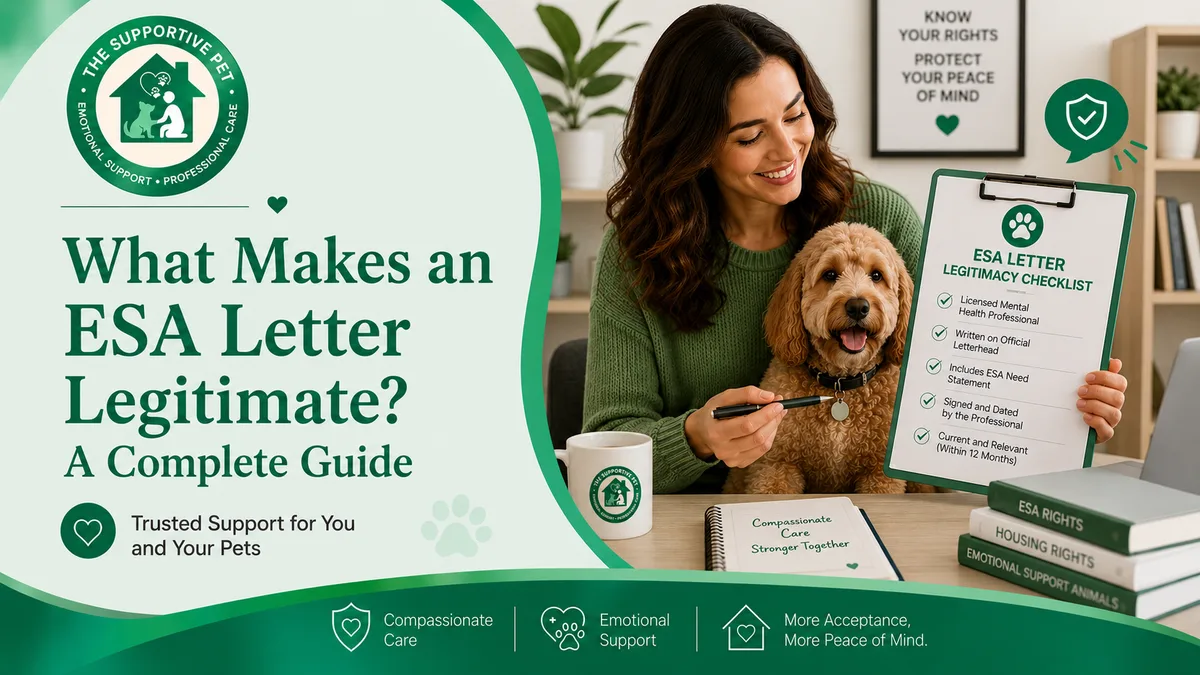
A legitimate ESA letter must:
- Be written on the clinician's official professional letterhead
- Include the clinician's full name, license type, license number, and state of licensure - all independently verifiable
- State that you have a mental health disability that substantially limits a major life activity (without specifying the diagnosis)
- Include a nexus statement connecting your disability to the therapeutic need for your ESA
- Confirm an established clinician-patient relationship, not a one-time form review
- Be signed by the clinician (original or verified digital signature)
- Be dated within the past 12 months
Red flags that identify a fraudulent ESA service
Avoid any service that displays any of the following characteristics:
- Offers an "instant" or "5-minute" letter with no clinician evaluation: No legitimate mental health professional can evaluate your case in zero minutes. Instant generation means no evaluation happened.
- Provides a letter based on a simple online quiz: A quiz is not a clinical assessment. HUD guidance requires documentation from a provider with personal knowledge of your disability.
- Sells "ESA registration," "certification," or "ID cards": No government ESA registry exists. These products have zero legal value. Learn why ESA registration is a scam.
- Cannot provide a verifiable clinician name, license number, and state of licensure: If you cannot look up the clinician on the state licensing board website, the letter will not survive a landlord's verification check.
- Guarantees approval: No legitimate clinician guarantees approval - they evaluate each case independently. "Guaranteed approval" means the evaluation is a rubber stamp.
- Price under $50 for what they call a "complete evaluation": A licensed clinician's time for a genuine evaluation cannot realistically cost less than this. Below this threshold, something in the process has been cut - usually the actual clinical review.
"The goal is not to 'get a letter' - it is to connect with a clinician who genuinely understands your situation and can document it professionally. The letter is just the tangible product of that clinical relationship. When that relationship is real, the letter is strong. When there is no relationship, the letter is paper."
- Kartik Sharma, LCSW
Who qualifies for an ESA letter?
The Fair Housing Act does not provide an exhaustive list of qualifying conditions. The standard is functional: you need a mental health condition that substantially limits a major life activity. Conditions that commonly qualify include:
- Anxiety disorders (generalized anxiety disorder, panic disorder, social anxiety disorder)
- Major depressive disorder and persistent depressive disorder
- Post-traumatic stress disorder (PTSD)
- Bipolar disorder (I and II)
- Obsessive-compulsive disorder (OCD)
- Attention-deficit/hyperactivity disorder (ADHD)
- Autism spectrum disorder
- Schizophrenia and related psychotic disorders
- Agoraphobia, specific phobias, and other anxiety-related conditions
You do not need a prior formal diagnosis from another provider to qualify. The clinician who evaluates you makes their own independent assessment. See all qualifying conditions.
How to get a legitimate ESA letter
There are two primary pathways to a legitimate ESA letter:
Option 1: Your existing therapist
If you already see a licensed mental health professional, ask them directly. This produces the strongest possible documentation because HUD guidance specifically favors letters from clinicians with established patient relationships. Many therapists write letters for existing patients at no additional charge or for a small documentation fee. See our guide on how to ask your therapist.
Option 2: A legitimate telehealth platform
The Supportive Pet connects you with a licensed clinician in your state who conducts a genuine clinical evaluation. The process involves three steps:
- Intake assessment: Complete a questionnaire about your mental health condition and how your animal helps you manage your symptoms. Be specific and detailed - this is the clinical foundation of your letter.
- Clinician review: A licensed clinician in your state reviews your case. They may request a brief telehealth consultation if they need additional information. If your case is straightforward and your intake is thorough, fast approval is typical.
- Letter delivery: If clinically appropriate, your letter arrives by email with the clinician's full credentials and verifiable license information.
The entire process is HIPAA-compliant. Your personal health information is never shared with your landlord, third parties, or any registry. Start your evaluation now or view current pricing.
Frequently Asked Questions
What is an ESA letter?
An ESA letter is a written document from a licensed mental health professional stating that you have a mental health disability and that your pet provides therapeutic benefit for that condition. It is a clinical recommendation - not a registration or certification - and it grants housing protections under the Fair Housing Act.
Who can write a legitimate ESA letter?
A legitimate ESA letter must be written by a licensed mental health professional in your state - including a psychiatrist, psychologist, licensed clinical social worker (LCSW), licensed professional counselor (LPC), or licensed marriage and family therapist (LMFT). It must include the clinician's license number, state of licensure, and signature.
How long is an ESA letter valid?
Most landlords require an ESA letter dated within the past 12 months. There is no federal rule specifying an expiration date, but annual renewal is the industry standard because it ensures the letter reflects a current clinician-patient relationship.
Does an ESA letter give me airline travel rights?
No. As of January 2021, the Department of Transportation ruled that airlines may treat ESAs as regular pets. Most major US airlines - including Delta, United, American, and Southwest - no longer provide cabin accommodations for ESAs. Only Psychiatric Service Dogs (PSDs) retain air travel rights under the Air Carrier Access Act.
See our articles highlighted in Google Search
Add The Supportive Pet as a preferred source - your results, your way.