
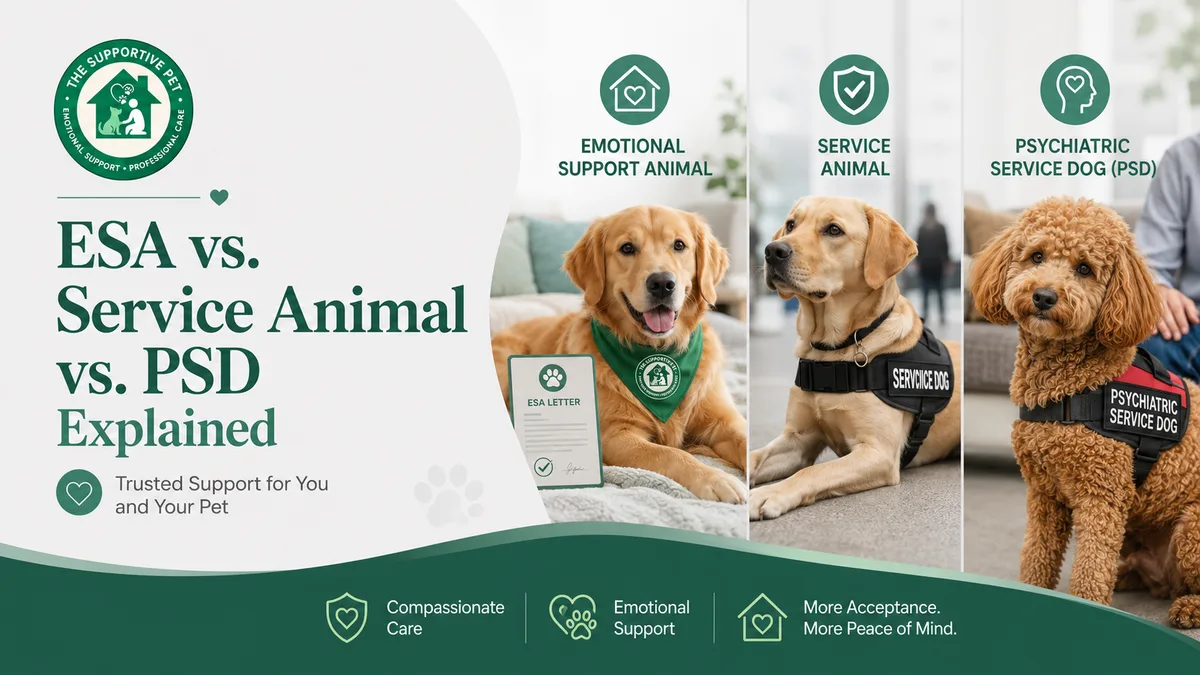
What is the difference between an ESA and a service animal?
An Emotional Support Animal (ESA) provides emotional comfort to someone with a mental health disability and is protected only in housing under the Fair Housing Act. A service animal is a trained dog that performs specific tasks for a person with any disability and has full public access rights under the ADA - including restaurants, stores, hotels, and airlines.
Medical Disclaimer: This article is for informational purposes only and does not constitute medical or legal advice. Consult a qualified mental health professional before making decisions about your care. If you or someone you know is in crisis, call or text 988 (Suicide & Crisis Lifeline, available 24/7).
Three types, three different laws
Understanding the difference between an Emotional Support Animal, a Service Animal, and a Psychiatric Service Dog is critical - because confusing them can lead to denied accommodations, misinformation, or legal problems.
Understanding the distinction matters for both housing and travel rights. See also: what an ESA letter includes, how a PSD letter works, and our comparison of ESA vs. therapy dog vs. regular pet.
Emotional Support Animal (ESA)
An ESA is any animal (dog, cat, rabbit, bird, etc.) that provides emotional or mental health support to a person with a diagnosed mental health disability. ESAs do not need task training.
Legal protection: Fair Housing Act (FHA) - housing only. As of 2021, no longer protected on airlines.
Documentation required: Letter from a licensed mental health professional.
Service Animal (ADA)
Under the Americans with Disabilities Act, a service animal is a dog (or miniature horse) trained to perform specific tasks related to a person's disability. Examples include guide dogs, seizure alert dogs, and diabetes alert dogs.
Legal protection: Public access rights - restaurants, stores, hospitals, hotels, and more. Also protected in housing and on airlines.
Documentation required: None - businesses can only ask two questions: (1) Is this a service animal? (2) What task is it trained to perform?
Psychiatric Service Dog (PSD)
A PSD is a specific type of service animal trained to perform tasks that mitigate a psychiatric disability. Examples include grounding during panic attacks, interrupting self-harm behaviors, or reminding the handler to take medication.
Legal protection: Full ADA public access rights, FHA housing rights, and Air Carrier Access Act (ACAA) airline rights.
Documentation required: For housing and airlines, a letter from a licensed mental health professional is recommended. For public access, the same two-question rule applies.
"Many people qualify for PSD protection without realizing it. If your dog performs a specific, trained behavior that helps manage a psychiatric condition, you may have significantly more legal protection than you think."
- Chetna Giri, Head of Legal & Compliance
Quick comparison
Here's a summary of the key differences:
- ESA: Any species · No task training · Housing only · FHA
- Service Animal: Dog (or mini horse) · Specific task training · Public access + housing + flights · ADA/FHA/ACAA
- PSD: Dog · Psychiatric task training · Public access + housing + flights · ADA/FHA/ACAA
The legal frameworks: FHA vs. ADA
The confusion between ESAs and service animals stems partly from the fact that different laws govern them:
- Emotional Support Animals (ESAs) are protected primarily under the Fair Housing Act (FHA), which is enforced by the U.S. Department of Housing and Urban Development (HUD).
- Service Animals are protected under the Americans with Disabilities Act (ADA), which is enforced by the Department of Justice.
- Psychiatric Service Dogs (PSDs) are protected under both - the FHA for housing and the ADA for public access.
Each law has different requirements for the animal, different rights it grants, and different circumstances under which the protections apply.
Emotional Support Animals: detailed breakdown
What qualifies as an ESA: Any animal of any species - dogs, cats, rabbits, birds, reptiles, and more - can be an ESA, as long as a licensed mental health professional has determined that the animal provides therapeutic benefit for a disability.
Training requirements: None. ESAs do not need task training. Their therapeutic role is provided through companionship and presence, not specific trained behaviors.
Documentation required: A letter from a licensed mental health professional (LMHP) - a psychiatrist, psychologist, licensed clinical social worker, licensed professional counselor, or licensed marriage and family therapist - who has evaluated your case.
Rights granted:
- Housing: landlords must accommodate your ESA in no-pet housing (FHA)
- Pet fees and deposits must be waived
- Breed and weight restrictions cannot be applied to your ESA
- Public access: ESAs do not have public access rights under the ADA. Restaurants, stores, and most public places are not required to admit ESAs.
- Air travel: as of 2021, the DOT no longer requires airlines to accommodate ESAs. Most US airlines now treat ESAs as pets, subject to pet fees and carrier requirements.
Psychiatric Service Dogs: detailed breakdown
What qualifies as a PSD: Only dogs (and in some cases, miniature horses under the ADA). The dog must be trained to perform at least one specific task that directly mitigates the handler's psychiatric disability.
Training requirements: Task-specific training is required. Examples of PSD tasks include:
- Deep pressure therapy during panic attacks
- Interrupting dissociative episodes
- Medication reminders
- Room checks for people with PTSD-related hypervigilance
- Interrupting self-harm behaviors
- Alerting to oncoming anxiety or panic attacks based on behavioral cues
The ADA does not require professional training - owner-training is permitted, as long as the dog is reliably trained to perform the task and is well-behaved in public.
Documentation required: A PSD letter from a licensed mental health professional confirming your psychiatric disability and the dog's status as a psychiatric service dog. Unlike ESAs, PSDs can also be verified through two questions under the ADA: (1) Is this a service animal required because of a disability? (2) What work or task has the dog been trained to perform?
Rights granted:
- Housing: same as ESAs under the FHA
- Public access: ADA rights to enter restaurants, stores, hotels, transportation, and virtually all places open to the public
- Air travel: PSDs are still accommodated on most airlines as service animals under the revised DOT rules
Which is right for you?
Use this decision framework:
- My pet is not a dog (cat, rabbit, bird, etc.) and I need housing rights: ESA letter
- My dog helps me and I only need housing rights: ESA letter
- My dog performs specific tasks for my psychiatric disability and I need public access rights: PSD letter
- I want both housing and public access rights for my dog: PSD letter (or ESA + PSD bundle for maximum protection)
If you're unsure whether your dog performs a qualifying task, think about specific, discrete behaviors: does your dog do something definable in response to your disability? "Being calming" is not a task - "placing their paws on my chest when my heart rate elevates during a panic attack" is a task.
The Supportive Pet offers both ESA letters and PSD letters, as well as a combined bundle. Our licensed clinicians evaluate each case individually and advise on which documentation is most appropriate for your situation. Learn more about PSD letters or view pricing for all options.
Frequently Asked Questions
What is the difference between an ESA and a service animal?
An Emotional Support Animal (ESA) provides emotional comfort to someone with a mental health disability and is protected only in housing under the Fair Housing Act. A service animal is a trained dog that performs specific tasks for a person with any disability and has full public access rights under the ADA - including restaurants, stores, hotels, and airlines.
Does an ESA have public access rights?
No. ESAs do not have public access rights under the ADA. They are only protected in housing settings under the Fair Housing Act. Businesses, restaurants, and public spaces are not required to allow ESAs. Only trained service animals - including Psychiatric Service Dogs - have ADA public access rights.
Can any animal be an ESA?
Yes - ESAs are not limited to dogs. Cats, rabbits, birds, hamsters, and other animals can be ESAs. In contrast, ADA service animals are limited to dogs (and miniature horses in some cases), because they must be trained to perform specific tasks.
What is a Psychiatric Service Dog (PSD)?
A Psychiatric Service Dog is a dog trained to perform specific tasks that mitigate a handler's psychiatric disability - such as deep pressure therapy during panic attacks, interrupting self-harm behaviors, or alerting to medication reminders. PSDs have full ADA public access rights, FHA housing rights, and airline travel rights under the ACAA.
See our articles highlighted in Google Search
Add The Supportive Pet as a preferred source - your results, your way.