
Can a landlord legally deny an ESA request?
Landlords can only deny an ESA accommodation request in limited circumstances: if the specific animal poses a direct, documented threat to the health or safety of others, if allowing the animal would impose an undue financial or administrative burden, or if the building qualifies for a narrow FHA exemption (owner-occupied buildings with four or fewer units, or single-family homes rented without a broker).
Medical Disclaimer: This article is for informational purposes only and does not constitute medical or legal advice. Consult a qualified mental health professional before making decisions about your care. If you or someone you know is in crisis, call or text 988 (Suicide & Crisis Lifeline, available 24/7).
First: understand what the law requires
The Fair Housing Act requires landlords to provide "reasonable accommodations" for people with disabilities - including allowing Emotional Support Animals, even in buildings with no-pet policies. This applies to most housing, including apartments, condos, and single-family homes.
If your landlord illegally rejects your ESA accommodation, you have concrete legal remedies. Review your ESA housing rights, understand the fee exemption rules, and see what to do when an ESA letter is rejected.
There are limited exceptions: buildings with four or fewer units where the landlord also lives, and single-family homes rented without a broker.
Step 1: Submit a formal written request
Verbal requests carry little legal weight. Send a formal reasonable accommodation request in writing (email is fine) that:
- States you have a disability (you do not need to name the specific condition)
- States that your ESA provides therapeutic benefit related to your disability
- Includes your valid ESA letter from a licensed clinician
- Requests that they allow your ESA as a reasonable accommodation under the FHA
Step 2: Know what they can and cannot ask
Landlords can ask for documentation of your disability and the need for an ESA. They cannot ask for your specific diagnosis, require medical records, or demand more information than your clinician's letter provides.
They also cannot charge pet fees or deposits for an ESA - though they can charge for any actual damage caused.
Step 3: If they still refuse
If your landlord denies your formal request, you have several options:
- File a HUD complaint: The U.S. Department of Housing and Urban Development investigates FHA violations. Filing is free at hud.gov.
- File with your state agency: Most states have their own fair housing agencies with parallel enforcement authority.
- Contact a fair housing organization: Many offer free legal consultations for housing discrimination cases.
- Consult a disability rights attorney: Many work on contingency for FHA violations.
"A landlord saying 'we don't allow pets' is not a legal denial of a reasonable accommodation request. Until they respond in writing to a formal FHA request, they have not actually denied anything yet."
- Chetna Giri, Head of Legal & Compliance
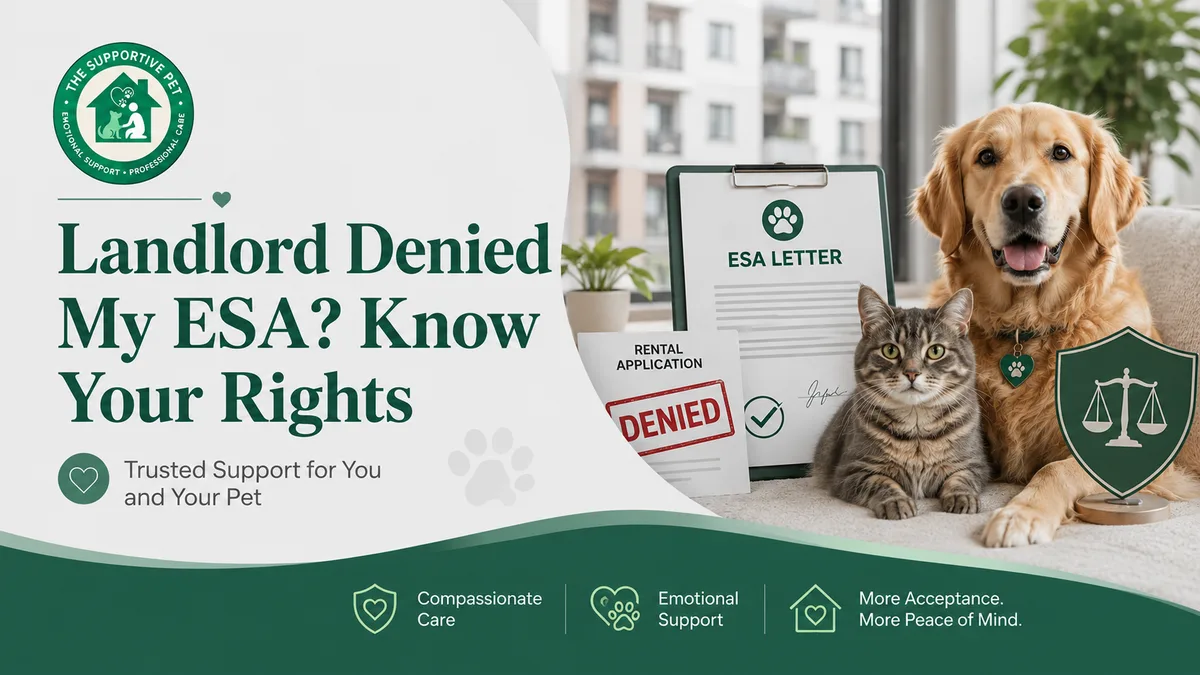
First: was the denial actually legal?
Most ESA denials landlords issue are not legally valid. Before taking action, determine whether your landlord's reason falls into one of the narrow legally permissible categories:
Legal reasons to deny an ESA accommodation request:
- The specific animal poses a direct threat to the health or safety of others that cannot be reduced through reasonable means
- The accommodation would impose an undue financial or administrative burden on the housing provider
- The property is genuinely exempt from FHA coverage (owner-occupied building with four or fewer units, private club housing, etc.)
- The animal would cause substantial physical damage to the property that cannot be reduced through reasonable means
Illegal reasons for denial (these do not justify rejection):
- We have a no-pets policy
- We don't allow dogs of your breed or weight
- Your letter is from an online service, not a local doctor
- We require an "official" ESA registration
- We don't believe in emotional support animals
- Other tenants have complained about your animal
If your landlord's stated reason is on the second list, your denial is almost certainly unlawful.
Step-by-step: what to do after a denial
Step 1: Get the denial in writing
If your landlord denied you verbally, reply in writing: "To confirm our conversation on [date], you indicated that my reasonable accommodation request to keep an emotional support animal was denied because [reason]. Please confirm this in writing." A written denial is essential for filing a complaint.
Step 2: Contact The Supportive Pet
If your letter came from The Supportive Pet, contact our support team immediately. We provide free landlord dispute support for every letter we issue. Our team will reach out to your landlord directly, provide formal documentation of your FHA rights, and work to resolve the situation - at no additional cost to you.
Step 3: File a HUD complaint
If direct resolution fails, file a complaint with the U.S. Department of Housing and Urban Development:
- Online: hud.gov/topics/housing_discrimination
- By phone: 1-800-669-9777 (TTY: 1-800-927-9275)
- By mail or in person at your nearest HUD office
HUD investigates fair housing complaints at no cost to you. HUD has the authority to award damages, civil penalties, and injunctive relief (requiring the landlord to allow your ESA).
Step 4: Contact your state fair housing agency
Many states have their own fair housing enforcement agencies that can investigate independently and in parallel with HUD. A quick search for "[your state] fair housing complaint" will find the appropriate agency.
Step 5: Consult a fair housing attorney
For serious violations - particularly where you lost housing or face eviction - a fair housing attorney can pursue damages on your behalf, often on a contingency basis (no fee unless you win). Many legal aid organizations also handle fair housing cases for free.
If you are facing eviction for having an ESA
If your landlord has issued an eviction notice or lease non-renewal because of your ESA - and you have submitted a valid accommodation letter that was improperly denied - this is a serious fair housing violation. Do not wait. Take all of the steps above simultaneously and as quickly as possible. Eviction proceedings have short deadlines.
Key points to document for your legal file:
- A copy of your ESA letter with the clinician's license information
- Your original accommodation request (email or written)
- Your landlord's written denial and stated reason
- All subsequent communications
- Any witnesses to relevant conversations
- Photos or records of your animal's behavior (to rebut any "direct threat" claims)
Preventing future ESA denials: best practices
Proactively strengthening your ESA accommodation request reduces the chance of denial in the first place:
- Use a letter from a clinician licensed in your state: Out-of-state clinicians are frequently challenged. The Supportive Pet matches you with a clinician licensed in your state.
- Renew your letter annually: Landlords routinely request updated letters. A letter more than 12 months old may be questioned.
- Submit early: Provide your letter before signing a lease, not after a conflict has already arisen.
- Keep your animal well-behaved: A clinically valid ESA letter can be challenged if your specific animal has demonstrated threatening behavior. Your legal rights are stronger when your animal has no history of issues.
Frequently Asked Questions
Can a landlord legally deny an ESA request?
Landlords can only deny an ESA accommodation request in limited circumstances: if the specific animal poses a direct, documented threat to the health or safety of others, if allowing the animal would impose an undue financial or administrative burden, or if the building qualifies for a narrow FHA exemption (owner-occupied buildings with four or fewer units, or single-family homes rented without a broker).
What should I do if my landlord refuses my ESA?
First, submit a formal written reasonable accommodation request - verbal requests have little legal weight. Include your valid ESA letter from a licensed clinician and cite the Fair Housing Act. If they still refuse, file a complaint with HUD at hud.gov (free), contact your state fair housing agency, or consult a disability rights attorney. Many attorneys take FHA cases on contingency.
Can a landlord charge a pet deposit for an ESA?
No. Under the Fair Housing Act, a landlord cannot charge a pet deposit, pet fee, or monthly pet rent for an Emotional Support Animal. An ESA is a reasonable accommodation for a disability - not a pet. However, landlords can hold you liable for actual property damage caused by your ESA, handled through the standard security deposit.
How do I file an FHA housing discrimination complaint?
File a complaint with the U.S. Department of Housing and Urban Development (HUD) at hud.gov/complaint or by calling 1-800-669-9777. Filing is free. You have one year from the date of the discriminatory act to file. HUD will investigate and may seek mediation, conciliation, or formal enforcement action on your behalf.
See our articles highlighted in Google Search
Add The Supportive Pet as a preferred source - your results, your way.