
Do I need to write a formal letter to my landlord for my ESA?
Yes. While the law does not require a specific format, a formal written reasonable accommodation request creates a legal record of your request and the date it was submitted. Verbal requests are difficult to enforce. A written request that cites the Fair Housing Act puts your landlord on notice of their legal obligations.
Medical Disclaimer: This article is for informational purposes only and does not constitute medical or legal advice. Consult a qualified mental health professional before making decisions about your care. If you or someone you know is in crisis, call or text 988 (Suicide & Crisis Lifeline, available 24/7).
Why you need a separate accommodation request
Your ESA letter is clinical documentation. Your accommodation request is the legal vehicle that invokes your Fair Housing Act rights. These are two separate documents that work together - and conflating them is one of the most common mistakes ESA owners make when approaching a landlord.
Handing your landlord the ESA letter alone is not the same as formally requesting accommodation. Many landlords will accept the letter, file it, and take no action - leaving your status ambiguous. A formal written accommodation request changes the dynamic: it creates a legal record, triggers the landlord's duty to respond, and establishes your rights clearly on paper.
A formal written accommodation request:
- Creates a timestamped legal record of your request and the date it was submitted
- Puts your landlord on notice of their Fair Housing Act obligations - they cannot claim ignorance
- Starts the clock on their duty to respond within a reasonable time (HUD guidance: 10 business days)
- Establishes grounds for a HUD complaint if they fail to respond or deny your request without legal basis
- Signals to your landlord that you understand the law and are making a formal legal request - not asking for a favor
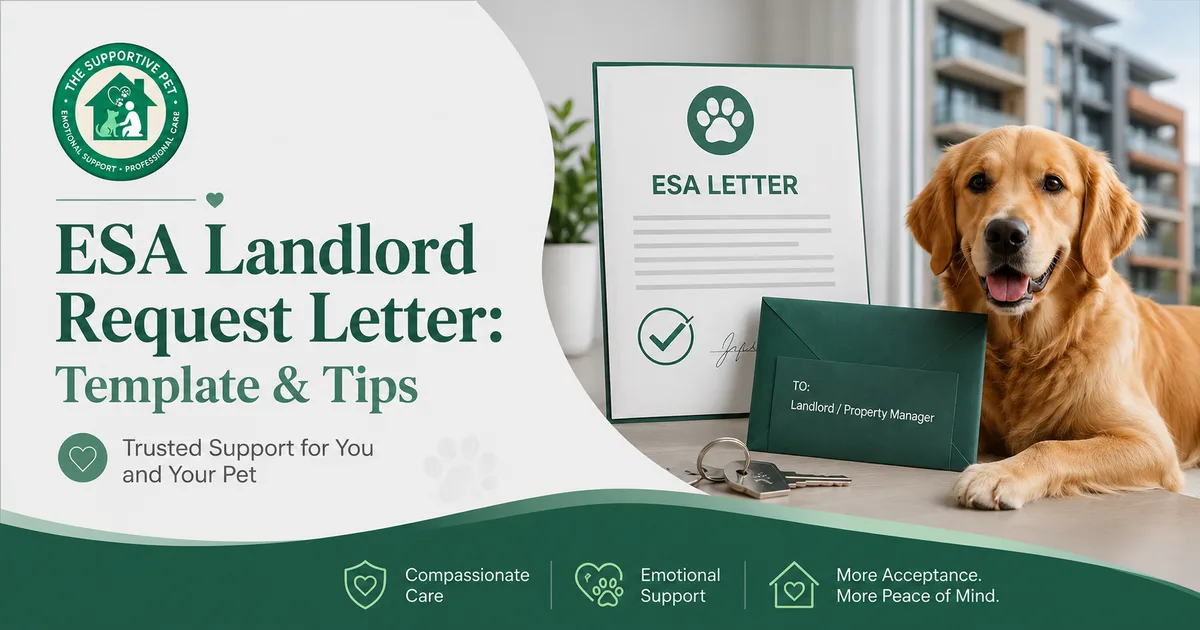
ESA accommodation request template
Use this as a starting point and customize it with your specific details. The language is deliberately direct and legally precise - that is intentional.
Subject: Reasonable Accommodation Request - Emotional Support Animal
Dear [Landlord/Property Manager Name],
I am writing to formally request a reasonable accommodation under the Fair Housing Act (42 U.S.C. § 3604(f)) to keep an emotional support animal in my unit at [Property Address, Unit Number].
I have a disability that substantially limits one or more major life activities. My emotional support animal provides therapeutic support that is directly related to my disability. I have attached a letter from my licensed mental health professional documenting my disability and establishing the therapeutic need for my emotional support animal.
I understand that reasonable accommodation requests are subject to an individualized review, and I welcome that process. I am available to provide any additional information that would assist in your evaluation of this request. I respectfully request a written response within 10 business days of this letter.
Thank you for your consideration.
Sincerely,
[Your Name]
[Unit Number]
[Contact Information]
[Date]
Send this by email with your ESA letter attached as a PDF. Email creates a timestamped record. For particularly contentious situations - an ongoing dispute, a prior verbal denial, or a landlord you expect to resist - follow up with certified mail as well.
What to include with your request
- Your ESA letter - the full letter from your licensed clinician, including their name, license number, state of licensure, signature, and date. Attach as a PDF, not a photo.
- Any supplemental forms the landlord has issued - many property management companies have their own reasonable accommodation forms. Check the tenant portal or ask the office if such forms exist. Complete them and attach them alongside your clinician's letter.
- Basic animal information if they have already asked - species, approximate size, and vaccination records. You are not required to provide this proactively, but having it ready speeds the review. Do not include it in the initial request unless your landlord has already requested it.
What not to include
- Your specific psychiatric diagnosis: You are legally protected from disclosing your diagnosis. Your ESA letter already states that you have a disability and a therapeutic need - that is sufficient. Do not volunteer your diagnosis in the cover email, the request letter, or any conversation.
- Detailed mental health history or treatment records: Landlords are not entitled to your medical history. Your clinician's letter is the appropriate documentation - not your therapy notes, medication list, or treatment summary.
- "ESA registration" or "certification" documents: These have no legal value under the FHA and may actually undermine your request by suggesting you do not understand what documentation is legally required. See our guide on why ESA registration is a scam.
- Apologies, hedging, or language suggesting you are asking for a favor: "I was hoping if it might be possible..." weakens your position. This is a legal rights invocation, not a personal request. Professional and factual language serves you better.
- Threats or confrontational language: The opposite extreme is equally counterproductive. Your goal is a smooth approval, not a fight. State your rights, cite the law, provide the documentation, and request a response. Save the escalation for if you actually need it.
"The tone of the request matters as much as the content. This is a legal accommodation request - not a petition, not a favor request, and not a confrontation. Professional, factual, and well-documented requests get processed smoothly. Emotional or confrontational ones create delays and defensiveness on both sides."
- Chetna Giri, Head of Legal & Compliance
Responding to common landlord reactions
Once you submit your request, your landlord may respond with questions or pushback. Here is how to handle common scenarios in writing:
"We need your specific diagnosis."
Respond: "I am not legally required to disclose my specific diagnosis under the Fair Housing Act. My clinician's letter confirms that I have a disability and that my emotional support animal is therapeutically necessary. That is the documentation required under HUD guidance."
"We don't accept letters from online services."
Respond: "HUD guidance does not require letters to come from in-person evaluations. What matters is that the letter comes from a licensed clinician who has conducted a genuine clinical assessment. My clinician's license can be verified at [state licensing board URL]. All required elements under HUD guidance are included in the letter."
"Our building rules don't allow pets."
Respond: "My ESA is not a pet under the Fair Housing Act - it is a disability accommodation. The FHA requires reasonable accommodation that modifies your no-pet policy in this case. My request and supporting documentation are attached for your review."
"We need more time to review this."
Respond: "I understand. I note that I submitted my request on [date]. Please let me know if there is any additional information I can provide to facilitate the review. I look forward to your written response."
What happens after you submit
Your landlord must respond within a reasonable time. HUD guidance suggests 10 business days is the standard. Here is what to do at each stage:
- Approval: Get the approval in writing. Confirm the specific accommodation (no pet fee, permission to keep your ESA) and keep a copy permanently.
- No response after 10 business days: Send a polite follow-up email noting the original submission date and requesting an update. Document the follow-up.
- Request for additional information: Respond in writing, providing only what is legally required. Do not provide more than your clinician's letter already covers unless the request is reasonable and within HUD guidelines.
- Denial: Ask for the specific legal reason in writing. Most denials are not legally valid. See our guide on what to do when your landlord denies your ESA for next steps.
If you have not yet obtained your ESA letter
You need the letter before you submit the accommodation request. The Supportive Pet provides fast ESA letters on business days following a genuine clinical evaluation. Visit our ESA letter for housing page to learn about the process, or start your evaluation now to get your letter today.
All letters issued through The Supportive Pet include a 365-day acceptance guarantee and free landlord dispute support - if your request is denied after submission, our team contacts your landlord directly to resolve the situation.
Frequently Asked Questions
Do I need to write a formal letter to my landlord for my ESA?
Yes. While the law does not require a specific format, a formal written reasonable accommodation request creates a legal record of your request and the date it was submitted. Verbal requests are difficult to enforce. A written request that cites the Fair Housing Act puts your landlord on notice of their legal obligations.
What should my ESA accommodation request letter say?
Your request should: identify you as a tenant, state that you have a disability (without specifying the diagnosis), request accommodation to keep your ESA as required by the Fair Housing Act, reference the attached ESA letter from your licensed clinician, and ask for written confirmation of the accommodation. Keep it factual and professional.
How long does my landlord have to respond to my ESA request?
The FHA does not set a specific deadline, but courts and HUD guidance generally consider 10 business days a reasonable response time. If your landlord does not respond within that window, follow up in writing. Continued non-response may constitute a de facto denial, which you can report to HUD.
Should I send my ESA letter by email or certified mail?
Email with delivery confirmation is generally sufficient and creates a clear timestamp. For high-stakes situations - ongoing disputes, impending eviction threats, or if you have reason to expect resistance - certified mail with return receipt provides the strongest documentation. Keep copies of everything regardless.
See our articles highlighted in Google Search
Add The Supportive Pet as a preferred source - your results, your way.