
How do I know if my pet is actually helping my mental health?
Observable signs include slower breathing and reduced heart rate when your pet is nearby, shorter or less intense panic episodes, more consistent daily routines, greater motivation to leave home, and a felt sense of purpose or grounding. These are physiological and behavioral markers that reflect real therapeutic benefit - not just emotional attachment.
Medical Disclaimer: This article is for informational purposes only and does not constitute medical or legal advice. Consult a qualified mental health professional before making decisions about your care. If you or someone you know is in crisis, call or text 988 (Suicide & Crisis Lifeline, available 24/7).
How to recognize genuine therapeutic benefit from your pet
Most people with emotional support animals can feel the difference intuitively - but when it comes to documenting that relationship for housing purposes, intuition is not enough. A licensed clinician evaluating your case needs to understand the specific therapeutic functions your animal performs, not just the general feeling of comfort their presence brings.
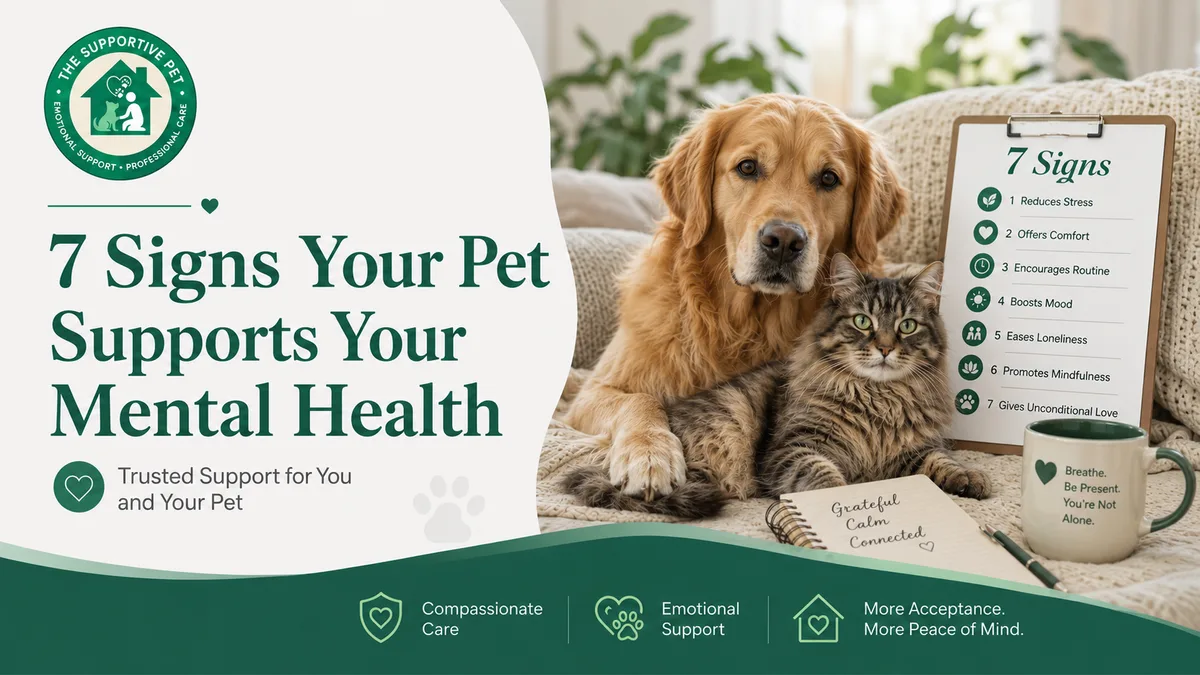
These seven signs are grounded in clinical observation and research on the human-animal bond. Each represents a specific, documentable therapeutic function that is clinically meaningful - not just emotional attachment. If your pet does several of these things for you, you likely have a genuine therapeutic relationship worth documenting.
1. Your breathing and heart rate slow when they are nearby
Research consistently shows that petting an animal triggers the parasympathetic nervous system - the "rest and digest" response that counteracts the stress response. If you notice slower, deeper breathing when your pet settles near you or climbs onto your lap, that is a physiological response, not imagination.
This mechanism is measurable. Studies using salivary cortisol samples, heart rate monitors, and blood pressure cuffs have documented these changes in controlled settings. The effect is strongest with direct physical contact and tends to occur within 5-15 minutes of sustained interaction. For people with anxiety disorders characterized by chronic sympathetic activation, this repeated, natural deactivation has real clinical value.
For your documentation: Describe specific situations where you notice this response. "When I'm having an anxious evening and my cat sits on my chest, my breathing slows within about 10 minutes" is a clinically meaningful description of a real therapeutic function.
2. Panic attacks or anxiety episodes feel shorter or less intense with your pet present
For people with panic disorder, generalized anxiety, or PTSD, the presence of a trusted animal during an acute episode can shorten duration and reduce peak intensity. The mechanism involves several overlapping effects: grounding attention in the present moment through sensory engagement, oxytocin release that counteracts the cortisol surge, and a shift in attentional focus away from internal catastrophic thinking.
If you have noticed your worst moments passing faster when your pet is nearby - if they interrupt a spiral, sit with you during one, or respond to your distress in ways that help you through it - that is a documented therapeutic function, not coincidence.
For your documentation: Try to estimate how your episodes differ with and without your pet. "My panic attacks usually last 45-60 minutes without my dog. When she is with me and I can focus on her, they tend to peak and pass in 15-20 minutes" is specific, clinically relevant information.
3. You maintain more consistent daily routines because of your pet
Depression's most damaging practical effect is often the collapse of routine. Motivation disappears. Eating, sleeping, moving - all become effortful to the point of non-occurrence. Caring for an animal disrupts this collapse by imposing external obligations that exist regardless of how you feel.
Your pet needs to eat, regardless of whether you want to get up. They need to go outside, regardless of whether you want to engage with the world. For many people, the animal's needs become the minimal scaffold that keeps basic functioning going during the deepest episodes. Research supports this: pet owners with depression show more consistent daily routine maintenance than non-pet owners with comparable symptom severity.
For your documentation: "On days when I cannot motivate myself to get out of bed for any other reason, I get up to feed my cat. This usually leads to me making coffee and starting my day, even when I felt completely unable to do so before the alarm."
4. You talk to your pet - and it helps you process difficult thoughts
This may feel like the most frivolous item on this list. It is not. Vocalizing thoughts - even to a non-human listener - activates the same cognitive processing as expressive writing or verbal therapy. The act of articulating something transforms it from a diffuse internal experience into something structured and external.
Animals provide non-judgmental presence that lowers the inhibition barrier to this kind of processing. There is no fear of judgment, no social consequence, no concern about the listener's reaction. For people who find therapy anxiety-provoking or who struggle to verbalize their experiences with other humans, their animal provides an accessible first step toward the same cognitive processing.
Research published in Anthrozoös has documented that people who talk to their pets show higher self-reported emotional processing and lower reported emotional suppression. Many therapists explicitly encourage clients to talk through problems with their animals as a between-session practice.
5. Physical touch from your pet brings you back to the present moment
For people with dissociation, derealisation, anxiety, or trauma responses, the sensory experience of their animal - warmth, texture, weight, movement, heartbeat - provides real-time grounding in a way that few other interventions match for immediacy and accessibility. This is the clinical basis for deep pressure therapy as a formal psychiatric service dog task.
If you have noticed that your pet sitting on you, pressing against you, or even just making physical contact interrupts a dissociative episode, pulls you out of a flashback, or reduces the intensity of a panic attack through sheer sensory presence - that is a therapeutically significant function. It is not a trained PSD task unless the animal performs it in response to a trained cue, but it is a documented mechanism of benefit that belongs in your ESA documentation.
6. You leave the house more, and engage with the world more, because of your pet
Social isolation is one of depression's most damaging and self-perpetuating features. It reduces opportunities for positive experience, weakens social skills, and removes the environmental stimulation that supports mood regulation. Pets - especially dogs - directly interrupt this cycle.
Dog ownership specifically has been shown in multiple studies to increase physical activity, time spent outdoors, and frequency of social interaction with other people. Dog owners are approached more frequently by strangers, talk to people more often in public, and report higher social connection overall. For someone with depression or social anxiety, these incidental social interactions can be the most accessible form of human connection during periods when intentional social effort is not possible.
For your documentation: If your dog has been getting you outside daily when you otherwise would not leave, or if interactions with other dog owners provide meaningful social contact, these are specific therapeutic benefits worth describing.
7. Your pet gives you a concrete reason to persist on your worst days
This is the most clinically significant item on this list, and the one that clinicians take most seriously in suicide risk assessments. A sense of responsibility for another living being - a felt obligation that exists independently of how you feel about yourself - is a documented protective factor against suicidal ideation and self-harm.
This is not anecdotal. It appears in structured research on suicide protective factors. The sense of being needed, of being the sole source of care for another living being, creates a reason to continue that is separate from and sometimes more immediate than abstract reasons for living. Many people report that during their worst moments, the thought of what would happen to their animal is the thing that stopped them from acting on suicidal thoughts.
When a client describes their pet as the reason they are still here, I do not minimize that or treat it as sentimental. I document it carefully, because it is clinically significant evidence of a real therapeutic relationship with life-saving implications.
"When a client tells me their cat is the reason they got out of bed this morning, I take that completely seriously. When they tell me their dog kept them here during their worst month last year, I take that even more seriously. These are real therapeutic relationships doing real clinical work. The ESA letter is how we protect the conditions that make that relationship possible."
- Kartik Sharma, LCSW
Using these signs in your ESA documentation
If you recognize several of these signs in your relationship with your pet, you likely have a clinically meaningful therapeutic relationship that qualifies for ESA documentation. The stronger your descriptions of specific, concrete therapeutic functions - rather than general emotional comfort - the stronger your case will be with a clinician and, ultimately, with a landlord reviewing your accommodation request.
When you complete an intake assessment, try to describe at least two or three of these functions with specific examples. "My cat reduces my anxiety" is less useful to an evaluating clinician than "when I am in an anxious spiral, my cat sits on me and my breathing slows within about 10 minutes, which is the only thing that consistently works short of medication."
Ready to get documentation for your emotional support animal? Start your ESA evaluation with a licensed clinician at The Supportive Pet. fast letters available on business days, from clinicians licensed in your state. Or learn more about how the process works.
Frequently Asked Questions
How do I know if my pet is actually helping my mental health?
Observable signs include slower breathing and reduced heart rate when your pet is nearby, shorter or less intense panic episodes, more consistent daily routines, greater motivation to leave home, and a felt sense of purpose or grounding. These are physiological and behavioral markers that reflect real therapeutic benefit - not just emotional attachment.
Can pets help during panic attacks?
Yes. Research and clinical experience consistently show that the presence of a trusted animal can shorten panic episodes by grounding attention in the present moment. Tactile contact - the warmth, weight, and texture of an animal - activates the parasympathetic nervous system and can interrupt the escalating physiological response of a panic attack.
Do pets help with depression symptoms?
Yes, through several mechanisms: they impose routine (feeding and care schedules), provide non-judgmental companionship that combats isolation, trigger oxytocin release through physical contact, and create a felt sense of responsibility and purpose. Multiple meta-analyses confirm that animal-assisted interventions produce meaningful reductions in depression severity.
Is talking to your pet therapeutic?
Research supports this. Vocalizing thoughts - even to a non-human listener - activates cognitive processing similar to journaling or expressive therapy. Pets provide non-judgmental presence that lowers the social inhibition barrier. Many therapists explicitly encourage clients to talk through problems with their animals as a low-barrier self-care practice.
See our articles highlighted in Google Search
Add The Supportive Pet as a preferred source - your results, your way.