
What is a PSD letter and what does it do?
A Psychiatric Service Dog (PSD) letter is documentation from a licensed mental health professional confirming you have a psychiatric disability and that your dog is trained to perform specific tasks that mitigate that disability. It provides housing protections under the FHA, public access rights under the ADA, and airline cabin travel rights under the ACAA - significantly broader than an ESA letter.
Medical Disclaimer: This article is for informational purposes only and does not constitute medical or legal advice. Consult a qualified mental health professional before making decisions about your care. If you or someone you know is in crisis, call or text 988 (Suicide & Crisis Lifeline, available 24/7).
What is a PSD letter?
A Psychiatric Service Dog (PSD) letter is documentation from a licensed mental health professional confirming two things: that you have a psychiatric disability, and that your dog is trained to perform specific tasks that directly mitigate that disability. It is the gateway to significantly broader legal protections than an ESA letter provides.
If you're also exploring emotional support animals, see our guides on ESA vs. service animal differences and how much a PSD letter costs. Pet owners with housing concerns should also review PSD letter housing rights.
While an ESA letter is a clinical recommendation that your animal provides therapeutic benefit, a PSD letter is documentation that your dog meets the legal definition of a service animal under the Americans with Disabilities Act - specifically for psychiatric conditions. This distinction transforms which laws protect you and where you can go with your dog.
PSD vs. ESA: the legal protections compared
Understanding the concrete difference in rights explains why many dog owners pursue PSD documentation even if they already have an ESA letter:
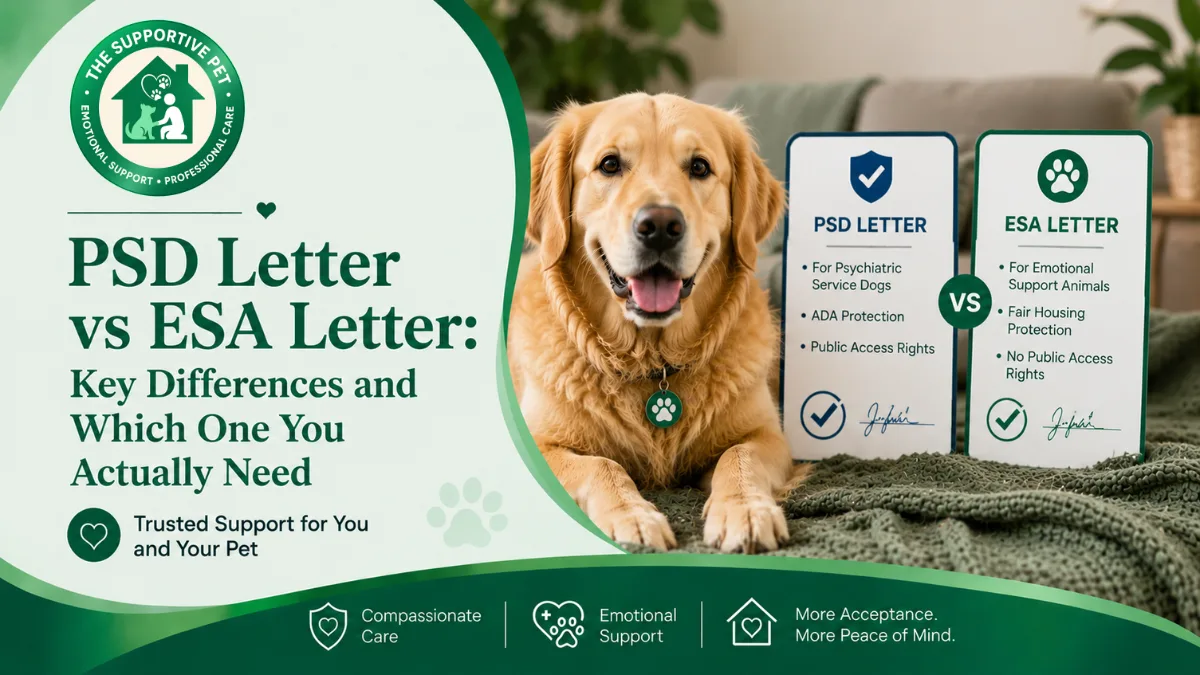
- ESA letter: Housing rights under the Fair Housing Act only. No pet deposits or fees. No public access rights. No airline cabin rights (since 2021).
- PSD letter: Housing rights under the FHA (same as ESA). Full ADA public access rights - restaurants, stores, hotels, workplaces, transportation, virtually all public spaces. Airline cabin travel rights under the Air Carrier Access Act. No size or breed restrictions in public spaces.
For people who need their dog with them in public spaces to manage a psychiatric condition, this difference is not abstract. It is the difference between bringing your dog to your therapist's office, your workplace, or a restaurant, versus having to leave them home.
The two requirements for PSD qualification
To qualify for a PSD letter, two independent criteria must both be met. A licensed mental health professional evaluates each:
Requirement 1: A qualifying psychiatric disability
You must have a psychiatric or mental health disability recognized under the DSM-5 (Diagnostic and Statistical Manual of Mental Disorders) that substantially limits a major life activity. Qualifying conditions include:
- Post-traumatic stress disorder (PTSD)
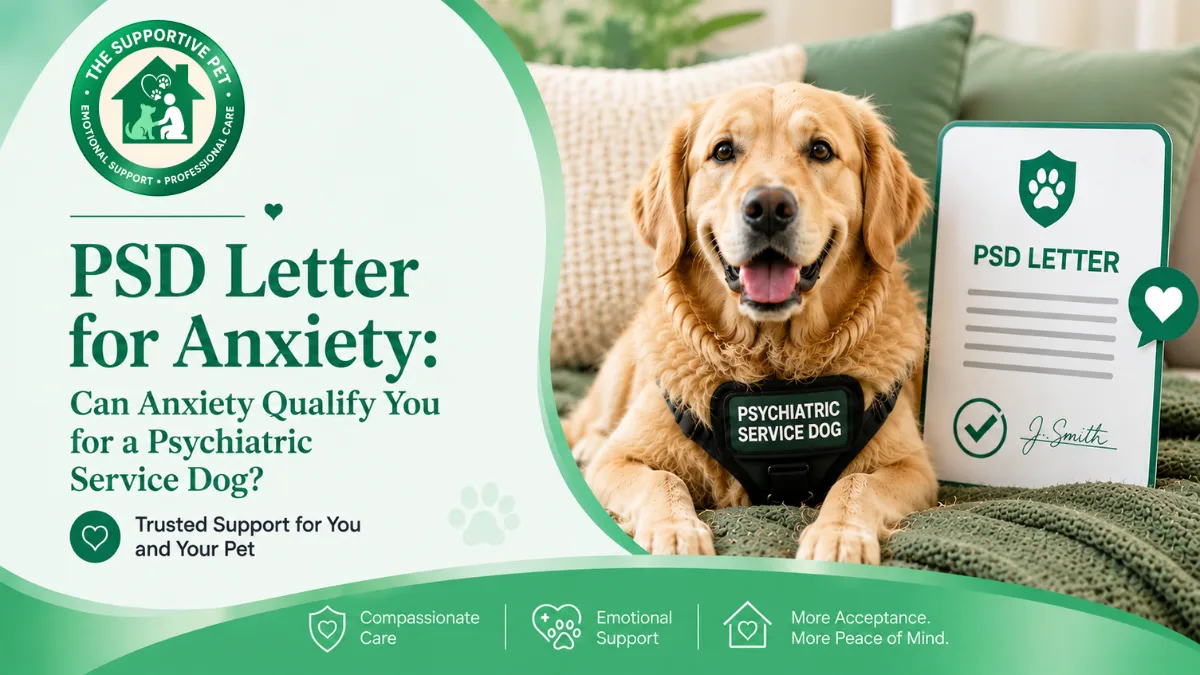
- Anxiety disorders: generalized anxiety disorder, panic disorder, social anxiety disorder, agoraphobia
- Major depressive disorder and persistent depressive disorder
- Bipolar disorder (I and II)
- Schizophrenia and related psychotic disorders
- Obsessive-compulsive disorder (OCD)
- Autism spectrum disorder
- Borderline personality disorder
- Dissociative disorders
- Attention-deficit/hyperactivity disorder (ADHD)
The condition does not need to be formally diagnosed by a prior provider before your PSD evaluation. The evaluating clinician makes their own independent assessment.
Requirement 2: A dog trained to perform specific tasks
Your dog must be trained to perform at least one specific, reliable behavior that directly mitigates your psychiatric disability. This is where the PSD legal standard diverges from the ESA standard - and understanding it precisely is essential.
A task under the ADA is a discrete, trained behavior the dog performs in response to your symptoms or needs. It must be taught - not naturally occurring - and it must reliably occur in response to a specific trigger or cue. General emotional attunement, general comfort, and general loyalty do not qualify as tasks.
Which tasks qualify for PSD status?
The following are recognized, clinically documented psychiatric service dog tasks:
- Deep pressure therapy (DPT): The dog places their body weight, head, or paws on the handler during a panic attack, anxiety episode, or dissociative state. The physical pressure activates the parasympathetic nervous system. The dog must perform this on cue or in response to observable distress cues - not just when they feel like it.
- Nightmare interruption: The dog wakes the handler from nightmares or night terrors. The dog learns to respond to the handler's physical cues during a nightmare - restless movement, elevated heart rate response, vocalizations - by waking them through pawing, nudging, or licking.
- Room checks / perimeter alerts: The dog enters a room ahead of the handler, checks the space, and returns to signal it is clear. This directly mitigates the hypervigilance associated with PTSD, allowing the handler to enter spaces they would otherwise be unable to use.
- Grounding for dissociation: The dog makes physical contact when the handler shows signs of dissociation, interrupting the episode and reorienting the handler to the present. This requires the dog to recognize behavioral dissociation cues and respond with trained contact behavior.
- Panic attack interruption: The dog responds to early anxiety or panic cues - before the attack peaks - with a specific interrupting behavior (pawing, nudging, bringing an item) that breaks the escalating response cycle.
- Medication reminders: The dog alerts at a specified time or in response to a trained cue indicating it is time for medication. The dog delivers a reliable alert behavior consistently without prompting.
- Crowd blocking / personal space creation: The dog positions themselves between the handler and others in crowded environments, creating a physical buffer. Particularly relevant for PTSD, agoraphobia, and social anxiety. Must be a trained position maintained on cue, not just where the dog happens to stand.
- Self-harm interruption: The dog interrupts self-harm behaviors through physical contact, redirection, or trained alerting behaviors. This is a sensitive but clinically significant task for some conditions.
- Guided navigation: During a dissociative episode, the dog guides the handler to a safe location using a trained "find home" or similar task.
What does not qualify as a PSD task
Many loving, therapeutic things dogs do are not PSD tasks under the ADA standard:
- "My dog knows when I'm upset and comes to comfort me" - natural emotional attunement is not a trained task
- "My dog calms me down" - unless this involves a specific trained behavior on cue, general calming presence is the role of an ESA
- "I feel safer with my dog" - a sense of safety is real and valuable, but it does not describe a discrete trained behavior
- "My dog doesn't like strangers, so he stays close to me" - natural guarding instinct is not a trained task and may actually create ADA problems
- "My dog has never been aggressive" - good behavior and temperament are required of all PSDs but do not themselves constitute a task
"The question I ask every PSD evaluation patient is the same: does your dog do something specific and reliable that helps you function in ways you couldn't without them? If the answer is yes, and if it is trained behavior rather than general affection, you likely qualify. Most people are surprised by how many of their dog's behaviors actually meet this standard once we name them specifically."
- Kartik Sharma, LCSW
Owner training vs. professional training
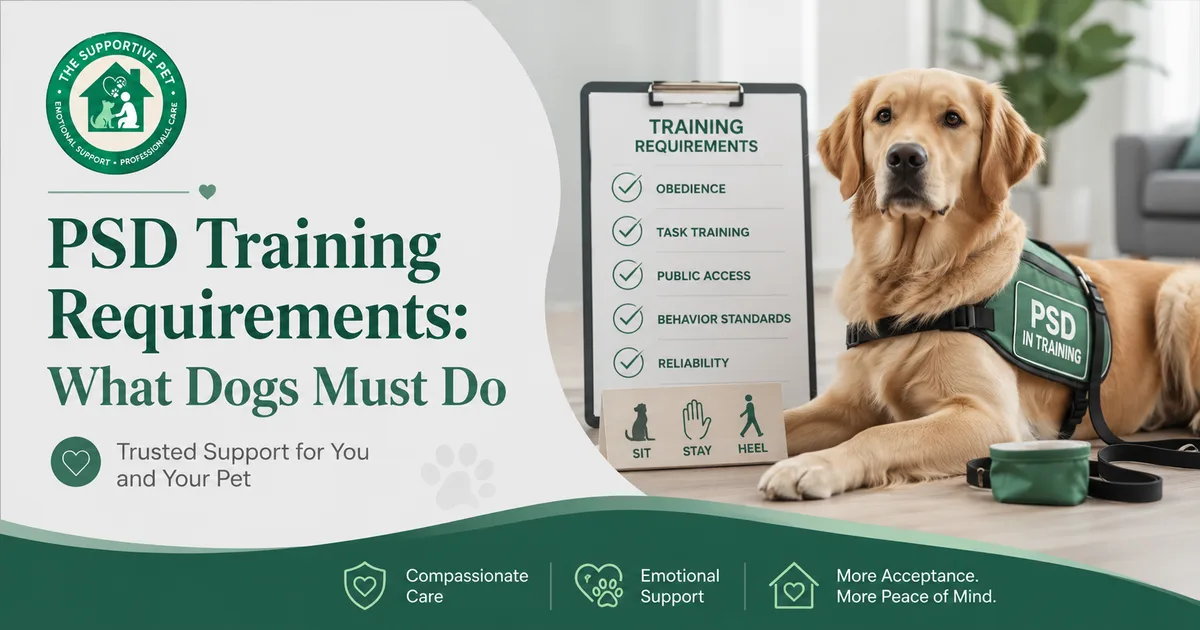
The ADA explicitly does not require professional training for service dogs. Owner-training is fully legal and widely practiced. What the ADA requires is that the dog reliably performs at least one specific task in varied environments, including distracting public settings. How that training was acquired is irrelevant.
Professional training typically costs $10,000-$30,000 for a fully trained PSD and involves a waitlist of 2-5 years. Owner training - often with guidance from a local trainer - costs significantly less and leverages the pre-existing bond between handler and dog. Many successfully owner-trained PSDs outperform professionally trained dogs in specific task reliability because the training was customized to the handler's actual symptoms.
For the PSD letter evaluation, the clinician assesses the task description and the task-disability nexus. You are not required to demonstrate training during the evaluation - you describe the specific tasks your dog reliably performs.
How the PSD evaluation works
A PSD letter evaluation at The Supportive Pet involves:
- Intake assessment: You describe your psychiatric condition in detail, including how it affects your daily functioning. You also describe the specific tasks your dog performs and how they mitigate your disability - be as concrete and behavioral as possible.
- Clinician review: A licensed mental health professional in your state evaluates both the disability and the task-disability nexus. They may request a telehealth consultation to clarify task descriptions.
- Letter issuance: If qualified, your PSD letter is issued on professional letterhead with the clinician's verifiable credentials. The letter documents your psychiatric disability and confirms your dog's status as a trained psychiatric service dog.
The Supportive Pet offers standalone PSD letters and ESA+PSD bundles for maximum housing and public access protection. View current pricing or start your PSD evaluation now.
Related: ESA vs. PSD Letter comparison · PSD letter for housing
Frequently Asked Questions
What is a PSD letter and what does it do?
A Psychiatric Service Dog (PSD) letter is documentation from a licensed mental health professional confirming you have a psychiatric disability and that your dog is trained to perform specific tasks that mitigate that disability. It provides housing protections under the FHA, public access rights under the ADA, and airline cabin travel rights under the ACAA - significantly broader than an ESA letter.
How is a PSD different from an ESA?
The key difference is training and legal coverage. An ESA provides comfort through presence and requires no task training - it only has housing protections. A Psychiatric Service Dog must be trained to perform specific tasks (like deep pressure therapy or nightmare interruption) and earns full ADA public access rights, FHA housing rights, and ACAA airline rights.
Can I train my own psychiatric service dog?
Yes. Under the ADA, owners are legally permitted to train their own psychiatric service dogs - professional training is not required. What matters is that the dog reliably performs at least one specific trained task that mitigates your psychiatric disability. However, professional task training often makes public access situations smoother and reduces challenges.
What conditions qualify for a PSD?
Any psychiatric disability recognized under the DSM-5 may qualify, including PTSD, anxiety disorders, depression, bipolar disorder, schizophrenia, OCD, and autism spectrum disorder. You also need a dog that is trained in at least one specific task that directly mitigates your disability - general comfort or affection alone does not qualify a dog as a PSD under the ADA.
See our articles highlighted in Google Search
Add The Supportive Pet as a preferred source - your results, your way.