
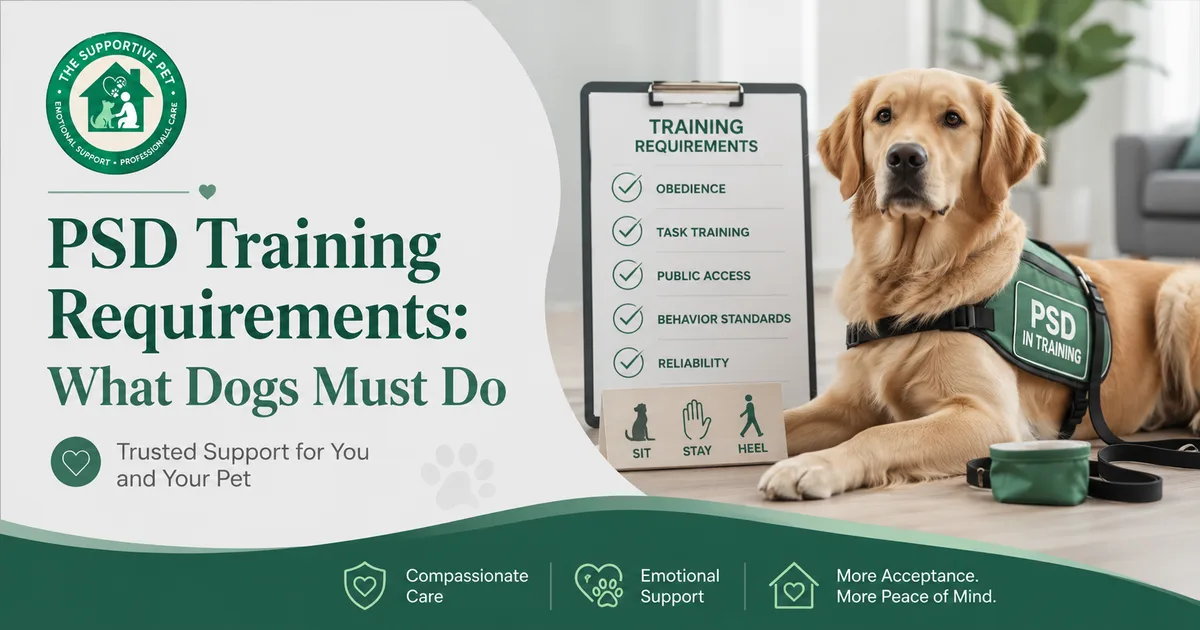
Does a psychiatric service dog need professional training?
No. The Americans with Disabilities Act does not require professional training for service dogs. Owner-training is fully legal and widely practiced. What the ADA requires is that the dog be trained to perform a specific task related to the handler's disability, and that the dog be under control in public. Professional training is often recommended for reliability, but it is not legally required.
Medical Disclaimer: This article is for informational purposes only and does not constitute medical or legal advice. Consult a qualified mental health professional before making decisions about your care. If you or someone you know is in crisis, call or text 988 (Suicide & Crisis Lifeline, available 24/7).
The one requirement that matters most
A Psychiatric Service Dog must be trained to perform at least one specific task that directly mitigates the handler's psychiatric disability. This is the defining legal requirement under the Americans with Disabilities Act - and it is the line that separates a PSD from an emotional support animal.
Training requirements are one part of qualifying your dog as a PSD. See our guides on specific PSD tasks recognized by the ADA, how to owner-train a psychiatric service dog, and the full PSD letter process.
General comfort, emotional presence, and companionship are real and valuable - but they do not constitute a task under the ADA. A task must be a discrete, trained behavior the dog performs in response to a specific cue or symptom.
What counts as a qualifying PSD task
The following are recognized, clinically validated psychiatric service dog tasks:
Deep pressure therapy (DPT)
The dog places their paws, body weight, or head on the handler during a panic attack, dissociative episode, or acute anxiety response. The physical pressure activates the parasympathetic nervous system and interrupts the stress response. This is one of the most common PSD tasks for anxiety disorders, PTSD, and panic disorder.
Training benchmark: The dog places on command and maintains position for a defined period, regardless of environmental distractions.
Nightmare interruption
The dog wakes the handler from a nightmare or night terror - by pawing, nudging, or licking. The dog may respond to physiological cues (elevated heart rate, restless movement) or to a cue from a bed partner. This task is particularly relevant for PTSD.
Training benchmark: The dog reliably wakes the handler when they exhibit the target behavior, without reinforcement from the handler during the episode.
Room checks and perimeter alerts
The dog enters a room ahead of the handler, checks the space, and returns to signal it is clear. This directly mitigates hypervigilance in PTSD - the dog's "all clear" signal allows the handler to enter spaces they would otherwise avoid.
Training benchmark: The dog checks the perimeter of a room on command and returns to deliver a defined signal (sit, touch, etc.).
Grounding for dissociation
The dog provides physical tactile contact when the handler shows signs of dissociation. The sensory input interrupts the dissociative episode and reorients the handler to the present. Relevant for dissociative disorders, severe PTSD, and borderline personality disorder.
Training benchmark: The dog responds to observable dissociation cues with a trained contact behavior.
Panic attack interruption
The dog provides a disruptive behavior - paw contact, nudging, licking - that interrupts the early stage of a panic attack before it escalates. The dog may also guide the handler to a quieter space or fetch medication.
Training benchmark: The dog responds to early anxiety cues before the panic attack peaks.
Medication reminders
The dog alerts at a specific time or in response to a cue that it is time for medication. Particularly relevant for bipolar disorder, schizophrenia, and ADHD where medication consistency is critical.
Training benchmark: The dog delivers a reliable alert at the trained time, consistently and without prompting.
Creating personal space (blocking)
The dog positions themselves between the handler and others in crowded spaces, creating a physical buffer. This reduces sensory overload and manages crowding triggers for PTSD, anxiety disorders, and autism spectrum disorder.
Training benchmark: The dog reliably positions on command in crowded environments and maintains position despite distractions.
What does NOT qualify as a PSD task
The following are therapeutic and valuable - but they do not meet the ADA definition of a trained task:
- "My dog knows when I'm sad and comforts me." This describes natural emotional attunement - not a trained task.
- "My dog calms me down." Unless the dog performs a specific behavior on cue, general calming presence is not a task.
- "I feel safer with my dog." The perception of safety is real, but it does not describe a discrete trained behavior.
- "My dog makes me feel less alone." This is the role of an emotional support animal. It qualifies for an ESA letter - not a PSD letter.
"Many of my clients already have a dog performing real psychiatric tasks - they just have not named them or formalized the training. 'My dog gets between me and strangers when I start to panic' is a task. Once we identify it, we can document it properly."
- Kartik Sharma, LCSW
Professional training vs. owner-training
The ADA does not require professional training. Owner-training is legal, common, and can produce fully qualified PSDs.
Professional training
- Pros: Higher reliability, certified trainers experienced with specific tasks, public access behavior typically well-established
- Cons: Cost ($10,000–$30,000+ for fully trained PSDs), long waitlists (often 2–5 years), limited availability for psychiatric-specific tasks
Owner-training
- Pros: Lower cost, the handler has a pre-existing bond with the dog, training can be highly customized to specific symptoms
- Cons: Requires significant time and consistency, training reliability depends on the handler's follow-through
Many people successfully owner-train their dogs with the help of a local trainer who specializes in service dog tasks. The key requirement is that the dog reliably performs the task in varied environments - including distracting public settings.
The PSD public access standard
Beyond task training, a PSD must meet a behavioral standard for public access. Under the ADA, businesses can remove a service dog if it is out of control, not housebroken, or poses a direct threat. A well-trained PSD should be calm in public, not reactive to other animals or strangers, and under the handler's control at all times.
How the PSD evaluation works
Getting a PSD letter requires a clinical evaluation with a licensed mental health professional who:
- Confirms you have a qualifying psychiatric disability
- Establishes the nexus between your disability and the dog's specific trained task
- Issues a letter on professional letterhead documenting both
You do not need to bring your dog to the evaluation - the clinician evaluates your disability and the task description. You will need to describe the specific task your dog performs in clear behavioral terms.
Learn more about the process on our PSD letter page, or view pricing for PSD documentation options.
ESA letter first, PSD letter later?
If you are unsure whether your dog qualifies for PSD documentation, or if your dog is still in training, an ESA letter is a valid starting point - it provides housing protections under the FHA without requiring task training. Once your dog's task training is reliable, you can pursue PSD documentation for broader legal coverage.
Related: ESA vs. PSD Letter comparison · PSD letter for housing
Frequently Asked Questions
Does a psychiatric service dog need professional training?
No. The Americans with Disabilities Act does not require professional training for service dogs. Owner-training is fully legal and widely practiced. What the ADA requires is that the dog be trained to perform a specific task related to the handler's disability, and that the dog be under control in public. Professional training is often recommended for reliability, but it is not legally required.
What tasks qualify a dog as a psychiatric service dog?
A qualifying PSD task must be a specific, trained behavior that directly mitigates the handler's psychiatric disability. Examples include: deep pressure therapy during panic attacks, interrupting self-harm behaviors, grounding techniques for dissociation, medication reminders, room checks for PTSD-related hypervigilance, alerting to oncoming anxiety or panic based on behavioral cues, and creating physical space between the handler and others. General comfort and companionship do not qualify as tasks - the behavior must be discrete and trained.
Can I train my own dog as a psychiatric service dog?
Yes. Owner-training is legal under the ADA. You are responsible for ensuring your dog is trained to perform specific tasks and is under control in public. Many PSDs are successfully owner-trained. For help verifying whether your dog qualifies and for documentation, a licensed mental health professional can evaluate the task-disability nexus as part of a PSD letter evaluation.
What is the difference between a PSD letter and an ESA letter?
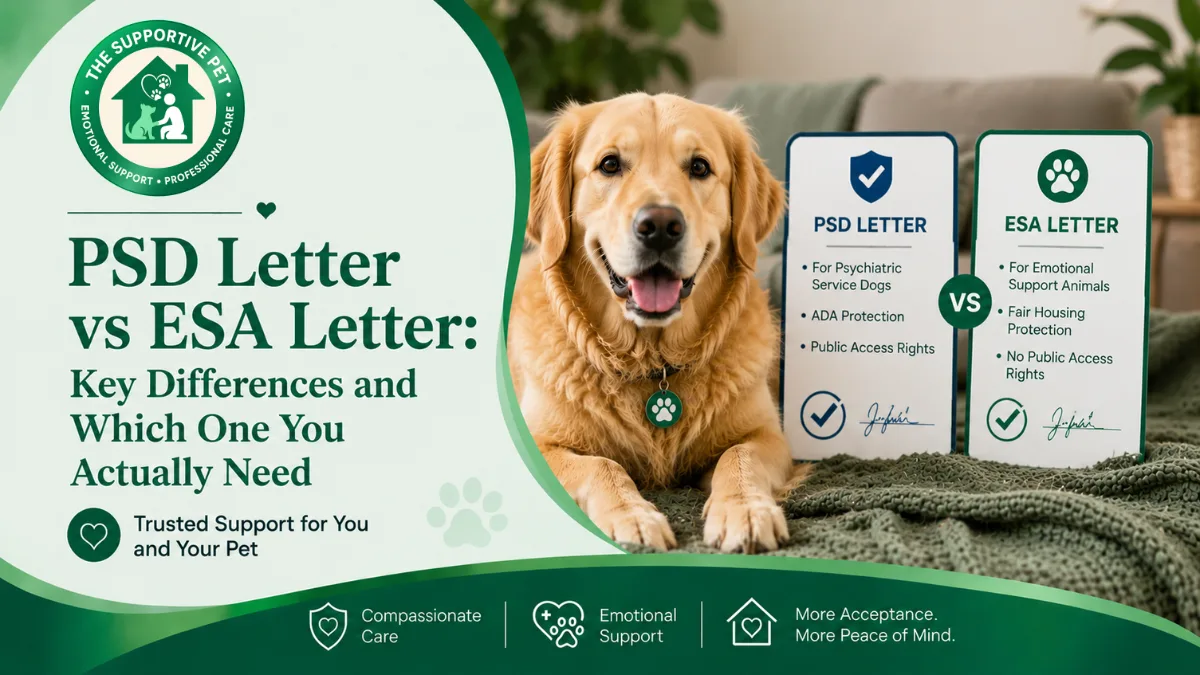
An ESA letter documents that you have a mental health disability and that your emotional support animal provides therapeutic benefit. It covers housing rights under the FHA only. A PSD letter documents the same disability, plus confirms that your dog is trained to perform specific tasks that mitigate that disability. PSD letters cover housing (FHA), full public access (ADA), and airline travel (ACAA). The PSD requires a dog, task training, and clinical evaluation of the task-disability nexus.
See our articles highlighted in Google Search
Add The Supportive Pet as a preferred source - your results, your way.