
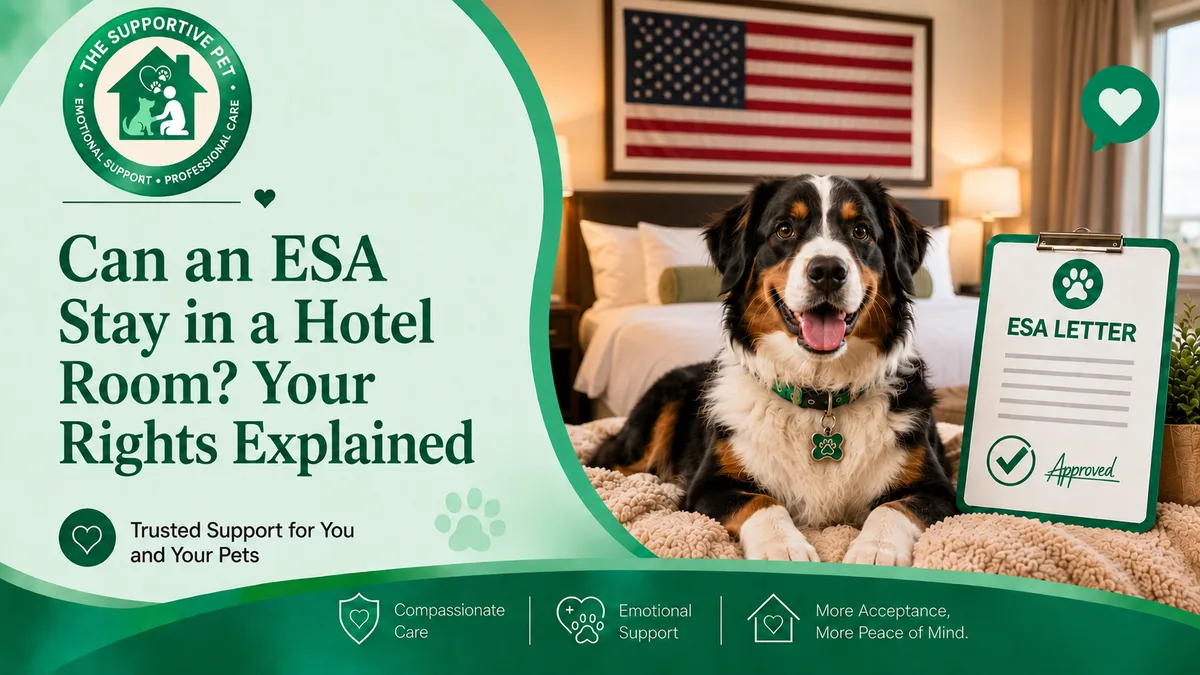
Can a hotel refuse my ESA?
Yes. Hotels are governed by the ADA, not the Fair Housing Act. The ADA requires hotels to accommodate service animals (task-trained dogs) but does not require accommodation of emotional support animals. A hotel may legally charge pet fees, restrict ESAs to pet-friendly rooms, or deny ESA entry under their pet policy.
Medical Disclaimer: This article is for informational purposes only and does not constitute medical or legal advice. Consult a qualified mental health professional before making decisions about your care. If you or someone you know is in crisis, call or text 988 (Suicide & Crisis Lifeline, available 24/7).
This is one of the most common ESA questions - and the answer often surprises ESA owners: hotels and motels are not covered by the Fair Housing Act's emotional support animal provisions. Unlike apartments and most long-term rentals, hotels can legally charge pet fees, require deposits, or even deny entry to ESAs. Here's what you actually need to know about ESAs and hotel stays.
Why Hotels Are Different from Apartments for ESAs
What the Law Actually Covers
The Fair Housing Act (FHA) protects ESA owners in residential housing - long-term rentals, condos, co-ops, and most housing communities. Hotels, motels, inns, and bed-and-breakfasts are transient accommodations governed instead by the Americans with Disabilities Act (ADA) and individual state laws. The ADA's accommodation rules apply to service animals - not ESAs.
Service Dogs vs. ESAs in Hotels
Key Differences
This distinction matters enormously for travel:
- Service dogs (task-trained for a specific disability) have full ADA public access rights - including hotel rooms - at no extra charge. The hotel must admit them and cannot charge fees.
- Emotional support animals are not covered by ADA public access provisions. Hotels may accommodate them as a courtesy, but they are not legally required to under federal law.
If your need for your animal extends to hotels and public spaces, a psychiatric service dog (PSD) letter may be more appropriate than an ESA letter. Read the ESA vs. PSD comparison.
What Hotels Can and Cannot Do with ESAs
What the Law Actually Covers
Under the ADA, hotels must accommodate service dogs in all areas. For ESAs specifically:
- Hotels may charge pet fees for ESAs - they are not prohibited from doing so
- Hotels may restrict ESAs to pet-friendly rooms
- Hotels may deny ESA entry if their policy prohibits pets (though many choose not to, as a courtesy)
- Hotels may not discriminate against guests with disabilities broadly - but ESA accommodation is not required to the extent FHA housing accommodation is
Practical Tips for Traveling with Your ESA
Key Points
- Book pet-friendly hotels - many chains (Kimpton, La Quinta, Motel 6) are fully pet-friendly with no fees; your ESA letter may help waive fees as a courtesy gesture even where not required
- Call ahead - explain you have an ESA and ask about their policy; many hotels will accommodate you without charge as a matter of courtesy
- Bring your ESA letter - while not legally required for hotels, it signals legitimacy and may help with fee waivers
- Consider extended-stay properties - extended-stay hotels that function more like apartments (with week or month minimum stays) may fall under FHA jurisdiction and be required to honor ESA letters
- Check state laws - some states provide broader ESA protections that may extend to hotels
Airbnb, VRBO, and Short-Term Rentals
What the Law Actually Covers
Short-term rental platforms (Airbnb, VRBO) occupy a gray area. Listings in owner-occupied properties with fewer than four units are often exempt from the FHA. However, professionally managed short-term rentals may qualify as residential housing subject to FHA accommodation requirements - particularly for stays of 30+ days. Read our dedicated guide on ESA letters for Airbnb rentals.
Your Best Option for Travel
Key Points
If you need your animal with you in hotels and public spaces - not just housing - consult with a licensed mental health professional about whether a psychiatric service dog designation is appropriate for your situation. PSDs have ADA public access rights that ESAs do not. Start your evaluation at The Supportive Pet.
Short-Term Rentals and ESA Rights
Airbnb and VRBO Properties
Airbnb and VRBO properties are subject to FHA rules when the property has 4 or more units and the owner does not live on-site. An owner-occupied duplex listed on Airbnb is exempt from the FHA. For properties where the FHA does apply, the same ESA accommodation rules as standard rentals apply - the host must consider a reasonable accommodation request backed by a valid ESA letter.
What to Do if Your Booking Is Cancelled
If an Airbnb or hotel cancels your reservation because of an ESA, document the cancellation and the reason given. If FHA rules applied to that property, the cancellation may constitute illegal housing discrimination. File a complaint with HUD at hud.gov/fairhousing and with the platform's resolution center. Many platforms have separate accommodation policies; report violations through both the platform and HUD.
Service Dogs vs. ESAs at Hotels
Why Service Dogs Are Different
If you have a Psychiatric Service Dog (PSD) instead of an ESA, your rights at hotels are very different. PSDstrained to perform specific disability-mitigating tasks have public accommodation rights under the ADA, which applies to hotels. Hotels cannot deny a service dog or charge fees for one. If your current ESA was trained to perform specific tasks for your disability, a PSD letter may give you broader access. See The Supportive Pet's PSD letter page for more information and our ESA vs. PSD comparison for details on the differences.
The Legal Framework: Why ESAs Have Limited Hotel Rights
The distinction between hotels and housing is the most common ESA misconception online. Hotels are governed by the Americans with Disabilities Act (ADA), which covers service animals only - dogs (and, in limited situations, miniature horses) that are trained to perform specific disability-related tasks. The Fair Housing Act, which gives ESAs their core protections, explicitly applies to residential housing only.
This means your ESA letter provides zero legal obligation on hotels. A hotel may choose to accept ESAs - many pet-friendly properties do - but they are under no federal law requirement to do so.
What Actually Works: Finding Hotel Accommodation for Your ESA
Pet-Friendly Hotels
The most reliable strategy is choosing explicitly pet-friendly hotels. Major chains with established pet policies include Kimpton (pets stay free), La Quinta (pets always welcome), Aloft Hotels, and many Marriott and Hilton brands. Pet-friendly means your ESA is welcome, usually with standard pet fees that apply to all guests.
Important: even at pet-friendly hotels, your ESA letter does not waive pet fees. Pet fees are a hotel's business choice, not an FHA obligation. Expect to pay $25–$150 per night or a flat stay fee depending on the property.
Extended Stay Properties
Extended-stay properties that function as temporary housing (longer than 30-day stays at apartment-style units) may qualify as "dwellings" under the FHA, creating ESA accommodation obligations. If you need housing for a month or more while relocating or in transition, FHA protections may apply. Properties like Marriott's Residence Inn, Hilton's Homewood Suites, and similar extended-stay brands often fall into this category for longer stays.
Vacation Rentals
Vacation rental platforms like VRBO, Airbnb, and direct-book vacation homes are treated differently from hotels. Many individual property owners accept pets or ESAs. For privately owned vacation rentals with multiple units (4+), FHA protections may apply. Single-owner-occupied properties are typically exempt.
How to Request ESA Accommodation at a Hotel
Even without a legal obligation, many hotels will accommodate ESAs when approached correctly:
- Call the front desk manager directly (not the general reservations line) and ask about their ESA policy before booking
- Offer to provide your ESA letter - many hotels accept ESA documentation as equivalent to a pet policy exception
- Ask for a pet-friendly room or floor to reduce potential conflicts with other guests
- Confirm the accommodation in writing (email confirmation) before arrival
- Offer to keep your animal crated when housekeeping enters - this resolves most hotel concerns proactively
Service Animal vs. ESA: The Hotel Distinction That Matters
Under the ADA, hotel staff can ask only two questions to determine if an animal is a service animal: (1) Is this a service animal required because of a disability? (2) What task or work has the dog been trained to perform? They cannot ask for documentation, require a vest or ID, or ask about the nature of your disability.
If your mental health condition has led you to train your dog to perform a specific task - retrieving medication during panic attacks, providing tactile stimulation to interrupt dissociation, guiding you away from environments that trigger episodes - your dog may qualify as a psychiatric service dog (PSD) rather than an ESA. PSDs have full ADA hotel access rights. This distinction matters enormously for travel.
Air Travel With an ESA: The Post-2021 Rule Change
Airlines updated their policies in 2021 after DOT rule changes. As of 2021, airlines are no longer required to accommodate ESAs in aircraft cabins - only trained service animals qualify for in-cabin access under current DOT rules. Major airlines (United, Delta, American, Southwest) all moved ESAs to standard pet cabin fees ($95–$150 each way) or cargo-only policies.
If you need air travel access, a psychiatric service dog (PSD) is the appropriate solution. PSDs with proper training documentation travel in-cabin at no charge on all major US airlines.
Frequently Asked Questions: ESAs in Hotels
Can I tell a hotel my ESA is a service animal?
No. Misrepresenting an ESA as a service animal is a federal offense under the Air Carrier Access Act and may be a misdemeanor under state laws. Hotels cannot verify training, but if your animal is challenged and cannot demonstrate task-specific training, you may be asked to leave. Beyond the legal risk, misrepresentation harms the service animal community by eroding hotel confidence in legitimate access claims.
What if a hotel refuses my ESA even though they have a pet-friendly policy?
Pet-friendly policies are voluntary, not FHA-mandated, and hotels can set conditions within them. If a specific room type isn't available, if the hotel is full of pet-allowed rooms, or if your animal doesn't meet the policy's size or species limits, the hotel can decline. Your ESA letter adds no additional rights beyond what the pet policy already grants.
Are cruise ships required to accommodate ESAs?
No. The same rule applies as hotels - the ADA covers cruise ships for service animals only, and the FHA does not apply to cruise accommodations. International maritime law may apply on some voyages, generally offering fewer protections than US law.
Can I convert my ESA to a service dog for travel purposes?
Only if your dog is trained to perform a specific disability-related task. You cannot simply declare an ESA a service dog - there must be genuine task training. However, many people with mental health disabilities have found that working with a professional trainer to develop task-specific responses (interrupting panic attacks, performing deep pressure therapy, medication reminders) creates a legitimate PSD that is also a travel-capable service animal.
Frequently Asked Questions
Can a hotel refuse my ESA?
Yes. Hotels are governed by the ADA, not the Fair Housing Act. The ADA requires hotels to accommodate service animals (task-trained dogs) but does not require accommodation of emotional support animals. A hotel may legally charge pet fees, restrict ESAs to pet-friendly rooms, or deny ESA entry under their pet policy.
Do service dogs have different hotel rights than ESAs?
Yes, significantly different. Service dogs - dogs individually trained to perform specific tasks for a person with a disability - have full ADA public access rights, including hotel rooms. Hotels cannot charge fees for service dogs or deny them entry to any area of the hotel. ESAs do not have these protections in hotels.
Will showing my ESA letter waive hotel pet fees?
Some hotels will waive fees as a courtesy when presented with a valid ESA letter, even though they are not legally required to. There is no guarantee - it depends on the hotel's individual policy. Calling ahead and explaining your situation before arrival gives you the best chance of a fee waiver.
What if I need my ESA in hotels regularly?
If you need your animal with you in hotels and public accommodations regularly, a psychiatric service dog (PSD) designation may be more appropriate. PSDs require training to perform specific disability-mitigating tasks but have full ADA public access rights including hotel rooms at no charge. Speak with a licensed mental health professional about which designation fits your situation.
See our articles highlighted in Google Search
Add The Supportive Pet as a preferred source - your results, your way.