
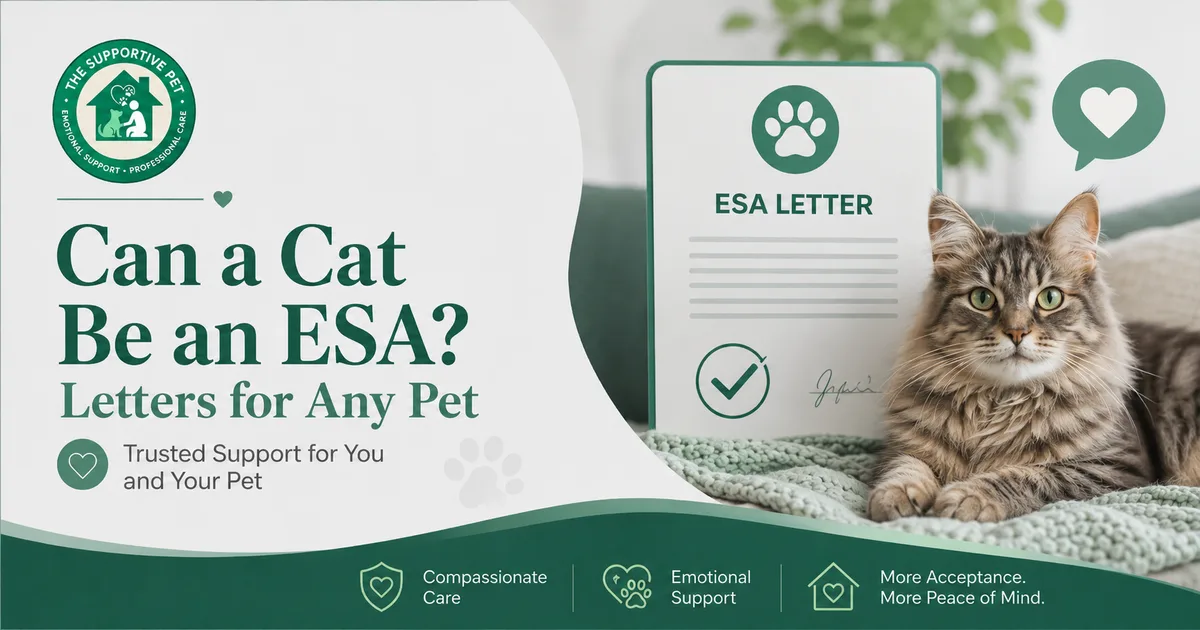
Can a cat be an emotional support animal?
Yes. The Fair Housing Act does not restrict emotional support animals to any specific species. Cats, rabbits, birds, hamsters, guinea pigs, and other animals can qualify as ESAs. What matters is not the species - it is whether you have a qualifying mental health disability and whether the animal provides genuine therapeutic benefit related to that condition.
Medical Disclaimer: This article is for informational purposes only and does not constitute medical or legal advice. Consult a qualified mental health professional before making decisions about your care. If you or someone you know is in crisis, call or text 988 (Suicide & Crisis Lifeline, available 24/7).
The ESA rules do not say "dogs only"
One of the most common misconceptions about emotional support animals is that the rules only apply to dogs. They do not. The Fair Housing Act - the law that protects ESA owners in housing situations - does not specify any particular species. Any animal can qualify as an ESA.
The therapeutic relationship is what matters. If your cat, rabbit, bird, or guinea pig genuinely helps you manage a mental health condition, they may qualify as your emotional support animal. This guide explains how the law applies to non-dog pets, what the research says about cats specifically, and how to get proper documentation for any species.
How cats provide measurable mental health support
Research on human-animal interaction is largely dog-focused, but the evidence for cats as therapeutic companions is substantial and growing. Cats offer a distinct set of benefits that make them particularly well-suited for people managing anxiety, depression, and trauma-related conditions.
- A study from the University of Missouri found that interacting with cats triggered the same oxytocin release as interacting with dogs in many participants - the same neurochemical associated with trust, bonding, and reduced stress.
- Purring in the 25-50 Hz frequency range has been associated with reduced blood pressure and lower self-reported anxiety in multiple studies. The vibration itself has a documented calming effect on the autonomic nervous system.
- Cats provide grounding tactile stimulation for people with dissociation, anxiety, and PTSD. The warmth, texture, and rhythmic movement of a resting cat on your chest or lap can interrupt a dissociative episode in real time.
- For people who find dogs too demanding - requiring walks, active training, and high energy engagement - cats provide low-barrier companionship with similar attachment benefits. For someone in a depressive episode, the lower maintenance requirement can make consistent care more achievable.
- Cats impose a feeding and care routine that provides external structure during periods when self-directed routine collapses - a common feature of depression and anxiety disorders.
From a clinical perspective, what makes a cat a valid emotional support animal is not the species - it is the genuine therapeutic relationship between the animal and the person. Many of my clients describe their cat's presence during panic attacks, their routine of feeding and grooming as a stabilizing anchor, and the non-judgmental companionship as profoundly different from human social interaction during periods of depression.
The ESA letter process is identical for all species
Getting an ESA letter for your cat, rabbit, or bird follows the exact same process as getting one for a dog. There is no separate category of letter, no additional documentation, and no species-specific evaluation pathway.
- Complete an intake assessment describing your mental health condition and how your animal helps manage your symptoms. Be specific: describe particular moments, behaviors, and functions your animal serves.
- A licensed clinician evaluates your case and determines whether a letter is clinically appropriate. They assess your condition, the therapeutic nexus between your disability and your animal, and whether documentation is warranted.
- If approved, you receive a letter on the clinician's letterhead with their license information, your disability statement, and a nexus statement connecting your need to your animal.
The letter itself typically does not specify the species - it documents your disability and your need for an emotional support animal. If your landlord requests information about the species, size, or breed, you can provide that separately. It is not required to appear in the clinical letter.
Ready to start? See how The Supportive Pet process works or view pricing for your ESA letter.
"I have many clients whose cats are genuinely central to their mental health management. The therapeutic relationship is real and clinically significant - whether the animal weighs 10 pounds or 100. The question I ask is: does this animal provide therapeutic benefit for a real mental health condition? If the answer is yes, the species is irrelevant."
- Kartik Sharma, LCSW
Species that commonly qualify as ESAs
The following animals are commonly approved by landlords as emotional support animals. While species flexibility is broad, practical acceptance depends on the individual animal's behavior and the landlord's individualized assessment.
- Cats: By far the most common non-dog ESA. Universally approved by landlords with minimal friction. Cats are low-maintenance, quiet, and widely accepted in multi-unit housing.
- Rabbits: Quiet, gentle, and well-suited for apartment living. Generally approved without issue. Rabbits are litter-trained, low-impact, and therapeutic for their tactile qualities.
- Birds (parrots, cockatiels, canaries): Social animals that provide companionship, routine, and interactive engagement. Approved in most housing situations; landlords occasionally ask about noise. Parrots in particular have documented cognitive engagement benefits.
- Small rodents (hamsters, guinea pigs): Low-maintenance but provide real grounding tactile interaction. Guinea pigs in particular are used in formal animal-assisted therapy settings. Generally approved with minimal landlord resistance.
- Fish: Watching fish has documented anxiety-reducing and blood-pressure-lowering effects. From a landlord perspective, fish are the easiest ESA to approve - no behavioral concerns and minimal property impact.
- Dogs: The most common ESA overall. The same process applies - an ESA letter covers any species, including dogs, for housing rights.
Exotic and unusual animals: what to expect
The FHA does not exclude exotic animals, but landlords have more grounds to scrutinize unusual species on a case-by-case basis. The Fair Housing Act allows landlords to consider whether the specific animal poses a direct threat to health or safety, or would cause substantial damage. For uncommon species:
- Reptiles (lizards, snakes): Small lizards are often approved without issue. Large constrictors may face legitimate safety objections. Your clinical case still needs to demonstrate a genuine therapeutic relationship.
- Farm animals: Miniature pigs have been approved in some jurisdictions, but larger farm animals face significant landlord and zoning resistance. These cases require stronger clinical documentation and are more likely to result in legal disputes.
- Insects and arachnids: Rare as ESAs but not legally excluded. Landlord acceptance will vary widely. Documentation is the same - clinician letter establishing therapeutic nexus.
For unusual species, a robust, detailed clinician letter that specifically addresses the therapeutic relationship with the specific animal strengthens the accommodation request. Generic letters are more likely to be challenged.
What landlords can ask about your ESA's species
Once you submit a valid ESA letter, your landlord can request general information about the type and size of your animal. What they cannot do:
- Apply a blanket "no cats" or "no birds" policy that eliminates your right to request a reasonable accommodation under the FHA
- Charge a higher pet deposit for a cat than they would for a dog (they cannot charge any pet deposit for an ESA)
- Require species-specific certification or additional documentation beyond your clinician's letter
- Deny based on species alone without demonstrating an individualized direct threat assessment
The FHA's reasonable accommodation standard applies equally to all species. If a landlord denies your cat ESA accommodation, they must provide a legitimate legal reason based on the specific animal - not blanket species preference. See our guide on what to do when a landlord denies your ESA for specific steps.
Important distinction: ESA vs. Service Animal species rules
The species flexibility described throughout this article applies to ESAs under the Fair Housing Act - not to service animals under the ADA. Under the ADA, service animals are limited to dogs (and in some cases miniature horses). This matters if you need public access rights in addition to housing rights.
For housing rights: any species can be your ESA.
For public access rights (restaurants, stores, airlines): only dogs qualify as service animals or psychiatric service dogs.
If your cat helps you manage a mental health condition and you need housing accommodation, an ESA letter is your tool. If your dog performs specific trained tasks for a psychiatric disability and you need public access rights, a Psychiatric Service Dog letter provides the broader protection. The two are not mutually exclusive - some people hold both an ESA letter for their cat and a PSD letter for their dog.
How to document your cat's therapeutic role effectively
When completing your intake assessment for an ESA letter, the strongest applications describe specific, concrete functions your animal performs - not just general emotional benefit. For cats, effective documentation might include:
- How your cat's presence during a panic attack changes your physiological response
- Whether your cat wakes you from nightmares or responds to distress
- Whether the routine of feeding and caring for your cat provides structure during depressive episodes
- Whether the tactile experience of your cat sitting with you provides grounding during dissociation or anxiety
- Whether your cat's companionship reduces your isolation during periods of depression or social anxiety
The more specific and behavioral your description, the more clearly a clinician can establish the nexus between your condition and your animal's therapeutic role. This makes for a stronger letter that withstands landlord scrutiny.
Ready to get your cat officially recognized as your emotional support animal? Start your evaluation with a licensed clinician at The Supportive Pet. fast letters available on business days.
Frequently Asked Questions
Can a cat be an emotional support animal?
Yes. The Fair Housing Act does not restrict emotional support animals to any specific species. Cats, rabbits, birds, hamsters, guinea pigs, and other animals can qualify as ESAs. What matters is not the species - it is whether you have a qualifying mental health disability and whether the animal provides genuine therapeutic benefit related to that condition.
Do I need a different ESA letter for a cat vs. a dog?
No. The ESA letter documents your disability and your therapeutic need for an emotional support animal - it is not species-specific unless you choose to include the animal's details. The letter process, requirements, and legal protections are the same regardless of whether your ESA is a dog, cat, rabbit, or bird.
Can my landlord refuse a cat ESA?
Generally no. Under the Fair Housing Act, landlords must provide reasonable accommodation for any species of ESA unless the specific animal poses a direct, documented threat to health or safety. A blanket "no cats" policy in a lease does not eliminate your right to request a reasonable accommodation under the FHA once you have submitted a valid ESA letter.
Are exotic animals allowed as ESAs?
The FHA does not exclude exotic animals, but landlords may have more grounds to evaluate unusual species on a case-by-case basis - particularly if the animal poses sanitation, safety, or zoning concerns. Common pets (cats, rabbits, birds, small rodents) are routinely approved. Reptiles, large snakes, and farm animals are more likely to face landlord pushback and legal scrutiny.
See our articles highlighted in Google Search
Add The Supportive Pet as a preferred source - your results, your way.