
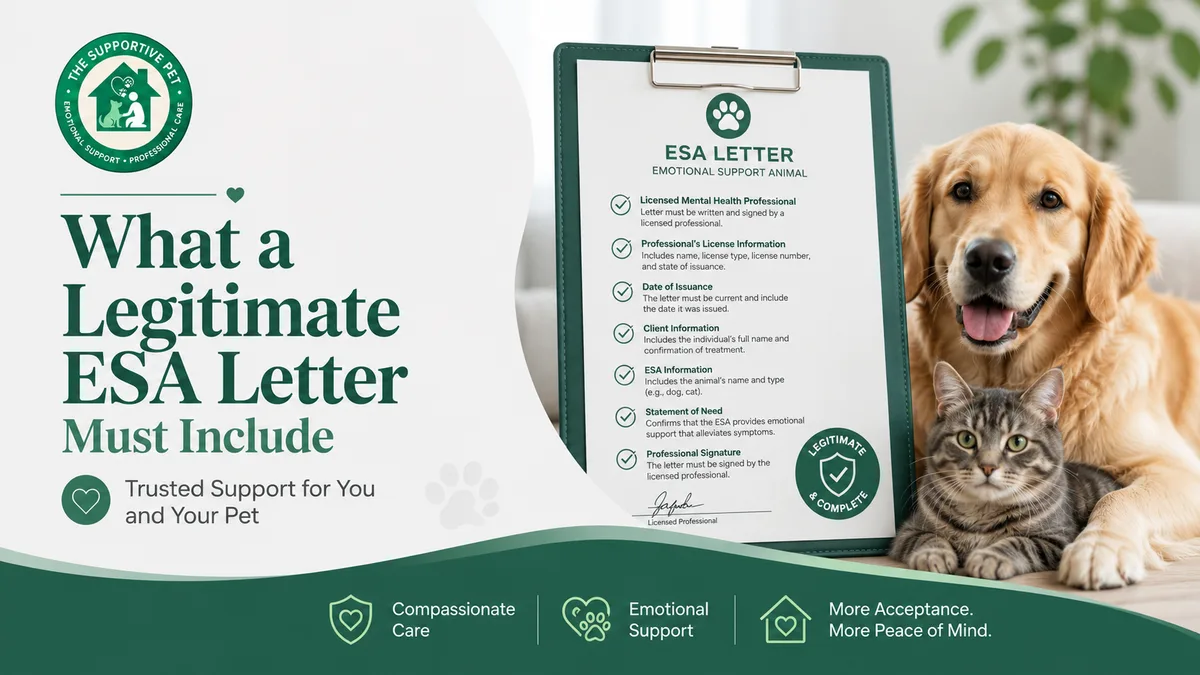
What should an ESA letter say?
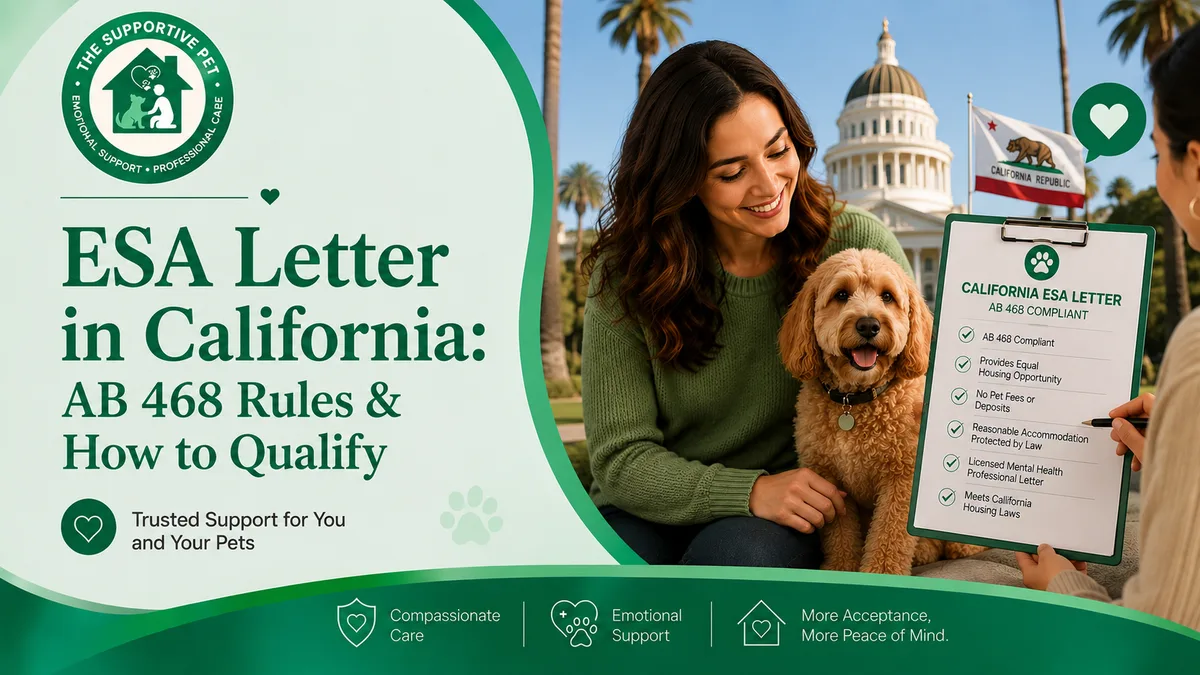
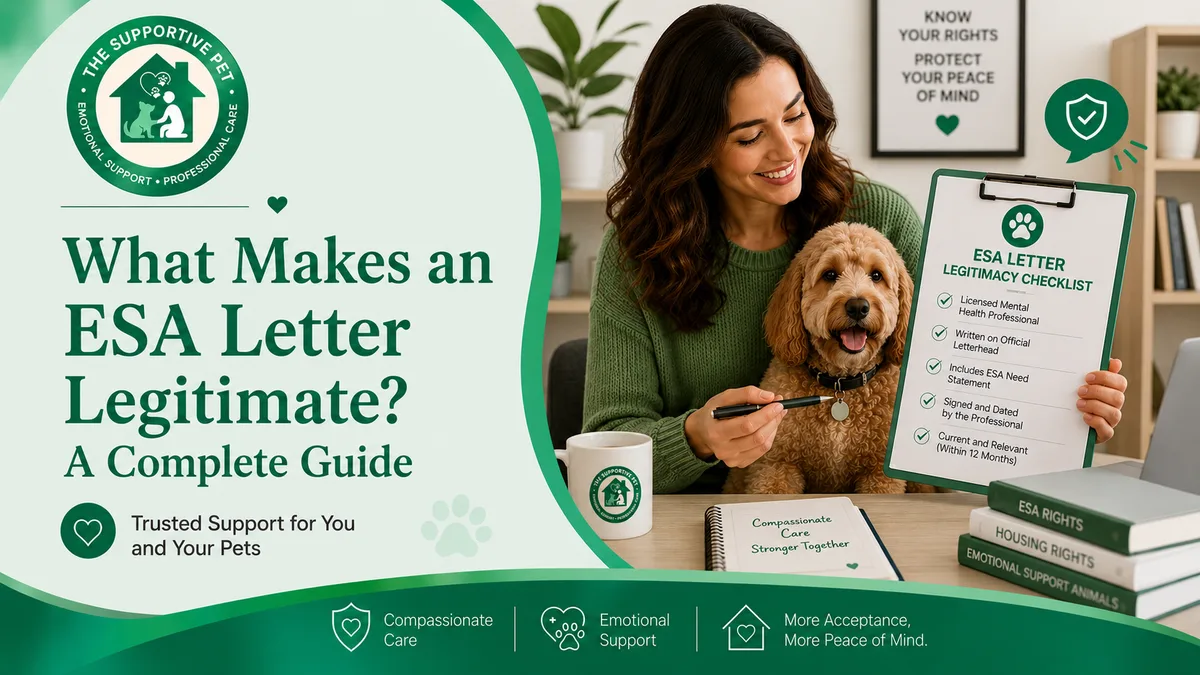
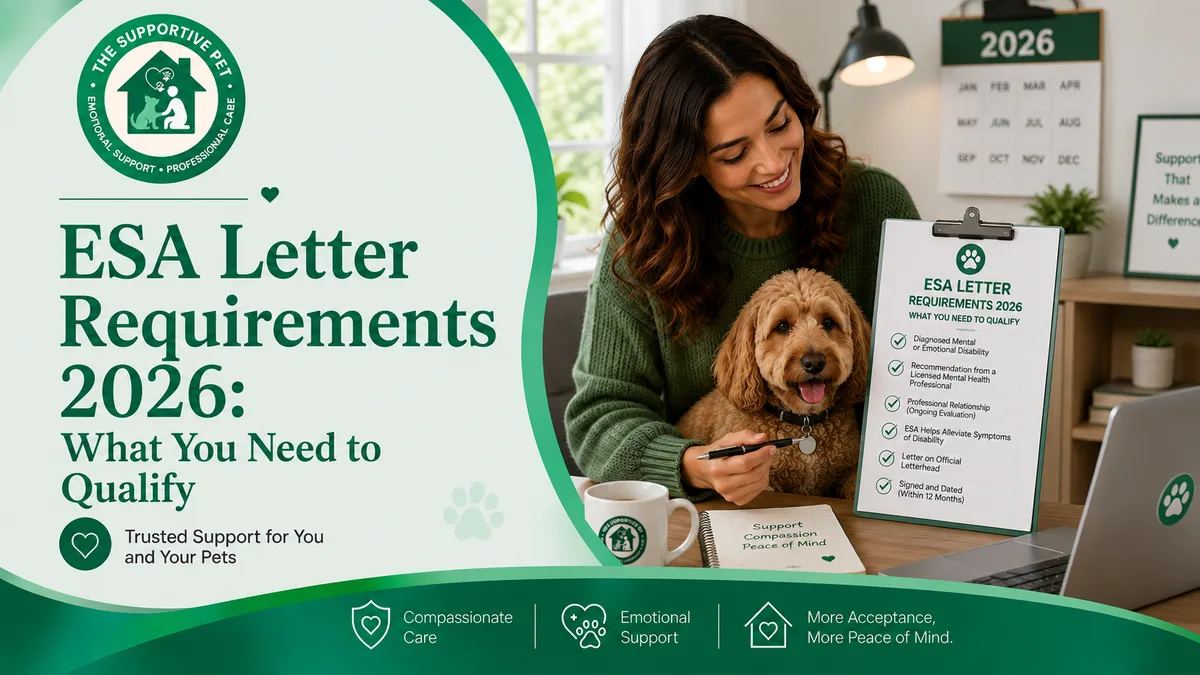
A legitimate ESA letter must state that the writer is a licensed mental health professional, provide their license number and state, confirm that you have a mental health disability, state that you have an established clinician-patient relationship, explain that your ESA provides therapeutic benefit related to your disability, and be signed and dated. The letter should not include your specific diagnosis - only that a disability exists.
Medical Disclaimer: This article is for informational purposes only and does not constitute medical or legal advice. Consult a qualified mental health professional before making decisions about your care. If you or someone you know is in crisis, call or text 988 (Suicide & Crisis Lifeline, available 24/7).
ESA Letter vs. ESA Certificate: The Critical Difference
Many websites sell "ESA certificates," "registration cards," or "ID vest packages." These documents have no legal value whatsoever. The only document with legal force under the Fair Housing Act is a letter from a licensed mental health professional who has personally evaluated you. No federal registry exists. No certification program is recognized by HUD. Certificates, ID cards, and registration numbers are commercial products with no statutory basis.
A proper ESA letter template includes specific required elements. For more context, review what an ESA letter must include, what makes a letter legally valid, and how landlords request ESA documentation.
This distinction matters enormously in practice. Presenting an ESA "certificate" to a landlord instead of a clinician's letter is likely to result in denial - and may signal to the landlord that you are unfamiliar with what the law actually requires. Start with the right document.
Required elements of a legitimate ESA letter
Based on HUD guidance and established case law, every valid ESA letter must contain the following elements. Missing any one of them gives a landlord legitimate grounds to request additional documentation or reject the letter entirely.
- Clinician's letterhead: The letter must be on official professional letterhead that includes the clinician's name, professional credentials, practice name (if applicable), mailing address, phone number, and email. The letterhead is what makes the document attributable to a specific, verifiable professional.
- License type, number, and state of licensure: These three elements are what make the letter independently verifiable. Without them, a landlord cannot confirm the clinician's credentials. Common license types include LCSW (Licensed Clinical Social Worker), LPC (Licensed Professional Counselor), LMFT (Licensed Marriage and Family Therapist), PhD (Psychology), and MD (Psychiatry).
- Established relationship statement: The letter should confirm that the clinician has an established professional relationship with you and has personally assessed your condition. HUD guidance specifically flags letters from clinicians who have not conducted a meaningful evaluation - and allows landlords to reject them.
- Disability statement: The letter must explicitly state that you have a mental health disability that substantially limits a major life activity. The specific diagnosis does not need to be named - but the existence of a disability must be clear.
- Nexus statement: This is the therapeutic link between your disability and your emotional support animal. The letter must explain that the animal provides therapeutic benefit that is related to your condition - not just that you own a pet you are attached to. This nexus is the clinical core of the letter.
- Original clinician signature: A wet signature (or a verified digital signature using a professional signing platform) from the clinician. Stamped signatures, auto-generated electronic signatures, and printed name lines are all red flags for mill letters.
- Current date: The letter must be dated. Most landlords require a letter dated within the past 12 months, making the date both a validity signal and a renewal trigger.
What a legitimate ESA letter deliberately omits
Knowing what should not appear in a legitimate letter is equally important. If you see any of the following in an ESA letter you are considering using, treat it as a warning sign:
- Your specific psychiatric diagnosis: The FHA does not require you to disclose your diagnosis to your landlord, and a legitimate letter protects that privacy. The letter states you have a disability - not what it is.
- Details of your treatment plan or medication: Treatment specifics are protected health information. They have no place in an ESA letter and should never appear there.
- Guarantees of approval or "legal protection": No clinician and no letter can guarantee that a landlord will approve your accommodation. Any letter claiming to provide "guaranteed legal protection" or "100% landlord acceptance" is making a promise the law does not support.
- ESA certification numbers, registration IDs, or database references: These elements signal that the document came from a mill that sells fake registration products alongside template letters. They have no legal meaning and may cause an informed landlord to question the entire letter.
- Unrealistic turnaround claims on the letter itself: Some mill letters include marketing language about their service or processing guarantees. Legitimate clinical letters contain only clinical content.
How landlords verify ESA letters - and what triggers rejection
Experienced property managers, housing attorneys, and large property management companies have developed systematic processes for reviewing ESA documentation. Understanding their verification steps helps you ensure your letter will pass scrutiny.
- State licensing board lookup: The clinician's name and license number are searched on the state licensing board's public website. If they do not appear, or appear with a lapsed license, the letter fails immediately. This lookup takes 30 seconds and is now routine for any property management company that has been burned by fraudulent letters.
- State of licensure check: The clinician must be licensed in the state where you live. An out-of-state clinician has no legal basis to evaluate your mental health condition for purposes of documentation in another state. This is one of the most common failures of online mill services.
- Practice legitimacy check: The practice address, phone number, and email on the letterhead are looked up. Virtual addresses, unregistered phone lines, and generic email domains (Gmail, Yahoo) on professional letterhead are red flags.
- Template language detection: Property managers who have seen many letters recognize form language. If the same letter template - with only the tenant name changed - has appeared multiple times in their portfolio, both the clinician and the service are flagged.
- Volume assessment: Some property management companies track letter sources. A clinician or service appearing repeatedly across many different tenants triggers additional scrutiny.
"The letter itself is almost secondary to the clinician behind it. What I look for first is: does this clinician appear on the state licensing board website with an active license in this state? If yes, I move on to the substance. If no, I stop there. A real clinician, real license, real practice - that is what makes a letter hold up."
- Chetna Giri, Head of Legal & Compliance
How to read a letter you have already received
If you have an existing ESA letter and are not sure whether it will hold up, check these things before submitting it to a landlord:
- Find the clinician's license number on the letter or letterhead.
- Search that license number on the state licensing board website for the state where you live.
- Confirm the clinician's name matches, the license type is appropriate (LCSW, LPC, LMFT, PhD, MD), and the license is active and in good standing.
- Confirm the letter includes all seven required elements listed above.
- Check the date - if it is more than 12 months old, renew before submitting.
If the license cannot be verified, or if any of the seven elements are missing, the letter will likely be rejected by a knowledgeable landlord. Get a replacement from a verifiable source before submitting.
How The Supportive Pet letters meet every standard
Every letter issued through The Supportive Pet comes from a state-licensed mental health professional with a verified, active license in your state of residence. We match you with a clinician licensed specifically in your state - not an out-of-state provider signing in bulk.
Every letter includes:
- Full clinician credentials on professional letterhead
- License type, license number, and state of licensure (verifiable on your state's licensing board website)
- A genuine disability and nexus statement drafted by the evaluating clinician
- The clinician's signature and current date
All letters come with our 365-day acceptance guarantee: if your letter is rejected by a landlord, we provide free dispute support. If the dispute cannot be resolved, you receive a full refund. View current pricing or start your evaluation now.
Frequently Asked Questions
What should an ESA letter say?
A legitimate ESA letter must state that the writer is a licensed mental health professional, provide their license number and state, confirm that you have a mental health disability, state that you have an established clinician-patient relationship, explain that your ESA provides therapeutic benefit related to your disability, and be signed and dated. The letter should not include your specific diagnosis - only that a disability exists.
Is there an official ESA letter template?
No official government template exists. Each clinician writes their own letter using their professional letterhead. However, HUD guidance establishes the minimum content requirements. Any letter meeting those requirements from a verifiable, state-licensed clinician is valid.
Can a landlord ask to see the full letter?
Yes. Landlords can request a copy of your ESA letter and may verify the clinician's license with the state licensing board. They can ask for enough information to evaluate whether the request is legitimate, but cannot demand your medical records, specific diagnosis, or more than the letter already provides.
Does the letter need to mention a specific animal?
Not always, but some landlords and housing providers request species and sometimes breed information. HUD guidance does not require the letter to name a specific animal. What it must establish is the nexus between your disability and your need for an emotional support animal of that general type.
See our articles highlighted in Google Search
Add The Supportive Pet as a preferred source - your results, your way.