
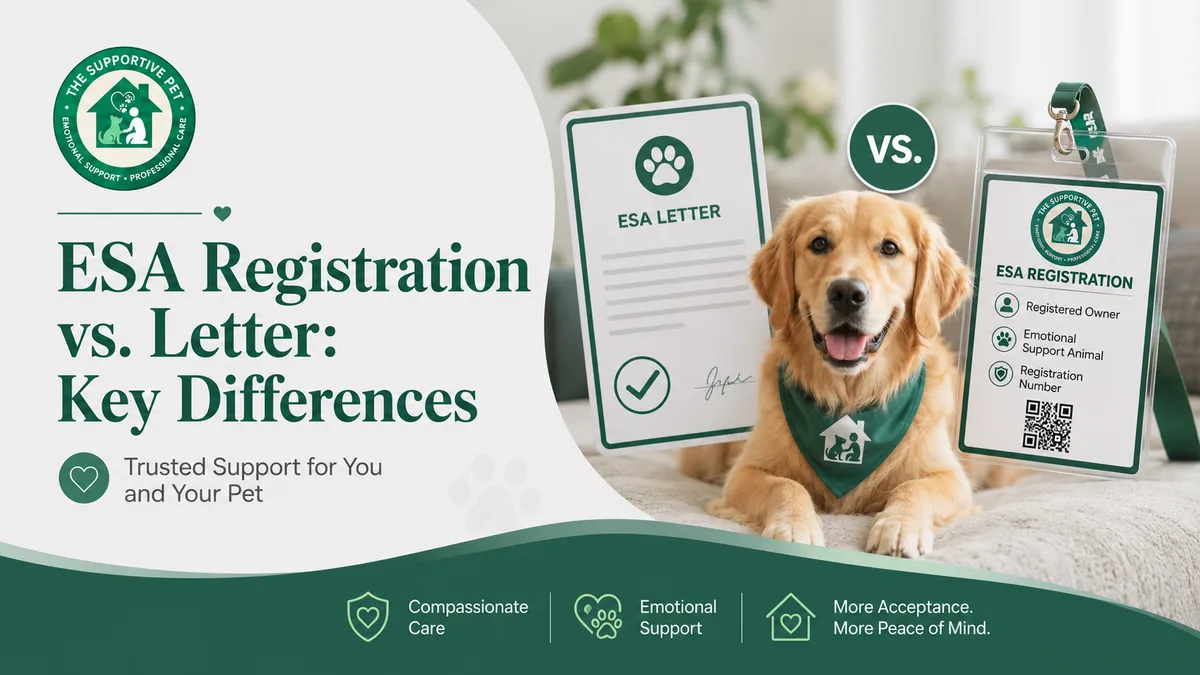
Is there an official ESA registry?
No. There is no government ESA registry, no official ESA certification program, and no federal or state agency that maintains a list of registered emotional support animals. Any website claiming to offer official ESA registration is selling a product with no legal value whatsoever.
Medical Disclaimer: This article is for informational purposes only and does not constitute medical or legal advice. Consult a qualified mental health professional before making decisions about your care. If you or someone you know is in crisis, call or text 988 (Suicide & Crisis Lifeline, available 24/7).
No official ESA registry exists - not federal, not state, not anywhere
The United States federal government does not operate an ESA registry. No state government does either. There is no official certification body, no government-issued ESA ID card, and no badge, vest, or certificate that grants legal rights under the Fair Housing Act or any other federal law.
Scam sites often look legitimate. Learn how to verify an ESA letter is legitimate, spot ESA letter red flags, and understand what makes an ESA letter legally valid.
The concept of "ESA registration" is a commercial invention with no legal basis. Dozens of websites have built businesses worth millions of dollars around selling these products to people who genuinely do not know that registration carries no legal weight. If you have ever searched "register my ESA" or bought a registration package, you are not alone - and this guide exists to clarify exactly what the law requires versus what these services sell.
What the FHA actually requires - the complete answer
The Fair Housing Act provides housing protections for people with disabilities who need an emotional support animal. The statute and HUD guidance specify exactly what documentation a tenant must provide to invoke these protections. It is simple and it is specific:
- A letter (not a certificate, not a registration, not an ID card) from a licensed healthcare provider
- That confirms the tenant has a mental or physical disability that substantially limits a major life activity
- And that establishes a nexus between the disability and the therapeutic need for the emotional support animal
- Written by a clinician who has personal knowledge of the tenant's disability - meaning a real clinical relationship, not a form review
That is the complete list. No registry. No certification. No ID card. No vest. A letter from a licensed clinician who actually knows your case.
How ESA registration scams are structured
Registration websites succeed because their marketing is deliberately designed to look official. Understanding exactly how they operate makes their products easier to recognize and avoid:
The government-authority illusion
Registration sites use official-looking language: "National Database," "Certified Emotional Support Animal," "Official Documentation," "Registered ESA." They display logos with eagles, government-style seals, and blue color schemes that evoke federal agencies. The URL often contains words like "national," "official," or "certified." None of this reflects any government authority. It is marketing design intended to create the impression of legitimacy.
The bundled product upsell
Most registration sites sell packages that bundle: a PDF "registration certificate," an ESA ID card you can laminate, a vest with a patch, and sometimes a letter template. The registration and ID have no legal value. The vest has no legal significance - there is no required ESA vest, and wearing one does not confer any rights. The "letter template" is usually a form document with no clinician review behind it.
The database claim
Registration sites frequently claim to "register your animal in the national database." There is no national database. There is no registry that landlords are required to check or recognize. A "registration number" has zero legal standing. When you present a registration certificate to a landlord and they look it up in their training materials or check with their attorney, the answer is always the same: not legally recognized.
The fake letter add-on
Many registration sites also sell ESA letters - but these are typically generated by template, reviewed in bulk by clinicians who spend seconds on each one, or signed by out-of-state providers with no legitimate patient relationship. These letters have the same problem as their registration products: they do not reflect a genuine clinical evaluation and will be rejected by a landlord who verifies the clinician's credentials and in-state license.
"When a tenant brings me an ESA registration certificate, I have to explain that it has no more legal standing than a gift card. I am not being dismissive of their situation - I understand they spent money and thought they were doing the right thing. But the FHA requires a clinician's letter, and nothing else satisfies the statute. The money they spent on registration is gone, and they still need to get the actual document."
- Chetna Giri, Head of Legal & Compliance
Real consequences: what happens when you present a registration certificate to a landlord
The practical sequence of events when a tenant presents a registration certificate instead of a clinician's letter typically looks like this:
- The landlord or property manager receives the certificate. If they are unfamiliar with ESA law, they may initially seem to accept it - which leads the tenant to believe the process is complete.
- The certificate goes to the property manager's legal department or housing attorney for review. This is standard practice for any larger property management company.
- Legal review confirms the certificate has no FHA standing. The accommodation request is denied, citing lack of valid documentation.
- The tenant is informed they need to provide a letter from a licensed mental health professional. They have now lost time, the accommodation remains unapproved, and they still need to get the actual document they should have started with.
In competitive housing markets, this delay can cost you the apartment. In ongoing tenancy disputes, it can create unnecessary conflict and delay the legal protection you were entitled to from the start.
Red flags that identify a registration or scam service
- Uses the words "register," "registration," "certified," or "certification" for your ESA
- Offers an ID card, badge, tag, or laminated certificate as part of the package
- Claims to list your animal in a "national database" or "official registry"
- Provides an "instant" letter with no clinical evaluation
- Does not provide the clinician's specific license number and state of licensure
- Sells vest packages, badge kits, or animal gear alongside documentation
- Advertises "guaranteed landlord acceptance" for a registration product
- Does not list real clinician names associated with letters
What actually works: the complete answer
The only documentation that provides legal protection under the Fair Housing Act is a letter from a licensed mental health professional. A valid ESA letter must include:
- The clinician's name, license type, license number, and state of licensure
- Their practice address and contact information for independent verification
- A statement that you have a mental health disability that substantially limits a major life activity
- A nexus statement connecting your disability to the therapeutic need for your ESA
- Evidence of a genuine clinical relationship - not a one-time form review
- The clinician's original signature and current date (within the past 12 months)
If you have already spent money on ESA registration and are now facing a housing situation, you need a legitimate clinician's letter to move forward. The registration certificate will not substitute for it, and presenting both will not help - landlords and their attorneys know which one counts.
The Supportive Pet provides legitimate ESA letters from state-licensed mental health professionals following a real clinical evaluation. No registration products, no ID cards, no vests - just the legal documentation the Fair Housing Act actually requires. View pricing or start your evaluation now.
Frequently Asked Questions
Is there an official ESA registry?
No. There is no government ESA registry, no official ESA certification program, and no federal or state agency that maintains a list of registered emotional support animals. Any website claiming to offer official ESA registration is selling a product with no legal value whatsoever.
Does ESA registration help with housing?
No. A registration certificate, ID card, or vest does not provide any housing protections under the Fair Housing Act. The only document recognized by the FHA is a letter from a licensed mental health professional. Presenting a registration certificate to a landlord instead of a clinician letter will almost certainly result in a denial.
What does the FHA actually require for ESA housing accommodation?
The Fair Housing Act requires tenants to provide documentation from a licensed healthcare provider confirming they have a disability and that the ESA is necessary to help with that disability. The documentation must come from a verifiable, licensed professional - not a registry, website, or certificate service.
How do I know if a website is an ESA scam?
Red flags include: selling "registration," "certification," or ID cards without requiring a clinician evaluation; offering an "instant" letter with no consultation; displaying a logo claiming official government recognition; selling vest packages or badge kits alongside documentation; and not listing verifiable clinician names or license numbers on their letters.
See our articles highlighted in Google Search
Add The Supportive Pet as a preferred source - your results, your way.