
Key Takeaways
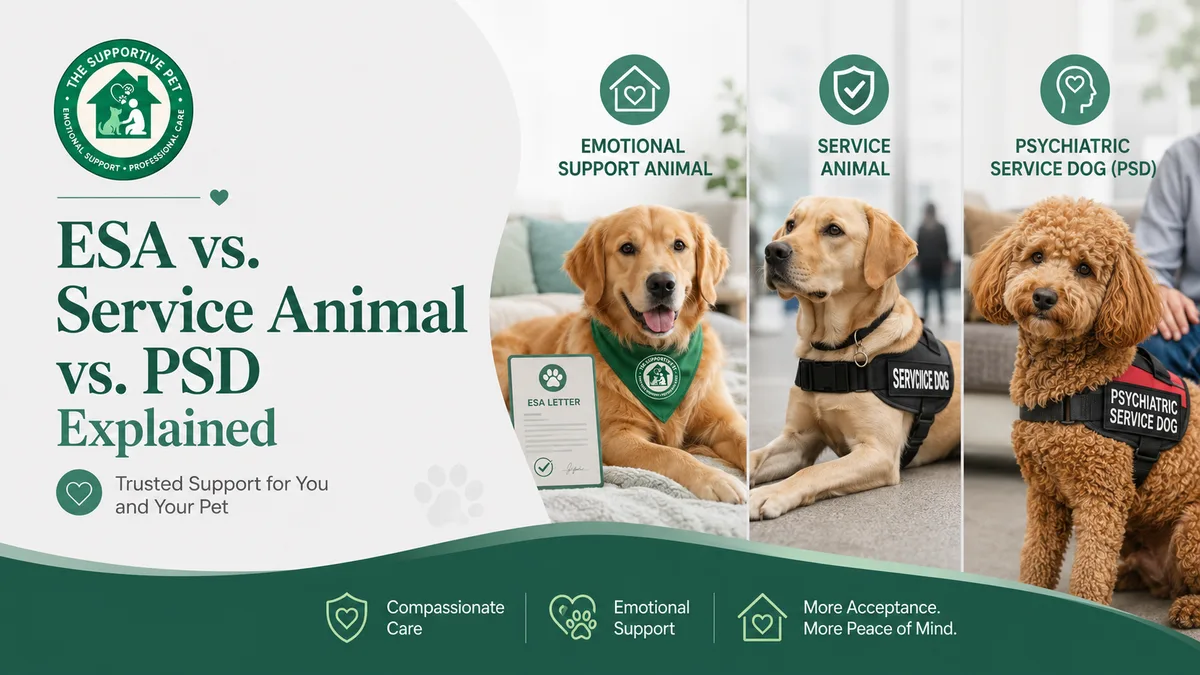
- Service animals (ADA) require individual task training; ESAs (FHA) do not.
- Service animals have public-access rights; ESAs have housing-accommodation rights.
- Airlines are no longer required to accommodate ESAs in-cabin under the 2021 DOT rule.
- Neither ESAs nor service animals require government registration or ID cards.
- Psychiatric service dogs (PSDs) qualify under both the ADA and FHA.
Medical Disclaimer: This article is for informational purposes only and does not constitute medical or legal advice. Consult a qualified mental health professional before making decisions about your care. If you or someone you know is in crisis, call or text 988 (Suicide & Crisis Lifeline, available 24/7).
Why This Comparison Matters in 2026
A landlord refusing your ESA because "it isn't a trained service animal" is invoking the wrong law. A flight attendant turning away a service dog because they think it needs an ESA letter has the same problem. The confusion between emotional support animals and service animals is one of the most common sources of housing denials, travel disputes, and legal complaints in the country - and it almost always traces back to misidentifying which federal statute applies.
This guide lays out both designations side by side, using the statutes and regulations in effect as of 2026, so you know exactly what rights you hold and which law to cite when they are challenged.
The Two Laws That Govern These Animals
Two distinct federal frameworks control this area. Understanding which one applies to your situation is the first step in any dispute.
Americans with Disabilities Act (ADA) - Service Animals
The ADA (42 U.S.C. § 12101 et seq.) and its implementing regulations at 28 C.F.R. Part 36 govern service animals in public accommodations: stores, restaurants, hotels, hospitals, schools, and any other place open to the public. Under the 2010 ADA Standards, a service animal is a dog (or in limited cases a miniature horse) that is individually trained to perform a specific task directly related to a person's disability.
Key phrase: individually trained to perform a task. The training must produce a discrete, observable behavior that mitigates the disability. A dog trained to alert a deaf person to sounds, guide a blind person, detect the onset of a seizure, or interrupt a self-harm behavior during a psychiatric episode all qualify. Providing comfort or emotional support through companionship alone does not meet the ADA definition, regardless of how meaningful that support is to the handler.
Fair Housing Act (FHA) - Assistance Animals Including ESAs
The FHA (42 U.S.C. § 3604(f)) and its implementing regulations at 24 C.F.R. Part 100 govern housing. Under the FHA, the relevant category is assistance animal, which has two subtypes: service animals and emotional support animals. Both receive reasonable accommodation in housing. Unlike the ADA, the FHA does not require individual task training. An animal qualifies as an ESA under the FHA when a licensed mental health professional (or other licensed healthcare provider) determines that the animal provides emotional support that alleviates one or more symptoms of the person's disability.
This is why the same dog can be a service animal under the ADA in public spaces and an ESA under the FHA in housing - the definitions and the applicable laws are different.
Side-by-Side Comparison
| Factor | Service Animal (ADA) | Emotional Support Animal (FHA) |
|---|---|---|
| Governing law | Americans with Disabilities Act, 28 C.F.R. § 36.302 | Fair Housing Act, 42 U.S.C. § 3604(f) |
| Where rights apply | All public accommodations and commercial facilities open to the public | Housing: rentals, condos, HOAs, most housing with four or more units |
| Species | Dogs only (miniature horses in limited cases) | Any species; dogs and cats are most common |
| Training requirement | Must be individually trained to perform a specific disability-related task | No task training required; must provide disability-related emotional support |
| Documentation a covered entity may request | Only two questions: (1) Is this a service animal required because of a disability? (2) What task is it trained to perform? | Reasonable supporting documentation from a licensed healthcare provider when the disability or need is not apparent |
| Certification or ID card required | No legal requirement; no government registry exists | No legal requirement; an ESA letter from a licensed clinician is the standard documentation |
| Airlines (as of 2021 DOT rule) | Service dogs trained to assist passengers with disabilities must be accommodated; airlines may require DOT form | Airlines are no longer required to accommodate ESAs in-cabin under the 2021 DOT rule; individual airline policies vary |
| Pet fees and deposits | No pet fees or deposits allowed for service animals | No pet fees or deposits allowed for ESAs in housing under the FHA |
| Breed and weight restrictions | Breed and weight restrictions cannot be applied to service animals | Breed and weight restrictions cannot be applied to ESAs in housing under the FHA |
The Specific Tasks Question (ADA)
When you bring a service animal into a public accommodation, staff may ask only those two questions listed above - nothing more. They may not ask about your diagnosis, request documentation, demand a vest or ID card, or require the dog to demonstrate its task on command. If the handler confirms the animal is a service animal and identifies a task, access must be granted.
The task requirement is specific. Courts have found that tasks like alerting to anxiety attacks, performing deep pressure therapy during a dissociative episode, and interrupting compulsive behaviors qualify. General calming presence does not. The distinction matters because it determines whether the ADA or only the FHA protects the animal in a given setting.
The Disability and Need Question (FHA)
In housing, the analysis is different. A housing provider may request reliable documentation when the disability or disability-related need is not apparent or already known. The Fair Housing Act recognizes that documentation helps housing providers evaluate requests consistently and fairly.
That documentation typically takes the form of an ESA letter from a licensed mental health professional - a psychologist, licensed clinical social worker, licensed professional counselor, or psychiatrist - who has evaluated the individual and determined that the animal provides emotional support that alleviates one or more symptoms of a disability covered under the FHA.
The FHA does not require task training. The animal's role is to provide support through its presence and the bond with its owner. That is a legally protected form of assistance under the Fair Housing Act.
State Law Variations in 2026
Several states have enacted legislation that adds requirements on top of federal minimums for ESA documentation:
- California (AB 468): The licensed healthcare provider must have an established relationship with the patient for at least 30 days before issuing an ESA letter, except in emergency circumstances.
- Arkansas (Act 268): 30-day client relationship required before ESA letter issuance.
- Iowa (Senate File 2268): 30-day relationship requirement.
- Louisiana (HB 407): 30-day relationship requirement.
- Montana (HB 703): 30-day relationship requirement.
These state laws apply to the clinician's documentation practices. They do not reduce the housing rights the FHA provides; they govern the process by which documentation is obtained.
When the Lines Blur: Psychiatric Service Dogs
A psychiatric service dog (PSD) occupies an important middle ground. A PSD is a service animal under the ADA - it is a dog trained to perform specific tasks that mitigate a psychiatric disability, such as alerting to pre-panic-attack physiological signs, interrupting self-harm, or guiding a person out of an overwhelming environment. Because a PSD meets the ADA's task-training requirement, it has both ADA public-access rights and FHA housing rights.
An ESA does not have ADA public-access rights. This is the most practically significant difference. An ESA owner cannot bring their animal into a restaurant, store, or other public accommodation solely on the basis of the ESA designation. An ESA is a housing accommodation under the FHA.
What to Carry and What to Say
For a service animal in public: you are not required to carry documentation. If asked, you can confirm the animal is a trained service animal and state the task it performs. That is legally sufficient.
For an ESA in housing: a letter from your licensed mental health provider is the standard documentation. The letter should be on the provider's letterhead, identify their license and state, confirm that you have a disability covered under the FHA, and state that the animal provides emotional support that alleviates a symptom of that disability. It should not diagnose you by name in the letter.
For a PSD in housing: the same FHA process applies. The provider's documentation may note that the animal is trained to perform specific tasks if that is relevant to the housing provider's evaluation.
Filing a Complaint When Rights Are Violated
If a housing provider denies a reasonable accommodation request for an ESA or service animal without legal justification, you may file a complaint with HUD's Office of Fair Housing and Equal Opportunity at hud.gov/program_offices/fair_housing_equal_opp. The FHA provides for actual damages, injunctive relief, and civil penalties. Private causes of action are also available in federal court.
For ADA violations at public accommodations, complaints go to the Department of Justice Civil Rights Division. Private lawsuits are also available under Title III of the ADA.
The Bottom Line
ESAs and service animals are not the same designation and they are not interchangeable. Service animals under the ADA require task training and provide public-access rights. ESAs under the FHA require documentation from a licensed clinician and provide housing accommodation rights. Both are legitimate, legally protected, and serve real needs - they simply serve them in different legal contexts. Knowing which law applies in your situation is the foundation of every successful accommodation request.
Frequently Asked Questions
See our articles highlighted in Google Search
Add The Supportive Pet as a preferred source - your results, your way.