
Can my therapist write my ESA letter?
Yes - and this is often the best option. A letter from your existing licensed therapist carries significant weight because it reflects a genuine, established clinician-patient relationship. HUD guidance explicitly favors documentation from providers with "personal knowledge" of your disability and treatment, which your treating therapist has by definition.
Medical Disclaimer: This article is for informational purposes only and does not constitute medical or legal advice. Consult a qualified mental health professional before making decisions about your care. If you or someone you know is in crisis, call or text 988 (Suicide & Crisis Lifeline, available 24/7).
Why your existing therapist is the strongest option
HUD guidance on ESA documentation specifically states that the letter should come from a healthcare provider with "personal knowledge" of your disability. This language is deliberate: it distinguishes genuine clinical relationships from one-off evaluations by providers who have never met you.
Your treating therapist satisfies this standard better than any online platform because they have a documented history with you, understand your condition in depth, and can speak to the therapeutic value of your ESA from direct clinical experience over time. A letter from an established treating clinician is also far less likely to be challenged by a landlord - the license is verifiable in your state, the practice is real, and there is no question about the authenticity of the clinical relationship.
If you have a therapist, psychiatrist, or licensed counselor - even if you see them infrequently - this conversation is worth having before you turn to a telehealth platform.
How to have the conversation: practical scripts
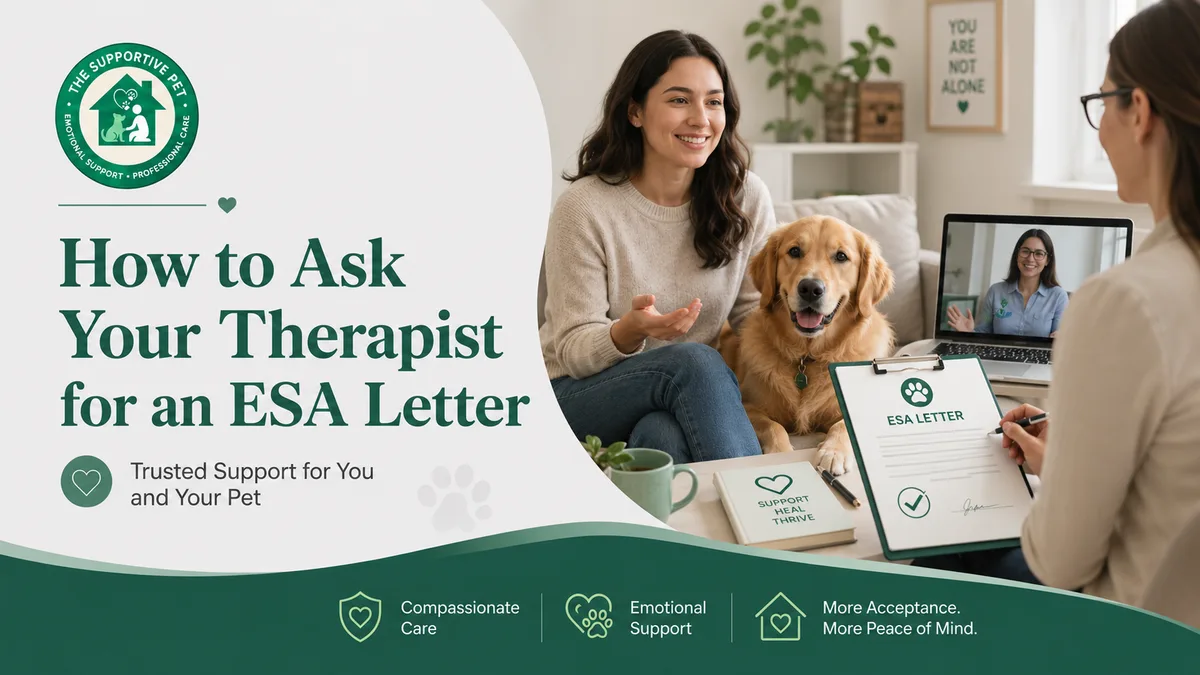
Many people feel awkward asking their therapist for documentation. There is no need to. ESA letters are a routine part of clinical practice for most licensed mental health professionals, and most therapists are already familiar with what the letter requires. Here is how to approach it effectively:
At the start of a session (preferred)
Bring it up at the beginning, not the end. Ending a session with "oh, by the way, can you write me an ESA letter?" puts your therapist in an impossible position and typically results in a vague "I'll think about it" response. A beginning-of-session mention gives them time to discuss it properly.
Example: "I wanted to mention something before we get started today. I have a housing situation where I need documentation for my [cat/dog/rabbit] as an emotional support animal. I know we've talked about how much [pet name] helps me with my anxiety - would you be willing to write a letter for that? I can share exactly what needs to be in it."
Providing the clinical context
The most effective conversations include specific examples of how your animal helps. Abstract statements like "my cat calms me" are less useful to a clinician than concrete descriptions. Think through:
- What specific symptoms does your animal help you manage? (panic attacks, dissociation, hypervigilance, sleep disturbances, social isolation)
- What specific things does your animal do that help? (sits on your chest, interrupts anxious behaviors, gets you out of bed, keeps you grounded in the present)
- Has the animal's presence noticeably changed the frequency or severity of your symptoms?
- Is your animal part of any coping strategies you and your therapist have discussed?
This level of specificity gives your therapist everything they need to write a strong nexus statement - the most clinically important part of the letter.
Making their job easy
Your therapist is a busy professional. Make the documentation request as frictionless as possible:
- Send them the list of required letter elements in advance (see below) so they know exactly what to include
- Give them at least one week - preferably two - to prepare the letter, not fast
- If your school or landlord has specific forms, download and send those in advance so everything can be completed in one step
- Ask about their documentation fee policy upfront so there are no surprises
What your therapist's letter needs to include
To make the letter legally effective under HUD guidance, your therapist's letter must contain all of the following. You can email or print this list and share it with your therapist's office - most will appreciate the clear guidance.
- Professional letterhead with their name, credentials, practice name, address, and contact information
- License information: license type (LCSW, LMFT, LPC, PhD, MD), license number, and state of licensure
- Established relationship statement: a sentence confirming they have an established clinician-patient relationship with you and have assessed your condition
- Disability statement: that you have a mental health disability that substantially limits a major life activity (the diagnosis itself does not need to be named)
- Nexus statement: that your emotional support animal provides therapeutic benefit related to your disability
- Original signature and the current date
What does not need to appear in the letter: your specific diagnosis, your treatment history, your medication, or any ESA "registration" information. The letter should be concise - typically one to two paragraphs on professional letterhead.
"I have written dozens of ESA letters for clients. The ones I feel most confident in are for clients where we have genuinely discussed how the animal helps them - specific moments, specific functions, real therapeutic history. That narrative makes the letter authentic and defensible. When a client comes in and hands me a template with blanks to fill in, that is a much weaker starting point."
- Kartik Sharma, LCSW
What if your therapist says no?
Some licensed mental health professionals decline to write ESA letters as a practice policy. This is not universal, but it is not uncommon. Reasons vary:
- Some clinicians prefer to keep their clinical and administrative roles strictly separate and do not want to serve as a documentation source
- Some have had negative experiences with landlord disputes and do not want to be involved in those interactions
- Some work within agencies or practices that have institutional policies against writing ESA letters
- Some have concerns about the specific clinical appropriateness of an ESA letter in your case
If your therapist declines, the conversation is worth having explicitly:
- "Is this a policy you have, or a clinical concern about my case specifically?" - This is important to know. If it is a clinical concern, that is feedback worth discussing. If it is a policy, it has nothing to do with your eligibility.
- "Could you provide a clinical summary that another provider could use as context for their own evaluation?" - Some therapists who will not write the letter themselves will provide a brief summary of your treatment that a telehealth evaluator can review.
- "Could you recommend a colleague who handles ESA documentation?" - Many therapists know other clinicians in their network who are comfortable with this kind of documentation.
A "no" from your therapist is a practice decision - not a statement about your eligibility for an ESA letter. You have entirely legitimate options to obtain documentation from another qualified clinician.
What if I don't have a therapist?
If you do not currently see a therapist, psychiatrist, or other licensed mental health professional, a reputable telehealth platform is your next best option. A legitimate telehealth ESA evaluation involves a real licensed clinician in your state reviewing your case - not a form review or automated system. The process typically takes less than 24 hours and is specifically designed for people who need documentation without an existing clinical relationship.
Through The Supportive Pet, a state-licensed clinician evaluates your case, asks any necessary follow-up questions, and issues a letter if clinically appropriate. All letters come with the clinician's verifiable credentials and a nexus statement that meets HUD standards. Learn how the process works or start your evaluation now.
What about asking my primary care doctor?
Primary care physicians can technically write ESA letters - HUD guidance refers to "healthcare providers" broadly, not just mental health professionals. However, most landlords and property managers are most familiar with ESA letters from licensed mental health professionals, and some specifically require a letter from an LMHP (licensed mental health professional). If your primary care doctor has documented your mental health condition and the therapeutic role of your animal, their letter has legal standing - but you may encounter more questions or pushback than with a mental health professional's letter.
The strongest documentation comes from licensed mental health professionals: psychiatrists, psychologists, licensed clinical social workers, licensed professional counselors, and licensed marriage and family therapists. If you have a choice, these credentials will produce the smoothest outcomes with landlords and housing offices.
Frequently Asked Questions
Can my therapist write my ESA letter?
Yes - and this is often the best option. A letter from your existing licensed therapist carries significant weight because it reflects a genuine, established clinician-patient relationship. HUD guidance explicitly favors documentation from providers with "personal knowledge" of your disability and treatment, which your treating therapist has by definition.
What should I say when asking my therapist for an ESA letter?
Be direct and specific. Explain that you have an emotional support animal (or are considering one), that it provides therapeutic benefit related to your condition, and that you need documentation for housing. Ask if they would be willing to write a letter. Most licensed therapists are familiar with ESA letters and will say yes if they believe it is clinically appropriate.
Will my therapist charge me for an ESA letter?
Policies vary by practice. Some therapists include letters as part of their standard services at no extra charge. Others charge a documentation fee, typically between $25 and $75. Ask ahead of time. If your therapist does not charge separately, offering to pay for the additional administrative time is a professional courtesy.
What if I do not have a therapist?
If you do not have an existing therapist, you can obtain a legitimate ESA letter through a licensed telehealth platform like The Supportive Pet. A licensed clinician in your state will conduct a genuine evaluation and, if appropriate, issue a letter that meets all FHA documentation requirements. The process typically takes less than 24 hours.
See our articles highlighted in Google Search
Add The Supportive Pet as a preferred source - your results, your way.