
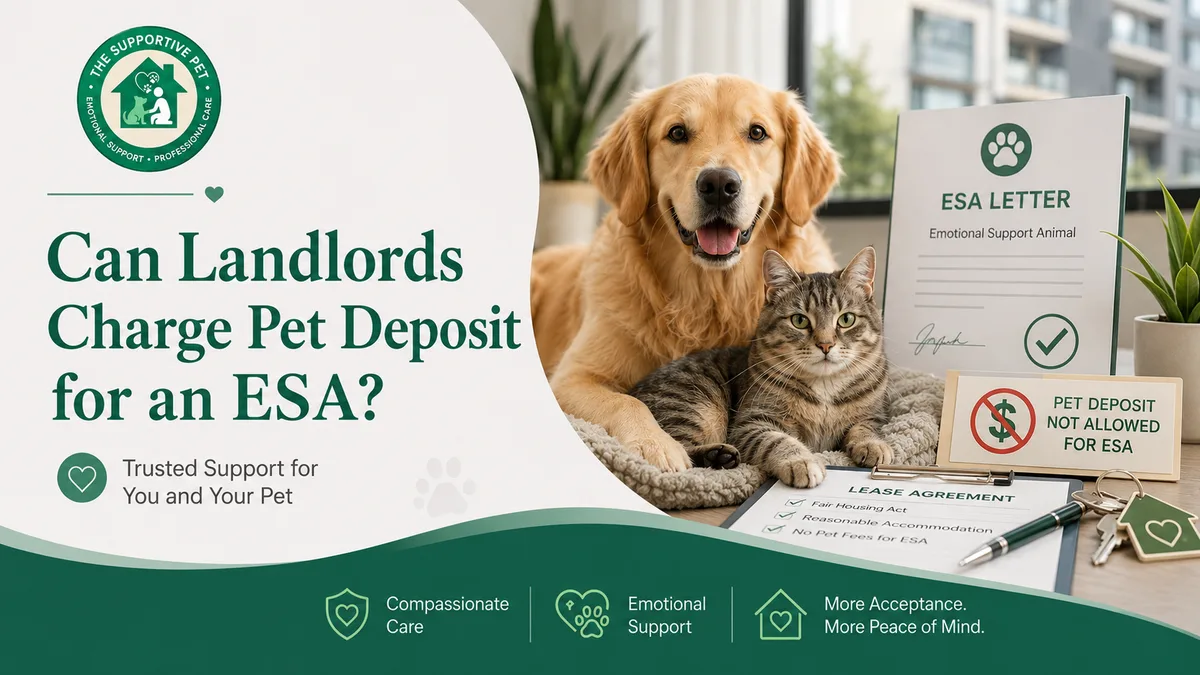
Can a landlord charge a pet deposit for an ESA?
No. Under the Fair Housing Act, a landlord cannot charge a pet deposit, pet fee, or pet rent for an Emotional Support Animal. An ESA is a disability accommodation - not a pet - so standard pet policies do not apply. Charging a pet deposit for an ESA is a violation of the FHA and can be reported to HUD.
Medical Disclaimer: This article is for informational purposes only and does not constitute medical or legal advice. Consult a qualified mental health professional before making decisions about your care. If you or someone you know is in crisis, call or text 988 (Suicide & Crisis Lifeline, available 24/7).
The clear rule: no pet deposit for an ESA
Under the Fair Housing Act, a landlord cannot charge a pet deposit, pet fee, monthly pet rent, or any other charge specifically tied to your emotional support animal. This rule is unambiguous. An ESA is not a pet under the FHA - it is a reasonable accommodation for a disability. Pet policies, including all associated fees, do not apply to disability accommodations.
Pet deposit exemptions are part of the broader FHA protections for ESA owners. See also: your full ESA housing rights guide, ESA rights in HOA communities, and how to respond if denied.
This protection exists because charging a pet deposit for an ESA would effectively penalize a person for having a disability. The FHA treats ESA accommodation similarly to other disability accommodations - a landlord cannot charge you extra for a wheelchair ramp, a grab bar, or an accessible unit. The same logic applies to an ESA.
What landlords can and cannot charge: the complete breakdown
What they cannot charge
- Pet deposit: A lump sum charged upfront for potential pet-related damage. Illegal for ESA owners.
- Pet fee (non-refundable): A one-time fee charged for keeping a pet in the unit. Illegal for ESA owners.
- Monthly pet rent: An additional monthly charge on top of base rent for tenants with pets. Illegal for ESA owners.
- Application fees that include a pet surcharge: If an application includes a line item for pets that adds to the fee, that surcharge cannot apply to ESA owners.
- Breed or size surcharges: Some landlords charge higher pet fees for larger breeds or certain species. These fees cannot be applied to any ESA regardless of species, size, or breed.
What they can charge
- Standard security deposit: The same security deposit all tenants pay. This applies to ESA owners just like any other tenant.
- Actual damage charges: If your ESA causes property damage, the landlord can charge for the actual cost of repair - typically deducted from your security deposit or billed separately if damage exceeds the deposit. This is the same standard that applies to all tenant-caused damage.
- Standard cleaning fees if documented: If your ESA causes documented cleaning costs beyond normal wear and tear (deep carpet cleaning after shedding, for example), these can be charged as actual damage - not as a preemptive pet fee.
The damage liability nuance: what you are responsible for
This is the most important nuance in ESA housing law and the area where tenants most often misunderstand their obligations. The prohibition on pet deposits does not exempt you from paying for damage your ESA causes.
The distinction is:
- Pet deposit (illegal for ESA): A preemptive charge collected before any damage occurs, based on the assumption that a pet will cause damage. You cannot be charged this.
- Damage liability (your responsibility): Actual, documented damage your ESA causes to the property. You are responsible for this, just as you are responsible for any damage you or your guests cause.
In practice, this means you should document the condition of your unit at move-in (photos, written notes) and maintain open communication with your landlord if any damage occurs during your tenancy. If your ESA scratches floors, chews furniture, or causes odor damage requiring remediation, you are financially responsible for those costs - through the standard security deposit mechanism.
Breed and weight restrictions: the evolving legal picture
This is the gray area that generates the most disputes in ESA housing law, and the law has evolved meaningfully through HUD guidance and court decisions over the past several years.
The current legal position:
- Blanket breed restrictions (e.g., "no pit bulls," "no Rottweilers," "no dogs over 50 lbs") are pet policies. Because ESAs are not pets under the FHA, these policies cannot be automatically applied to ESA accommodation requests.
- Landlords must conduct an individualized assessment of each ESA accommodation request. They cannot apply a breed ban categorically without examining whether the specific animal poses a direct threat.
- The direct threat standard is specific: the landlord must be able to demonstrate, based on objective evidence about the individual animal, that it poses a direct threat to the health or safety of others. A general breed stereotype does not satisfy this standard.
- The burden of establishing direct threat falls on the landlord, not the tenant. You do not need to prove your dog is safe; the landlord needs to prove they are unsafe based on individualized evidence.
"'We don't allow large dogs' or 'no pit bulls' are pet policies. They are not valid reasons to deny an ESA accommodation. The landlord's obligation is to evaluate the specific animal and demonstrate, with concrete evidence, that this particular animal poses a direct threat. Generalized breed assumptions do not meet that legal standard."
- Chetna Giri, Head of Legal & Compliance
What "direct threat" actually means legally
Landlords can legitimately deny an ESA accommodation if they can demonstrate that the specific animal poses a direct threat to the health or safety of other tenants or the property. This standard is high and specific:
- The threat must be direct - not speculative, not based on general statistics about the breed, and not based on another tenant's discomfort.
- The threat must be based on specific, objective evidence about the individual animal - documented aggressive behavior, a prior bite incident, or veterinary evidence of dangerous behavior.
- The landlord must consider whether reasonable mitigation could address the concern (muzzle when in common areas, restricted elevator access, etc.) before denying outright.
- A landlord who denies based on breed alone - without individualized evidence - is likely violating the FHA.
If your ESA accommodation request is denied based on your animal's breed or size, ask the landlord for the specific legal basis for their denial in writing. If they cannot point to concrete, individualized evidence of direct threat, their denial is likely unlawful.
What to do if a landlord charges you a pet fee for your ESA
If you have submitted a valid ESA letter and your landlord is still charging - or has already charged - a pet deposit or fee, here is the correct sequence of steps:
- Put your objection in writing: Send an email or letter to your landlord stating that under the Fair Housing Act, pet deposits and fees cannot be applied to emotional support animals. Request a refund of any charged fees and removal of any pending charges. Cite the FHA (42 U.S.C. § 3604(f)) explicitly.
- Wait for a response: Give your landlord a reasonable opportunity to correct the situation - 5 to 10 business days is appropriate. Most landlords correct this when it is formally raised in writing because they know the law is clear.
- Escalate if they refuse: If your landlord refuses to refund the fee or continues to charge pet fees after a formal written request, file a complaint with HUD (hud.gov/complaint) or your state fair housing agency. Charging a pet fee for a disability accommodation after being formally notified of the FHA prohibition is a fair housing violation.
- Contact The Supportive Pet support: If your letter came from us, our dispute support team can contact your landlord directly to document the FHA requirements. This resolves most disputes without the need for a formal complaint.
ESA fees at move-in: how to prevent the problem before it starts
The best approach is to address fees proactively when you submit your accommodation request - before any fee is charged. Include in your accommodation request letter a specific statement that you understand no pet deposit, pet fee, or monthly pet rent will be applied to your ESA accommodation. This establishes the expectation in writing from the start and prevents misunderstanding or "policy default" charges.
Ready to get your ESA letter? Learn about ESA letters for housing, view pricing, or start your evaluation now.
Frequently Asked Questions
Can a landlord charge a pet deposit for an ESA?
No. Under the Fair Housing Act, a landlord cannot charge a pet deposit, pet fee, or pet rent for an Emotional Support Animal. An ESA is a disability accommodation - not a pet - so standard pet policies do not apply. Charging a pet deposit for an ESA is a violation of the FHA and can be reported to HUD.
Is a landlord allowed to enforce breed restrictions for an ESA?
Not automatically. HUD guidance and court decisions generally hold that blanket breed restrictions must yield to ESA accommodation requests on a case-by-case basis. A landlord can only deny accommodation for a specific animal if they can document a direct threat based on that individual animal's behavior - not a generalized breed assumption.
What happens if my ESA causes property damage?
You are financially responsible for actual damage caused by your ESA, even though the landlord cannot charge a pet deposit in advance. Damage is typically addressed through the standard security deposit or a repair charge. Document the condition of the property when you move in and maintain open communication with your landlord if any damage occurs.
Is an ESA considered a pet under the law?
No. Under the Fair Housing Act, an ESA is classified as a disability accommodation - not a pet. This distinction matters because it means pet policies, pet deposits, pet fees, and breed restrictions cannot legally be applied to an ESA. The FHA treats ESA accommodation similarly to other disability accommodations like wheelchair ramps or grab bars.
See our articles highlighted in Google Search
Add The Supportive Pet as a preferred source - your results, your way.