
Does Alabama have its own ESA housing law?
Yes. The Alabama Fair Housing Act (Alabama Code § 24-8-1 et seq.) mirrors the federal FHA and is enforced by the Alabama Attorney General's Civil Rights Division. A valid ESA letter from a licensed clinician is what landlords can request and verify.
Medical Disclaimer: This article is for informational purposes only and does not constitute medical or legal advice. Consult a qualified mental health professional before making decisions about your care. If you or someone you know is in crisis, call or text 988 (Suicide & Crisis Lifeline, available 24/7).
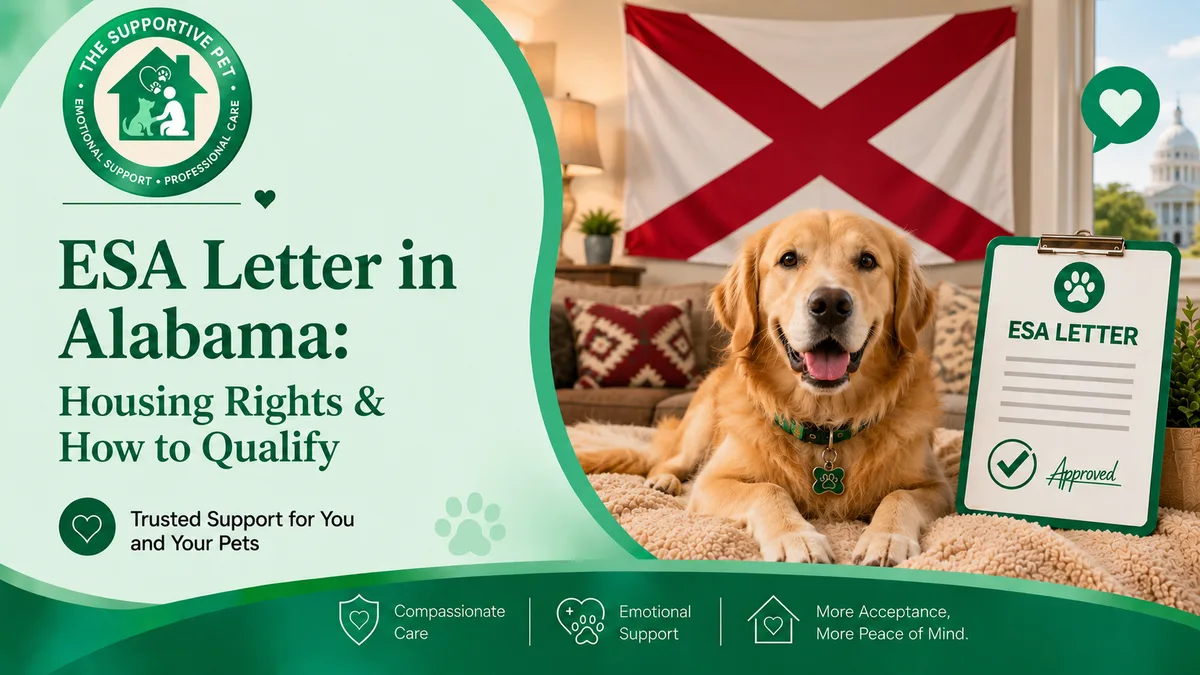
Alabama renters with emotional support animals are protected by the federal Fair Housing Act regardless of whether their landlord has a no-pet policy. From Birmingham's Southside and Homewood apartment market to Huntsville's booming tech-corridor rentals, Alabama landlords cannot legally deny housing, charge pet fees, or enforce breed restrictions when you present a valid ESA letter from a licensed clinician.
ESA Housing Rights in Alabama
Alabama ESA owners are primarily protected by the federal Fair Housing Act (FHA), which applies in all 50 states. Alabama also has the Alabama Fair Housing Act (Alabama Code § 24-8-1 et seq.), which mirrors the federal law and is enforced by the Alabama Attorney General's Civil Rights Division. Both laws require landlords to grant reasonable accommodation for documented ESA owners regardless of no-pet policies, breed restrictions, or weight limits.
Alabama's rental market is growing rapidly, particularly in Birmingham (Southside, Homewood, Vestavia Hills), Huntsville (surrounding the Cummings Research Park and Redstone Arsenal), and Mobile. Pet deposits in these markets can run $200-$500 - documented ESA owners are legally exempt from all pet-related charges.
What Alabama Landlords Must Do
- Grant reasonable accommodation for tenants with a valid ESA letter from a licensed clinician
- Waive pet deposits, monthly pet rent, and pet move-in fees for documented ESAs
- Accept telehealth-issued ESA letters - online evaluations are fully valid in Alabama
- Respond to accommodation requests in a timely good-faith manner
What Alabama Landlords Cannot Do
- Enforce breed, weight, or size restrictions against a documented ESA
- Charge any pet-related fee for a documented ESA
- Require ESA registration certificates or vest documentation - these have no legal standing
- Ask for your specific psychiatric diagnosis or medical records
- Deny accommodation based solely on a no-pet lease clause
Huntsville's Military Community
Huntsville is home to Redstone Arsenal, one of the Army's largest installations, as well as a large defense-contractor workforce. Veterans and active-duty service members managing PTSD and combat-related anxiety frequently use ESA letters for rentals near the arsenal. Alabama military renters have the same FHA protections as all Alabama residents. See our ESA letters for veterans guide for specifics.
How to Get Your Alabama ESA Letter
Alabama residents need an ESA letter from a licensed mental health professional (LMHP) licensed in Alabama - a licensed professional counselor (LPC), licensed clinical social worker (LCSW), psychologist, or psychiatrist. Alabama does not impose a mandatory prior-relationship requirement. A fast telehealth evaluation with an Alabama-licensed clinician is fully valid.
If your dog is individually task-trained to mitigate a psychiatric disability, a PSD letter may provide broader protections. Read the ESA vs. PSD comparison to decide which fits your situation.
Frequently Asked Questions: Alabama ESA Letters
Does Alabama have its own ESA housing law?
Yes. The Alabama Fair Housing Act (Alabama Code § 24-8-1 et seq.) mirrors the federal FHA and is enforced by the Alabama Attorney General's Civil Rights Division. The federal FHA documentation standard applies: a valid letter from a licensed mental health professional is all landlords can request.
Can my Alabama landlord charge a pet deposit for my ESA?
No. Alabama landlords must waive all pet-related charges - deposits, monthly pet rent, and move-in fees - for a documented ESA under the FHA and Alabama Fair Housing Act.
How do I get an ESA letter in Alabama?
You need a letter from an Alabama-licensed LCSW, LPC, psychologist, or psychiatrist. The Supportive Pet connects Alabama residents with AL-licensed clinicians for fast evaluations and letter delivery.
Start your Alabama ESA evaluation at The Supportive Pet. Most Alabama patients receive their letter the same business day.
Qualifying Mental Health Conditions for Alabama ESA Letters
Conditions That Qualify in Alabama
Any mental health condition that substantially limits one or more major life activities can qualify for an ESA letter in Alabama. Common qualifying conditions include anxiety disorders, major depression, PTSD, panic disorder, bipolar disorder, OCD, ADHD, phobias, autism spectrum disorder, and schizophrenia. The condition doesn't need to be severe or disabling - moderate symptoms that regularly impact sleep, work performance, or social functioning qualify. What matters is an evaluation by a licensed clinician who documents your therapeutic need for an emotional support animal.
The Evaluation Process
Getting an ESA letter in Alabama starts with a clinical evaluation by a licensed mental health professional. At The Supportive Pet, Alabama-licensed therapists and clinicians conduct genuine telehealth evaluations - a real conversation about your mental health history and how your ESA helps you manage your condition. There are no instant approvals or automated questionnaires. Most patients receive their ESA letter the same business day they complete their evaluation.
Submitting Your ESA Accommodation Request in Alabama
How to Request ESA Accommodation from Your Landlord
Once you have your ESA letter, send a written reasonable accommodation request to your landlord. Include your name, unit address, a statement that you have a disability-related need for an ESA, and a copy of your letter from a licensed clinician. Send it in writing - email is fine, text is not ideal - and keep copies with timestamps. Your landlord must respond in good faith within a reasonable timeframe (HUD considers 10 business days standard).
If Your Alabama Landlord Denies Your ESA
Most ESA denials in Alabama are illegal. If your landlord refuses without legal justification - denying based on breed, charging pet fees, or simply ignoring your request - you have two main enforcement routes: (1) file a fair housing complaint with HUD at hud.gov/fairhousing within one year, and (2) file a complaint with the Alabama Attorney General's Civil Rights Division. Complaints are free, and successful cases can result in the landlord being required to grant accommodation, refund fees, and pay civil penalties. The Supportive Pet provides free landlord dispute support to every client who receives a letter through our clinicians. Start your Alabama ESA letter evaluation here.
Major Rental Markets in Alabama and What ESA Owners Save
Alabama's largest rental markets - Birmingham and Montgomery - have seen consistent pet fee policies from landlords and property management companies. The typical pet deposit in Birmingham and Montgomery ranges from $250–$500 per animal, with monthly pet rent of $25–$75 per month on top. Over a one-year tenancy, an ESA owner in Alabama can save $600–$1,500 or more in fees that the Fair Housing Act prohibits from being charged for documented emotional support animals.
Alabama relies primarily on federal FHA enforcement through HUD; there is no dedicated state fair housing enforcement agency.
The ESA Accommodation Process in Alabama
Whether you rent in Birmingham and Montgomery or elsewhere in Alabama, the process for establishing your ESA housing rights is the same:
- Obtain your ESA letter: From a licensed mental health professional (LMFT, LCSW, LPC, psychologist, or psychiatrist) licensed in Alabama, including their license number and state
- Submit your accommodation request: Write a brief letter to your landlord or property manager referencing the FHA and requesting reasonable accommodation to keep your emotional support animal
- Wait for response: Your landlord has 10 business days under HUD guidelines to respond
- Keep records: Maintain copies of your ESA letter, accommodation request, and all landlord correspondence
If your landlord denies your accommodation without a legally sufficient basis, you may file a complaint with the HUD Region IV Office (Atlanta) or with HUD directly at hud.gov/complaints.
Rental Markets in Alabama: What to Expect
Landlords in Birmingham and Montgomery range from small individual owners to large corporate property management companies. Corporate management companies often have standardized no-pets policies that apply chain-wide - these policies cannot be enforced against ESA owners. When approaching these companies, provide your ESA letter with a formal written accommodation request and reference HUD's reasonable accommodation guidelines.
Individual landlords are sometimes less familiar with ESA law. Providing a brief, non-confrontational explanation of the FHA and your rights - along with your ESA letter - is often sufficient to resolve any initial resistance. Frame it as a legal requirement they are helping you meet, not a conflict.
Frequently Asked Questions: ESA Letters in Alabama
Can I get an ESA letter from a clinician in Alabama I have never met before?
Yes. A telehealth assessment with a licensed clinician in Alabama is a valid basis for an ESA letter, even for a first appointment. The clinician must conduct a real assessment of your mental health condition and professionally determine that an ESA is part of your treatment plan - not just issue a letter on request. A genuine telehealth consultation meets this standard.
My Alabama landlord says their corporate policy prohibits ESAs. What are my rights?
Corporate no-ESA policies do not override the Fair Housing Act. The FHA is a federal civil rights law that applies regardless of corporate policy. Submit your ESA letter with a formal reasonable accommodation request. If denied, file with the HUD Region IV Office (Atlanta) or HUD.
Can a Alabama HOA prohibit my ESA?
No. Homeowners associations in Alabama are covered by the FHA. Submit your ESA letter and reasonable accommodation request to the HOA board. They must consider your request under the same standards as any housing provider.
What is the additional documentation a Alabama landlord can request?
Landlords can request confirmation that you have a disability (without requiring diagnosis specifics) and that the accommodation is disability-related. They can ask for the clinician's license number and state for verification. They can also request vaccination and licensing records for your animal. They cannot request medical records, therapy notes, or details of your specific diagnosis.
Does Alabama have any state-level ESA laws beyond the federal FHA?
Federal FHA protections are the primary framework in Alabama. Some states have additional protections - if you believe you have been discriminated against, contact the HUD Region IV Office (Atlanta) to understand any state-specific remedies available to you beyond the federal framework.
I am a student living in Alabama - does my university housing qualify for ESA protections?
Yes. University dormitories and campus housing are covered by the FHA. Submit your ESA documentation to your university's disability services office, which will coordinate with housing. Most universities have an established accommodation process that specifically addresses ESAs.
Frequently Asked Questions
Does Alabama have its own ESA housing law?
Yes. The Alabama Fair Housing Act (Alabama Code § 24-8-1 et seq.) mirrors the federal FHA and is enforced by the Alabama Attorney General's Civil Rights Division. A valid ESA letter from a licensed clinician is what landlords can request and verify.
Can my Alabama landlord charge a pet deposit for my ESA?
No. Alabama landlords must waive all pet-related charges for a documented ESA under the federal FHA and Alabama Fair Housing Act. Pet deposits of $200-$500 common in Birmingham and Huntsville do not apply to documented ESA owners.
How do I get an ESA letter in Alabama?
You need a letter from an Alabama-licensed LCSW, LPC, psychologist, or psychiatrist. The Supportive Pet connects Alabama residents with AL-licensed clinicians for same-day delivery.
See our articles highlighted in Google Search
Add The Supportive Pet as a preferred source - your results, your way.