
What is California AB 468 and how does it affect ESA letters?
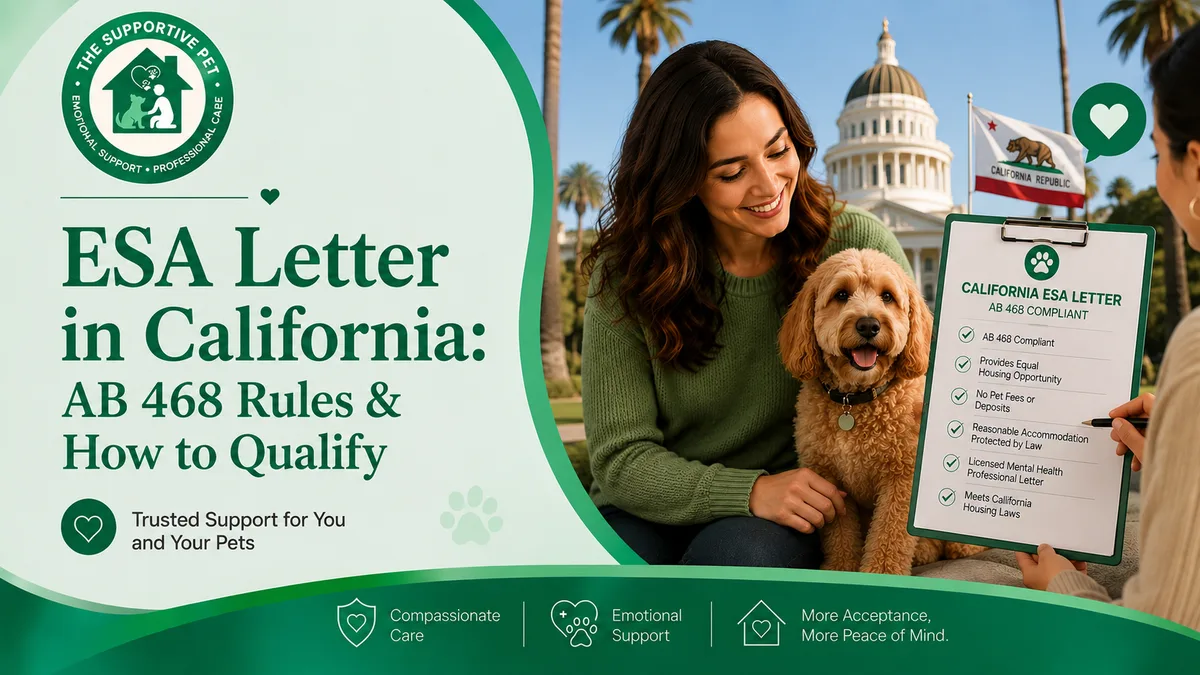
California AB 468, effective January 1, 2022, makes it illegal for any person or business to charge a fee for an emotional support animal letter or documentation unless the person issuing the letter has an established relationship with the client. The law requires that the mental health professional has conducted a clinical evaluation of the client and has established a client-provider relationship for at least 30 days before issuing the ESA documentation. Violating AB 468 is a misdemeanor.
Key Takeaways
- California AB 468 (effective 2022) requires that your ESA letter come from a clinician with whom you have an established relationship of at least 30 days - one-time letter-mill evaluations are illegal in California.
- California's FEHA provides stronger housing protections than the federal FHA, covering more housing types and stricter anti-discrimination enforcement.
- A California-compliant ESA letter from The Supportive Pet satisfies both AB 468 and federal FHA requirements - clinicians establish a bona fide relationship before issuing documentation.
Medical Disclaimer: This article is for informational purposes only and does not constitute medical or legal advice. Consult a qualified mental health professional before making decisions about your care. If you or someone you know is in crisis, call or text 988 (Suicide & Crisis Lifeline, available 24/7).
ESA Letters in California: What Changed with AB 468
Getting an ESA letter in California involves one extra step compared to most other states. California Assembly Bill 468 (AB 468), effective January 1, 2022, added state-level requirements on top of the federal Fair Housing Act.
The core requirement: your ESA letter must come from a licensed mental health professional. You must have an established clinical relationship — defined as at least 30 days. This law was enacted to stop letter mills that issued instant online letters with no real clinical evaluation.
If you are a California resident, this is what you need to understand before you start the ESA letter process.
What California AB 468 Actually Requires
AB 468 (Health & Safety Code § 122318) makes it a misdemeanor for any person to:
- Charge a fee for an ESA letter or documentation unless they have established a client-provider relationship with the individual
- Issue an ESA letter without first conducting a clinical evaluation of the client
- Issue an ESA letter for a client they have not had a relationship with for at least 30 days (with limited exceptions for clients who are already established patients of a licensed professional)
The law also requires that the mental health professional be licensed in California. Out-of-state clinicians cannot legally issue ESA letters for California residents under AB 468.
What this means in practice: instant letter services are illegal in California. If a website promises an ESA letter in minutes with no clinical relationship, that letter is not AB 468-compliant. It will not hold up to landlord or legal scrutiny in California.
California FEHA vs. Federal FHA: What's Stronger in California
California residents benefit from both federal and state-level housing protections for ESA owners. The California Fair Employment and Housing Act (FEHA) provides additional protections beyond the federal Fair Housing Act:
- Broader housing coverage: California FEHA covers virtually all rental housing, including single-family homes rented through a broker - types that have limited exceptions under federal FHA
- Broader disability definition: California's definition of disability under FEHA is broader than the federal definition, making it easier to qualify
- Stronger enforcement: The California Civil Rights Department (CRD) actively investigates and prosecutes housing discrimination complaints
- No pet deposits or fees: Same as federal law - California landlords cannot charge pet fees for documented ESAs
- No breed or size restrictions: Standard pet policies do not apply to documented ESAs in California
What California Landlords Can and Cannot Ask
Under California law and federal FHA, your landlord:
Can legally ask:
- Whether you have a disability (yes/no - not what it is)
- Whether the animal provides disability-related assistance
- For documentation from a licensed mental health professional (your ESA letter)
- To verify the clinician's license with the California Board of Behavioral Sciences or other licensing board
Cannot legally ask:
- Your specific diagnosis or medical records
- Details about your treatment history
- For the animal to be trained, certified, or registered
- For more than one piece of documentation (one valid ESA letter is sufficient)
- For proof of ESA "registration" (there is no official ESA registry - see our guide on ESA registration scams)
How to Get a California-Compliant ESA Letter
To get an ESA letter that complies with both AB 468 and the federal FHA as a California resident:
- Work with a California-licensed clinician - your clinician must be licensed by the California Board of Behavioral Sciences (LCSW, MFT) or the California Board of Psychology (PhD, PsyD) or hold a California medical license (MD, DO). Out-of-state licenses are not sufficient.
- Establish a clinical relationship - AB 468 requires at least 30 days. This means beginning your evaluation and establishing the provider-patient relationship well before you need the letter in hand.
- Complete a real clinical evaluation - the clinician must assess your mental health condition, determine whether it qualifies under the FHA/FEHA, and document the therapeutic nexus between your condition and your animal.
- Receive your letter on clinical letterhead - your letter must include the clinician's California license number, license type, and state of licensure, along with all required nexus language.
At The Supportive Pet, California residents begin with a clinical intake and initial evaluation with a California-licensed clinician. The provider-patient relationship is established on day one. Your letter is issued once the clinical assessment is complete and the AB 468 timeline is satisfied.
What Conditions Qualify for an ESA Letter in California?
California follows the same functional standard as federal law for qualifying mental health conditions: your condition must substantially limit a major life activity. Common qualifying conditions include:
- Anxiety disorders (generalized anxiety, social anxiety, panic disorder)
- Depression and major depressive disorder
- Post-traumatic stress disorder (PTSD)
- ADHD
- Bipolar disorder
- OCD
- Autism spectrum disorder
- Insomnia and sleep disorders related to mental health
- Agoraphobia and other phobias
You do not need a prior formal diagnosis from a different provider. The California-licensed clinician at The Supportive Pet conducts an independent evaluation and makes their own clinical determination. See our full qualifying conditions guide.
If Your California Landlord Denies Your ESA
If your landlord denies your ESA accommodation request unlawfully, you have two primary options in California:
- File a complaint with the California Civil Rights Department (CRD): calcivilrights.ca.gov - California's state-level enforcement is robust and responds faster than federal HUD in most cases
- File a complaint with HUD: hud.gov/fairhousing - federal enforcement option available in all 50 states
Lawful reasons to deny are narrow: the specific animal poses a documented direct threat to others or would cause substantial property damage. A no-pet policy, breed restriction, weight limit, or pet deposit requirement is not a valid reason to deny an accommodation for a documented ESA in California.
The Supportive Pet provides free landlord dispute support for every letter we issue - including help drafting responses to improper denials in California.
Getting Started in California
If you are a California resident, you need an ESA letter that meets both AB 468 and federal FHA requirements. The process starts with a clinical evaluation from a California-licensed mental health professional.
Start your California ESA evaluation at The Supportive Pet. Our California clinicians are licensed by the California Board of Behavioral Sciences and conduct evaluations that satisfy both AB 468 and FHA requirements.
Frequently Asked Questions
What is California AB 468 and how does it affect ESA letters?
California AB 468, effective January 1, 2022, makes it illegal for any person or business to charge a fee for an emotional support animal letter or documentation unless the person issuing the letter has an established relationship with the client. The law requires that the mental health professional has conducted a clinical evaluation of the client and has established a client-provider relationship for at least 30 days before issuing the ESA documentation. Violating AB 468 is a misdemeanor.
Do ESA letters from out-of-state clinicians work in California?
No. Under AB 468 and federal FHA requirements, your ESA letter must come from a licensed mental health professional who is licensed in the state of California. An out-of-state clinician cannot legally issue an ESA letter for a California resident. The Supportive Pet's California evaluation pathway connects you with California-licensed clinicians who comply with AB 468's established relationship requirement.
What rights do California ESA owners have that go beyond federal law?
California's Fair Employment and Housing Act (FEHA) provides stronger protections than the federal FHA in several ways: it covers more housing types (including single-family homes rented through a broker), it has a broader definition of disability, and the California Civil Rights Department enforces violations more aggressively than federal HUD in many cases. California landlords also cannot charge pet fees or pet deposits for documented ESAs - same as under federal law.
Can a California landlord deny my ESA?
A California landlord can only deny an ESA accommodation if the specific animal poses a direct, documented threat to others or would cause substantial property damage, or if the accommodation would impose an undue financial or administrative burden. A no-pet policy alone, breed restrictions, weight limits, or pet fees do not apply to documented ESAs. If your landlord denies your request unlawfully, you can file a complaint with the California Civil Rights Department or HUD.
How long does it take to get an ESA letter in California under AB 468?
Because AB 468 requires an established clinical relationship of at least 30 days before an ESA letter can be issued, California-compliant evaluations are structured to establish this relationship. At The Supportive Pet, California patients begin with a clinical intake and initial telehealth evaluation, establishing the provider relationship on day one. The letter itself can be issued once the required relationship period and clinical assessment are complete.
See our articles highlighted in Google Search
Add The Supportive Pet as a preferred source - your results, your way.