

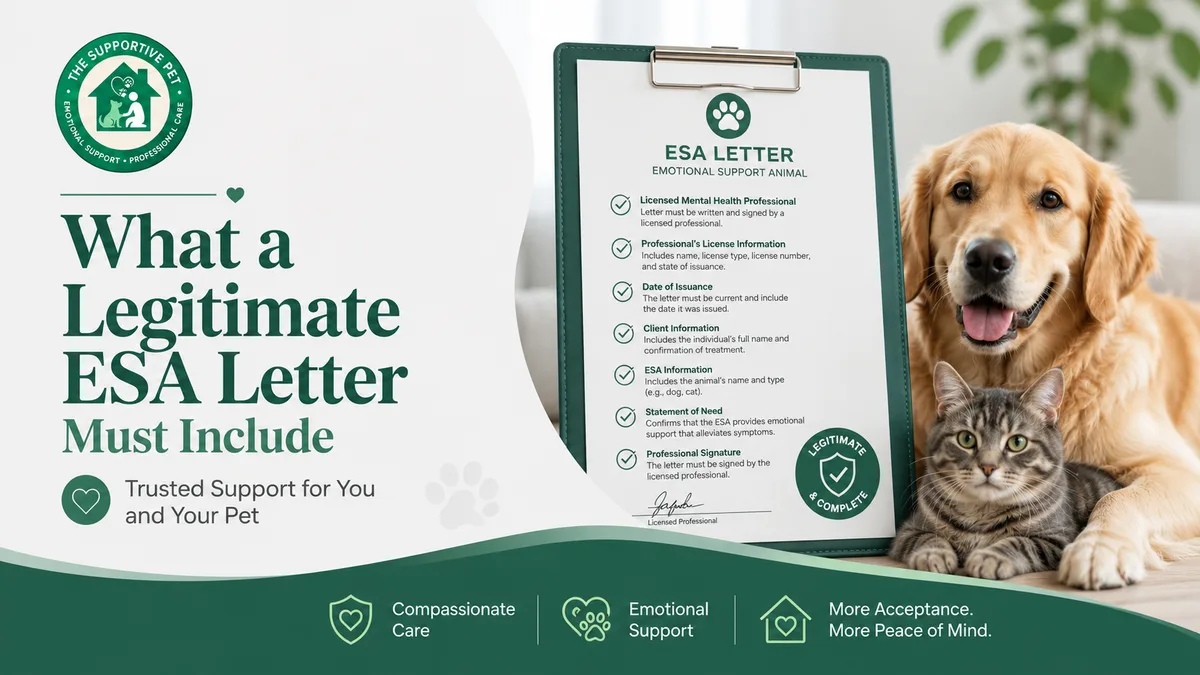
What does an ESA letter look like?
A valid ESA letter is typically a 1–2 page letter on professional letterhead (or a digital document with equivalent identifying information). It includes: the clinician's name, title, and license number; the date of issuance; a statement that the patient has a qualifying mental health disability under the Fair Housing Act; a statement that an emotional support animal is needed as part of the patient's treatment; and the clinician's original signature. It is addressed to the housing provider or 'To Whom It May Concern.'
Key Takeaways
- A valid ESA letter must be signed by a licensed mental health professional with their license number and state of licensure - a blank template filled in by anyone else has no legal standing.
- The letter must reflect a real clinical evaluation; its value comes from the clinician's professional judgment, not its format or wording.
- You can use this article's breakdown to verify any ESA letter you receive - or to understand exactly what your landlord is entitled to see.
Medical Disclaimer: This article is for informational purposes only and does not constitute medical or legal advice. Consult a qualified mental health professional before making decisions about your care. If you or someone you know is in crisis, call or text 988 (Suicide & Crisis Lifeline, available 24/7).
Why the Format of Your ESA Letter Matters
People searching for an "ESA letter template" often want one of two things: to understand what a valid letter looks like before requesting one, or to find a blank document they can fill in themselves. This article addresses both - and explains why the second approach will not work.
The legal foundation of an ESA letter is not its wording. It is the professional judgment of the licensed clinician who signs it. The letter works because a licensed mental health professional has evaluated your condition and made a clinical determination that an emotional support animal is part of your treatment. That judgment - backed by the clinician's verifiable credentials - is what gives the letter standing under the Fair Housing Act (42 U.S.C. § 3604). A template without a real evaluation behind it is just a piece of paper.
What a Valid ESA Letter Must Contain
Here is a breakdown of every element a valid 2026 ESA letter should include, and why each one matters:
1. Provider Identification
The letter must identify the clinician by:
- Full legal name
- Professional title and license type (e.g., LCSW, LPC, PhD, PsyD, MD)
- License number
- State of licensure
- Contact information (address, phone, or email)
This information allows a landlord - or an attorney - to verify the clinician's credentials directly through the state licensing board. A letter without a verifiable license number is not independently verifiable and may be rejected.
2. Patient Information
The letter should identify you as the patient. It typically includes your name and may include the date of evaluation. It does not need to include your address, Social Security number, or any other identifying information beyond your name.
3. Disability Statement
The letter must state that you have a disability that qualifies under the Fair Housing Act. The FHA defines disability as a physical or mental impairment that substantially limits one or more major life activities. The letter does not need to name your specific diagnosis - your landlord is not entitled to that level of detail. The statement that a qualifying disability exists is sufficient.
4. Animal Necessity Statement
The letter must state that an emotional support animal is necessary for your disability-related need, or that the animal is part of your ongoing mental health treatment. This is the clinical nexus statement - the clinician's professional judgment connecting your disability to your need for the animal.
5. Date and Signature
The letter must be signed by the clinician and dated. Most landlords expect a letter dated within the past 12 months. An undated letter or a letter without an original signature (physical or secure digital) is incomplete.
What a Valid ESA Letter Does NOT Need
Understanding what is not required helps you push back if a landlord makes improper demands:
- Your specific diagnosis: A landlord cannot require this. The letter states that a qualifying disability exists - full stop.
- Your full medical history: The FHA does not authorize landlords to demand medical records or detailed treatment histories.
- Your animal's breed or training records: Unlike service animals, ESAs have no training requirements. Breed restrictions cannot legally apply to a documented ESA.
- A "certified" or "registered" animal: No such certification is legally required. There is no official national ESA registry.
- A specific registration number or certificate: Landlords cannot require you to use a specific third-party service or provide a registration ID.
Sample ESA Letter Format (What to Look For)
A legitimate ESA letter follows this general structure:
[Provider Letterhead or Header]
[Clinician Name], [Title]
Licensed [License Type], License No. [XXXXX] - [State]
[Date]

To Whom It May Concern:

I am a licensed [license type] practicing in the state of [State]. I am providing this letter on behalf of my patient, [Patient Name].

[Patient Name] has been under my professional care and has a mental health disability that substantially limits one or more major life activities as defined by the Fair Housing Act (42 U.S.C. § 3604).

As part of [his/her/their] ongoing treatment, I have determined that an emotional support animal is necessary to assist [Patient Name] with [his/her/their] disability-related needs.

Please grant the reasonable accommodation requested under the Fair Housing Act to allow [Patient Name] to have an emotional support animal in their housing.

Sincerely,
[Signature]
[Clinician Name], [Title]
License No. [XXXXX] - [State]
Note: This is a format illustration only. A valid ESA letter must be issued by a licensed mental health professional who has actually evaluated your condition. Do not fill in your name and print this as your ESA letter - it will not hold up with a landlord.
How to Get a Real ESA Letter
At The Supportive Pet, the process starts with a clinical intake evaluation - real questions about your mental health history and how your animal helps manage your condition. A licensed clinician in your state reviews your case. If approved, your letter is issued by that clinician, on their professional credentials, and emailed to you typically within hours during business hours.
The result is a letter that meets every element described above - one your landlord can verify, one that holds up to scrutiny, and one that gives you enforceable Fair Housing Act rights.
Start your evaluation at The Supportive Pet to find out if you qualify.
Frequently Asked Questions
What does an ESA letter look like?
A valid ESA letter is typically a 1–2 page letter on professional letterhead (or a digital document with equivalent identifying information). It includes: the clinician's name, title, and license number; the date of issuance; a statement that the patient has a qualifying mental health disability under the Fair Housing Act; a statement that an emotional support animal is needed as part of the patient's treatment; and the clinician's original signature. It is addressed to the housing provider or 'To Whom It May Concern.'
Can I write my own ESA letter or use a free template?
No. A self-written ESA letter or a template downloaded from the internet is not valid under the Fair Housing Act. The legal weight of an ESA letter comes from the licensed clinician's professional attestation - their knowledge of your condition, their clinical judgment that an ESA is therapeutically necessary, and their professional accountability (their license number can be verified by a landlord). A form letter without these elements is not reliable documentation under the FHA and will be rejected by most landlords.
What exactly must an ESA letter include to be valid?
Under the FHA, a valid ESA letter must: (1) Come from a licensed healthcare professional - a licensed therapist (LCSW, LPC, LMFT), psychologist (PhD/PsyD), or psychiatrist (MD/DO) with an active state license. (2) State that you have a disability that qualifies under the Fair Housing Act. (3) State that an emotional support animal is necessary for your disability-related need. (4) Include the clinician's license number, license type, and state of licensure. (5) Include the clinician's signature and the letter's date. It does not need to disclose your specific diagnosis.
My ESA letter doesn't have a license number. Is it still valid?
Probably not. A landlord can request reliable documentation - and a letter without a verifiable license number cannot be independently verified. Most legitimate ESA letters include the clinician's full license information precisely because this is what allows a landlord to confirm the letter's authenticity. If your letter is missing this information, contact the provider who issued it to get a corrected version, or consider obtaining a new letter from a verified service.
How often do I need to renew my ESA letter?
The FHA does not set a specific expiration period, but most landlords expect documentation dated within the past 12 months. As a practical matter, annual renewal ensures your letter remains current and reflects your ongoing therapeutic relationship. The Supportive Pet offers straightforward annual renewal evaluations for existing patients.
See our articles highlighted in Google Search
Add The Supportive Pet as a preferred source - your results, your way.