
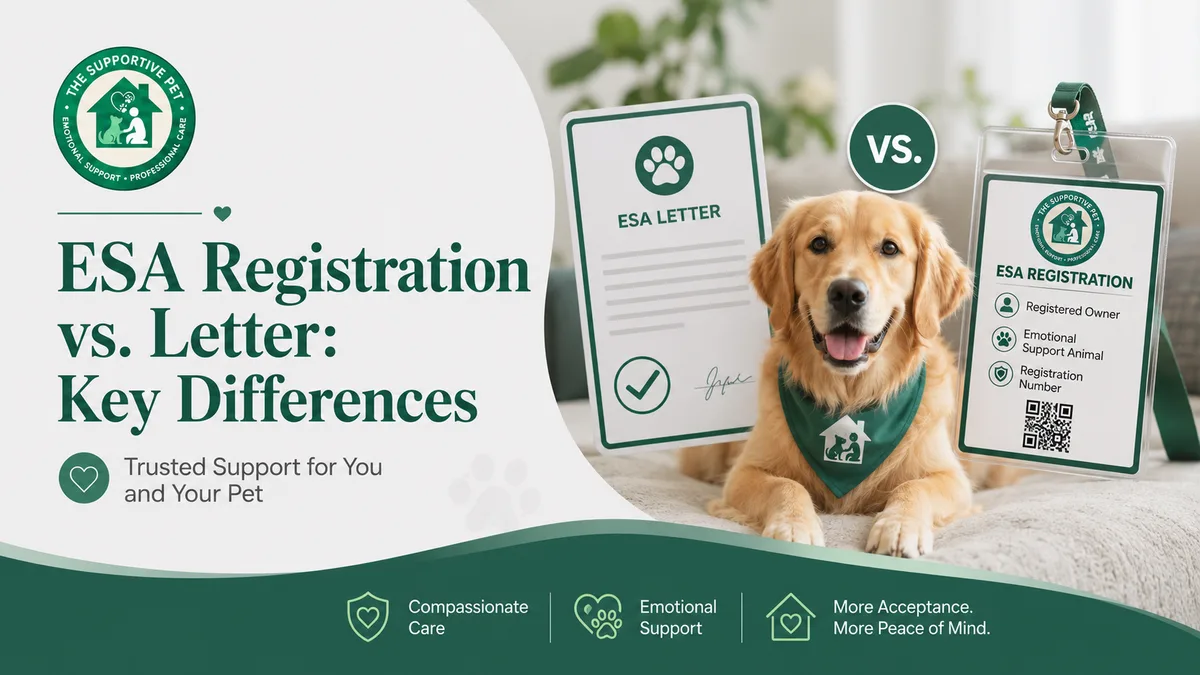
Is ESA registration required by law?
No. The Fair Housing Act (42 U.S.C. § 3604) does not require ESA registration in any database. No federal agency maintains an official emotional support animal registry. No state law in the US requires registration either. A landlord has no legal basis to require a registration certificate or ID card as a condition of granting your accommodation request.
Key Takeaways
- No federal or state law requires ESA registration in any database. The Fair Housing Act (42 U.S.C. § 3604) does not mention registration at all.
- Websites selling ESA registration certificates, ID cards, or vest kits have no legal standing - landlords are not required to accept these documents.
- The only documentation that carries weight under the FHA is a letter from a licensed mental health professional who has evaluated your condition.
Medical Disclaimer: This article is for informational purposes only and does not constitute medical or legal advice. Consult a qualified mental health professional before making decisions about your care. If you or someone you know is in crisis, call or text 988 (Suicide & Crisis Lifeline, available 24/7).
The ESA Registration Industry Explained
Search for "ESA registration" online and you will find dozens of websites offering emotional support animal registration for anywhere from $29 to $200. They sell certificates printed on official-looking paper, laminated ID cards, vests, and even custom "national registry" numbers. The implication is that registering your animal makes it officially recognized - giving it the same rights as a trained service dog.
None of this is true. No federal or state law requires ESA registration. The Fair Housing Act (42 U.S.C. § 3604) - the law that actually governs your right to live with an emotional support animal - does not mention registration at all. There is no official national ESA database maintained by any government agency. The organizations selling these products are private companies with no legal authority to create binding ESA status.
What the Fair Housing Act Actually Requires
The FHA gives people with disabilities the right to request a "reasonable accommodation" in housing. For ESA owners, that means the right to keep your emotional support animal in housing that otherwise prohibits pets, and the right to do so without paying pet deposits or fees.
To exercise this right, a landlord may request "reliable documentation" confirming that you have a disability-related need for the accommodation. The FHA's implementing regulations describe what counts as reliable documentation: a statement from a licensed healthcare provider who has personal knowledge of your condition and can confirm the disability-related need for the animal.
What that means in practice: a letter signed by a licensed mental health professional - a licensed therapist, psychologist, clinical social worker, or psychiatrist - who has evaluated you and determined that an ESA is part of your treatment or necessary for your disability. A registration certificate from a private website is not this documentation, and landlords have no obligation to accept it.
Why Landlords Reject Registration Certificates
Experienced property managers and their attorneys are increasingly familiar with the difference between a legitimate ESA letter and a registration certificate. Several reasons they reject certificates:
- No clinician attestation: A certificate merely states that you paid a fee. It contains no clinical evaluation, no professional judgment, and no licensed provider's signature. It provides no basis for a landlord to evaluate whether the need is genuine.
- No verifiable license: A valid ESA letter includes the clinician's license number and state of licensure. A landlord can verify this with a 30-second search on the state licensing board's website. A certificate cannot be verified the same way.
- No diagnosis or nexus statement: The letter must connect your disability to your need for the animal. A certificate provides no such connection.
- Landlord liability: If a landlord accepts a certificate and the tenant later causes damage or other issues, the landlord cannot demonstrate they complied with FHA reasonable accommodation standards - because they accepted documentation that was never legally sufficient.
The 5 Warning Signs of an ESA Scam
Thousands of people are misled by these services every year. Here is how to identify them:
- The main product is a certificate, ID card, or vest. Legitimate services deliver a professional letter - not merchandise.
- No licensed mental health professional is involved. If the site does not explicitly connect you with a licensed clinician for a real evaluation, no valid ESA letter can result.
- The process takes under 5 minutes. A clinical evaluation that meets FHA standards requires real questions about your condition, history, and how an animal helps. It cannot be completed in 3 minutes.
- They claim a national or government registry. No such registry exists. This is a sales tactic, not a legal process.
- The price is $29–$69 for everything. A legitimate telehealth evaluation with a licensed clinician has actual clinical overhead. Suspiciously low prices signal that no real evaluation is happening.
What a Valid ESA Letter Looks Like
A legitimate ESA letter is printed on the clinician's professional letterhead or includes equivalent identifying information. It contains:
- The clinician's full name, professional title, and license type (LCSW, LPC, PhD, PsyD, MD, etc.)
- The clinician's license number and state of licensure
- A statement that you are a patient under their care with a qualifying disability
- A statement that an emotional support animal is therapeutically necessary or beneficial for your condition
- The clinician's original signature and the date
The letter does not need to name your specific diagnosis - a landlord may not require that level of disclosure. It also does not need to specify your animal's breed or name, though some providers include this.
Getting a Valid ESA Letter Through The Supportive Pet
At The Supportive Pet, every ESA letter is issued by a licensed mental health professional who holds an active license in your state. Your evaluation is conducted via telehealth - a real clinical assessment, not a checkbox form. You are never charged until a clinician approves your case.
Your letter arrives by email, signed on professional letterhead with your clinician's full credentials. It meets FHA standards and is appropriate to submit directly to your landlord, property manager, or HOA as a reasonable accommodation request.
No certificate. No ID card. No vest. A real letter from a real clinician - the only documentation that gives you enforceable housing rights.
Start your evaluation at The Supportive Pet and find out if you qualify today.
Frequently Asked Questions
Is ESA registration required by law?
No. The Fair Housing Act (42 U.S.C. § 3604) does not require ESA registration in any database. No federal agency maintains an official emotional support animal registry. No state law in the US requires registration either. A landlord has no legal basis to require a registration certificate or ID card as a condition of granting your accommodation request.
What does an ESA registration certificate actually do legally?
Nothing - at least not in the way the selling websites imply. A registration certificate from an unofficial website is not recognized under the Fair Housing Act. Landlords are not legally required to accept it, and many will reject accommodation requests backed only by a certificate. The only documentation with FHA standing is a letter from a licensed mental health professional who has evaluated your condition and confirmed a disability-related need for your emotional support animal.
How do I know if an ESA service is a scam?
Watch for these red flags: (1) The site sells a 'certificate,' 'registration,' 'ID card,' or 'vest kit' as the primary product. (2) No licensed mental health professional is involved. (3) The process takes under 5 minutes with no real clinical questions. (4) The price is suspiciously low (often $29–$69). (5) The site claims to list you in a national database. A legitimate service connects you with a licensed clinician for a real evaluation, and the deliverable is a signed letter on professional letterhead - not a laminated card.
What must an ESA letter include to be valid under the FHA?
A valid ESA letter must: (1) Be written by a licensed mental health professional (LMHP) - such as a licensed therapist, psychologist, or psychiatrist - who holds an active license in the state where you reside. (2) State that you have a disability that qualifies under the Fair Housing Act. (3) State that an emotional support animal is part of your treatment or necessary for your disability-related need. (4) Include the clinician's full name, license type, license number, state of licensure, and signature. (5) Be dated within the past 12 months in most cases. It does not need to name your diagnosis or disclose detailed medical history.
Can a landlord require a specific ESA registry certificate?
No. Under the Fair Housing Act and HUD's guidance, landlords cannot require tenants to use a specific service, registry, or database. They can request reliable documentation confirming disability-related need - which a proper LMHP letter satisfies - but they cannot mandate third-party certification, registration numbers, or ID cards as a condition of granting accommodation.
See our articles highlighted in Google Search
Add The Supportive Pet as a preferred source - your results, your way.