
Does Virginia have its own ESA housing law?
Yes. Virginia Fair Housing Law (Va. Code § 36-96.1 et seq.) enforced by the Virginia Real Estate Board's Fair Housing Office mirrors the federal FHA. Virginia landlords must honor valid ESA letters from licensed clinicians and cannot charge pet fees or enforce breed restrictions.
Medical Disclaimer: This article is for informational purposes only and does not constitute medical or legal advice. Consult a qualified mental health professional before making decisions about your care. If you or someone you know is in crisis, call or text 988 (Suicide & Crisis Lifeline, available 24/7).
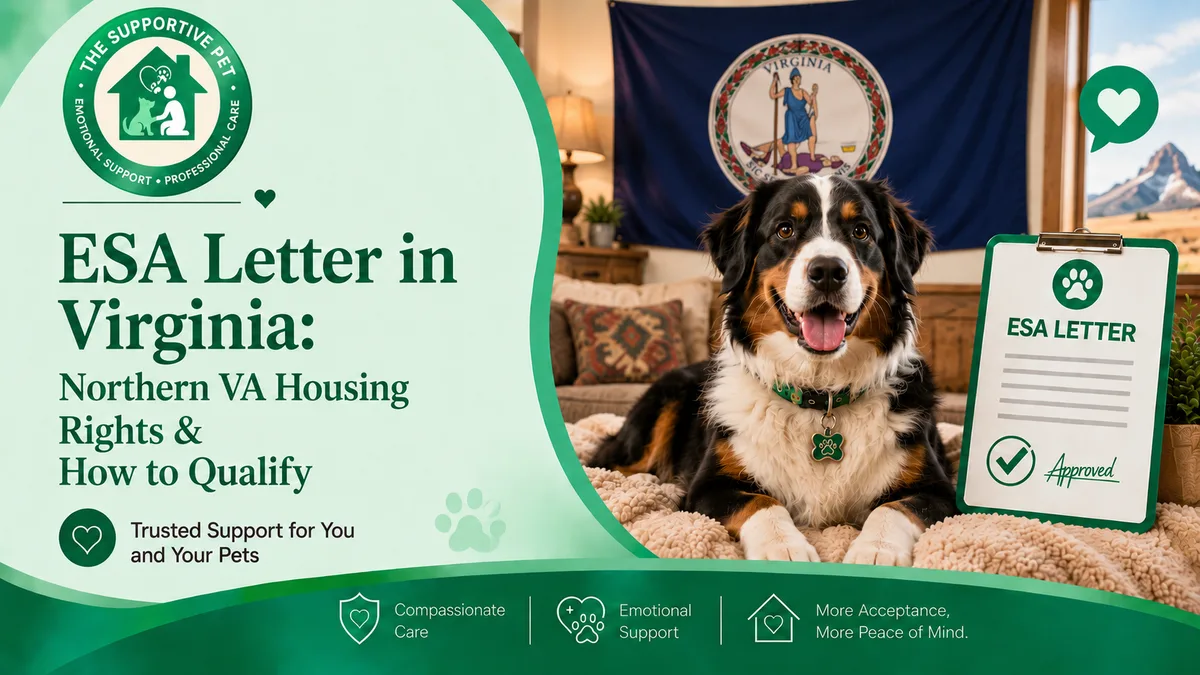
Virginia renters with emotional support animals are protected by both the federal Fair Housing Act and Virginia Fair Housing Law. Northern Virginia's Arlington, Alexandria, and Fairfax County are among the most expensive rental markets in the mid-Atlantic; Richmond's Church Hill, Scott's Addition, and Manchester neighborhoods are rapidly appreciating; and Norfolk and Virginia Beach serve a large military and veteran population. ESA documentation saves Virginia renters significant money and prevents housing denial.
ESA Housing Rights in Virginia
Federal Protections That Apply in Virginia
The Fair Housing Act (FHA) is a federal law that applies in every state, including Virginia. It requires landlords to grant reasonable accommodations to tenants with documented disabilities - including emotional support animals. Your landlord cannot legally refuse an ESA accommodation request backed by a valid letter from a licensed mental health professional (LMHP), regardless of what the lease says about pets.
Virginia State Housing Law
Virginia ESA owners are protected by the federal Fair Housing Act (FHA) and Virginia Fair Housing Law (Va. Code § 36-96.1 et seq.), enforced by the Virginia Real Estate Board's Fair Housing Office and the Virginia Attorney General's Office. Virginia's fair housing law mirrors the federal FHA and provides state-level enforcement. Virginia does not have a state-specific ESA anti-fraud statute.
Northern Virginia - Arlington, Alexandria, Fairfax, and Prince William County - is one of the highest-cost rental markets in the country, driven by federal government employment and the tech sector. Pet deposits of $400-$700 and monthly pet rent of $50-$100 are common in the DC suburbs. Richmond's revitalizing neighborhoods and the Hampton Roads area (Norfolk, Virginia Beach, Hampton, Newport News) also have active rental markets with strict pet policies. Documented ESA owners are exempt from all pet-related charges throughout Virginia.
What ESA Documentation You Need in Virginia
To request ESA accommodation in Virginia, you need a letter from a licensed mental health professional - a therapist, psychologist, psychiatrist, licensed clinical social worker (LCSW), or similar credential. The letter must state that you have a qualifying disability and that your ESA provides therapeutic benefit. Your landlord is entitled to documentation; they are not entitled to your diagnosis, your medical records, or any special registry or certification.
Qualifying Mental Health Conditions in Virginia
Conditions That Typically Qualify
Under the FHA, a qualifying disability is any mental or physical condition that substantially limits one or more major life activities. The most common qualifying mental health conditions for an ESA letter include anxiety disorders, depression, PTSD, panic disorder, bipolar disorder, OCD, ADHD, and phobias. Autism spectrum disorder (ASD) and schizophrenia also commonly qualify. You do not need a severe diagnosis - even moderate anxiety that impacts sleep, work, or social function can qualify.
The Evaluation Process
Getting an ESA letter starts with a clinical evaluation - not a test you pass or fail, but a genuine conversation with a licensed clinician about how your mental health condition affects your daily life. The clinician assesses whether your condition qualifies under DSM-5 criteria and whether an emotional support animal provides therapeutic benefit. At The Supportive Pet, evaluations are conducted by Virginia-licensed clinicians via telehealth. Most patients receive their letter the same business day.
What Virginia Landlords Must and Cannot Do
Mandatory Accommodations
- Grant reasonable accommodation for tenants with a valid ESA letter from a licensed clinician
- Waive all pet-related fees - deposits, monthly pet rent, and move-in fees - for documented ESA owners
- Accept telehealth-issued ESA letters; online evaluations are fully valid in Virginia
- Respond to accommodation requests in a timely, good-faith manner
Actions Virginia Landlords Cannot Take
- Enforce breed, weight, or size restrictions against a documented ESA
- Charge any pet-related fee for a documented ESA
- Require ESA registration certificates, ID cards, or vests - these have no legal standing
- Ask for your specific psychiatric diagnosis or medical records
- Deny housing based solely on the fact that you have an ESA
What Virginia Landlords Can Legitimately Request
Your landlord is entitled to request written documentation from a licensed mental health professional confirming your disability-related need for an ESA. They may ask for the clinician's license number, state of licensure, and contact information. They may not demand that you use a specific provider, pay for a landlord-verification service, or provide documentation beyond what The Fair Housing Act specifies.
How to Submit Your ESA Request in Virginia
Getting Your Virginia ESA Letter
Virginia residents need an ESA letter from a Virginia-licensed LCSW, LPC, psychologist, or psychiatrist. Virginia does not require a prior treatment relationship. fast telehealth evaluations are fully valid.
Start your Virginia ESA evaluation at The Supportive Pet. Most Virginia patients receive their letter the same business day.
Writing Your Accommodation Request to Your Landlord
Once you have your ESA letter, submit a written reasonable accommodation request to your landlord. Include your name, unit address, the fact that you have a disability-related need for an ESA, and a copy of your ESA letter. Keep a copy of everything you send and note the date. Your landlord must respond in a reasonable timeframe - HUD considers 10 business days a standard expectation. If they delay or deny without legal justification, you have grounds to file a complaint.
What to Do If Your Virginia Landlord Denies Your ESA
Filing a HUD Complaint
If a Virginia landlord denies a valid ESA accommodation request, refuses to waive pet fees, or retaliates against you for requesting accommodation, you can file a complaint with the U.S. Department of Housing and Urban Development (HUD) at hud.gov/fairhousing. HUD complaints are free and can result in the landlord being required to grant accommodation and pay damages. The statute of limitations is one year from the discriminatory act.
Filing a Virginia State Complaint
You can also file a complaint with the Virginia Attorney General's Office. State agencies often investigate faster than HUD and may have additional remedies available under Virginia state law. The Supportive Pet provides free landlord dispute support - including template letters and guidance - to every client who receives a letter from our clinicians.
If your animal is trained to perform specific disability-mitigating tasks rather than just providing emotional support, a Psychiatric Service Dog (PSD) letter may give you broader rights. See the full ESA vs. PSD comparison to determine which is right for your situation. Start your Virginia ESA letter evaluation at The Supportive Pet.
Frequently Asked Questions
Does Virginia have its own ESA housing law?
Yes. Virginia Fair Housing Law (Va. Code § 36-96.1 et seq.) enforced by the Virginia Real Estate Board's Fair Housing Office mirrors the federal FHA. Virginia landlords must honor valid ESA letters from licensed clinicians and cannot charge pet fees or enforce breed restrictions.
Can my Northern Virginia landlord charge a pet deposit for my ESA?
No. Virginia landlords must waive all pet-related charges for a documented ESA under the FHA and Virginia Fair Housing Law. High pet deposits common in Northern Virginia (Arlington, Alexandria, Fairfax) do not apply to documented ESA owners.
How do I get an ESA letter in Virginia?
You need a letter from a Virginia-licensed LCSW, LPC, psychologist, or psychiatrist. The Supportive Pet connects Virginia residents with VA-licensed clinicians for fast evaluations and letter delivery.
See our articles highlighted in Google Search
Add The Supportive Pet as a preferred source - your results, your way.