
Can I bring my ESA into Target with my ESA letter?
No. Target's policy permits only trained service dogs under the ADA. ESA letters provide housing rights under the Fair Housing Act but do not grant access to retail stores. The ADA explicitly excludes emotional support animals from public accommodation protections.
Medical Disclaimer: This article is for informational purposes only and does not constitute medical or legal advice. Consult a qualified mental health professional before making decisions about your care. If you or someone you know is in crisis, call or text 988 (Suicide & Crisis Lifeline, available 24/7).
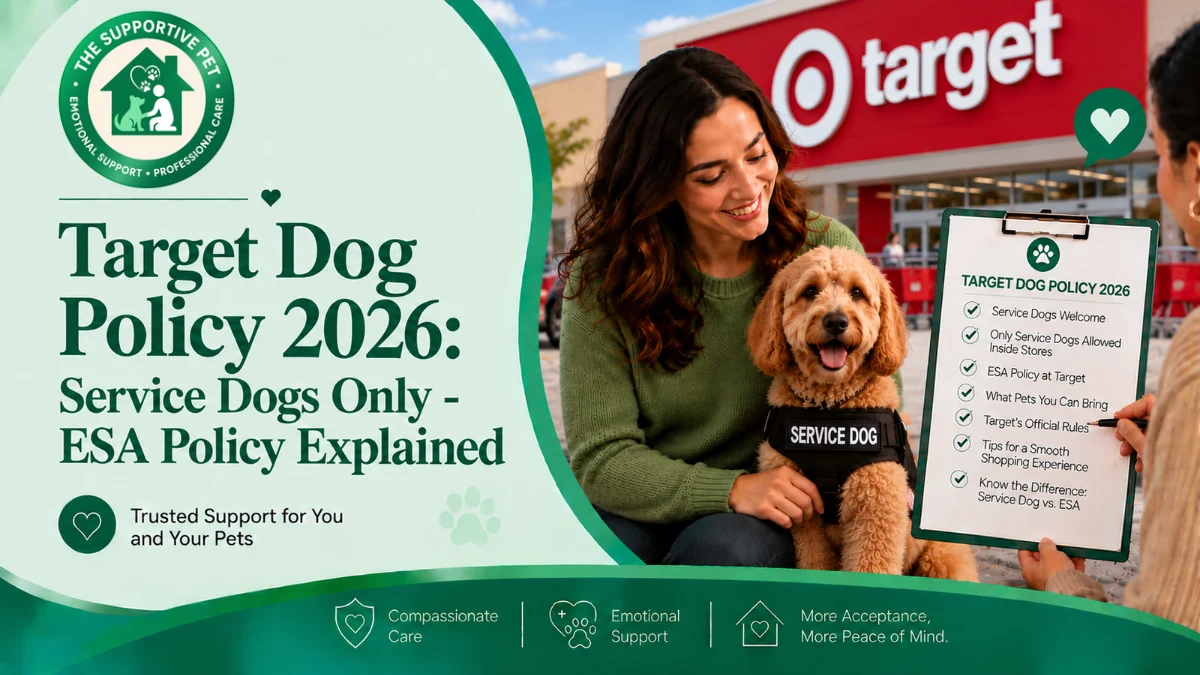
Target is one of America's most visited retailers, and many pet owners wonder about bringing their dogs into Target stores. Here's the definitive answer on Target's 2026 dog policy, why ESA letters don't apply in retail settings, and what service dog and psychiatric service dog owners need to know.
Target's Official Dog Policy 2026
Target's official policy permits only trained service dogs inside its stores. Emotional support animals - regardless of whether you have an ESA letter - are not permitted under Target's policy.
This policy is consistent with Target's obligations under the Americans with Disabilities Act (ADA), which requires public accommodations (including retail stores) to allow service dogs but does not require them to admit emotional support animals.
Why ESA Letters Don't Work at Target
ESA letters provide protections under the Fair Housing Act (42 U.S.C. § 3604) for housing - specifically rental housing. The ADA governs public accommodations like retail stores, and the ADA's service animal provisions cover only:
- Dogs trained to perform specific tasks for a person with a disability
- Miniature horses (in limited circumstances)
Emotional support animals are explicitly excluded from ADA public accommodation protections. An ESA letter - even from a licensed mental health professional - does not grant access to Target or any other retail store.
Psychiatric Service Dogs at Target
If your dog is a psychiatric service dog (PSD) - trained to perform specific tasks that mitigate a psychiatric disability (such as interrupting panic attacks, performing deep pressure therapy during PTSD episodes, or alerting to dissociation) - they qualify as a service animal under the ADA and must be admitted to Target.
Target staff may ask only two questions under the ADA:
- Is this a service animal required because of a disability?
- What work or task has the dog been trained to perform?
They cannot ask about your diagnosis, require documentation, or ask the dog to demonstrate its task. See our PSD letter guide and our ESA vs. PSD comparison.
What Happens If You Bring a Non-Service Dog to Target?
Target staff may ask you to remove a non-service dog from the store. While individual staff may not always enforce the policy consistently - particularly for small, contained dogs in carriers - the official policy is service dogs only, and Target can legally ask you to leave with a non-qualifying animal.
ESA Rights Are in Housing, Not Retail
Your ESA letter is most valuable where it was designed to work: housing. Under the Fair Housing Act, your landlord must allow your ESA and waive all pet fees. If you need an ESA letter for housing, The Supportive Pet can help with same-day telehealth evaluations.
Service Dog vs. ESA: The Legal Distinction at Retail Stores
Understanding why ESAs are excluded from Target requires understanding the fundamental legal distinction:
The Americans with Disabilities Act (ADA) governs public accommodations (retail stores, restaurants, hotels, transportation). Under the ADA, "service animals" are defined exclusively as dogs (and in limited cases, miniature horses) individually trained to do work or perform tasks for a person with a disability. The ADA explicitly excludes animals providing only emotional support, comfort, or companionship.
ESA letters are issued under the Fair Housing Act, which governs rental housing. The FHA's ESA provisions have no reach into retail stores. These are two entirely separate federal laws governing two entirely separate contexts.
This means no ESA letter - regardless of who issued it, what it says, or how legitimate it is - provides access to Target or any other retail store.
Upgrading from ESA to Psychiatric Service Dog
If retail access is important to you and you have a qualifying psychiatric disability, upgrading to a psychiatric service dog (PSD) is worth considering. A PSD is a dog individually trained to perform specific tasks that directly mitigate your psychiatric disability. Examples of qualifying psychiatric service dog tasks include:
- Interrupting panic attacks through deep pressure therapy
- Alerting to oncoming dissociative episodes and guiding the handler to safety
- Interrupting repetitive self-harm behaviors through physical contact
- Waking the handler from PTSD-related nightmares
- Medication reminders for conditions requiring strict timing
These tasks must be specific, trained behaviors - not simply the comfort or calming presence that characterizes ESA relationships. For more on the distinction and the process of obtaining a PSD letter, see our PSD letter guide and ESA vs. PSD comparison.
Target's Pet-Friendly Policy Areas
Some Target locations have designated outdoor areas, including garden centers or seasonal outdoor sales areas, where local store policies may be more permissive toward well-behaved pets. These are store-specific decisions - not company policy - and should be verified with your local store before bringing a non-service pet to any Target location.
Frequently Asked Questions: Target Dog Policy 2026
Q: Can Target employees ask what disability my service dog is for?
No. Target employees are permitted to ask only two questions: (1) is this a service animal required because of a disability, and (2) what work or task has the dog been trained to perform. They cannot ask about your diagnosis or disability type, request documentation, or ask the dog to demonstrate the task.
Q: Can I bring my dog in a bag or stroller to Target?
Target's policy applies to dogs regardless of whether they're being carried or in a stroller. The official policy is service dogs only. Individual store enforcement may vary in practice, but the policy does not distinguish between dogs on leash and dogs being carried.
Q: Does Target's policy differ in pet-friendly states?
No. Target's national policy follows federal ADA requirements, which apply uniformly regardless of state pet-friendliness laws. State laws governing pet-friendly establishments typically apply to restaurants and food service under state health codes - not to general retail.
Frequently Asked Questions About Dogs in Target
Can I carry my small dog in a bag at Target? Target's policy covers service animals, not pet dogs carried in bags. If your small dog is in a carrier bag, they are still considered a pet under store policy and are not permitted unless they are a trained service animal.
What if a manager approaches me about my service animal? Remain calm. Under the ADA, store employees may ask only two questions: Is this a service animal required because of a disability? What work or task has the dog been trained to perform? You are not required to show certification or documentation.
Are emotional support animals allowed in Target? No. The ADA's service animal provisions cover only dogs (and miniature horses) trained to perform specific disability-related tasks. ESAs do not have public access rights under the ADA and are not permitted in Target stores.
Can I take my Psychiatric Service Dog into Target? Yes. A trained PSD is a service dog under the ADA and is permitted in all areas of Target open to customers. Your dog must be under control and must not be disruptive.
If you are considering whether a Psychiatric Service Dog might be right for your needs, The Supportive Pet can connect you with a licensed clinician for an evaluation.
Frequently Asked Questions
Can I bring my ESA into Target with my ESA letter?
No. Target's policy permits only trained service dogs under the ADA. ESA letters provide housing rights under the Fair Housing Act but do not grant access to retail stores. The ADA explicitly excludes emotional support animals from public accommodation protections.
Does Target allow dogs in carriers or strollers?
Target's official policy is service dogs only - a dog in a carrier is still a non-service animal and is not covered by the policy. Individual store and staff enforcement may vary, but officially, only trained service dogs are permitted.
What is the difference between a service dog and an ESA at Target?
A service dog is trained to perform specific tasks that mitigate a disability and is protected by the ADA for public access. An ESA provides emotional comfort through companionship but is not trained for specific tasks - it is protected by the Fair Housing Act for housing only, not by the ADA for public access like retail stores.
See our articles highlighted in Google Search
Add The Supportive Pet as a preferred source - your results, your way.