
Who can write an ESA letter?
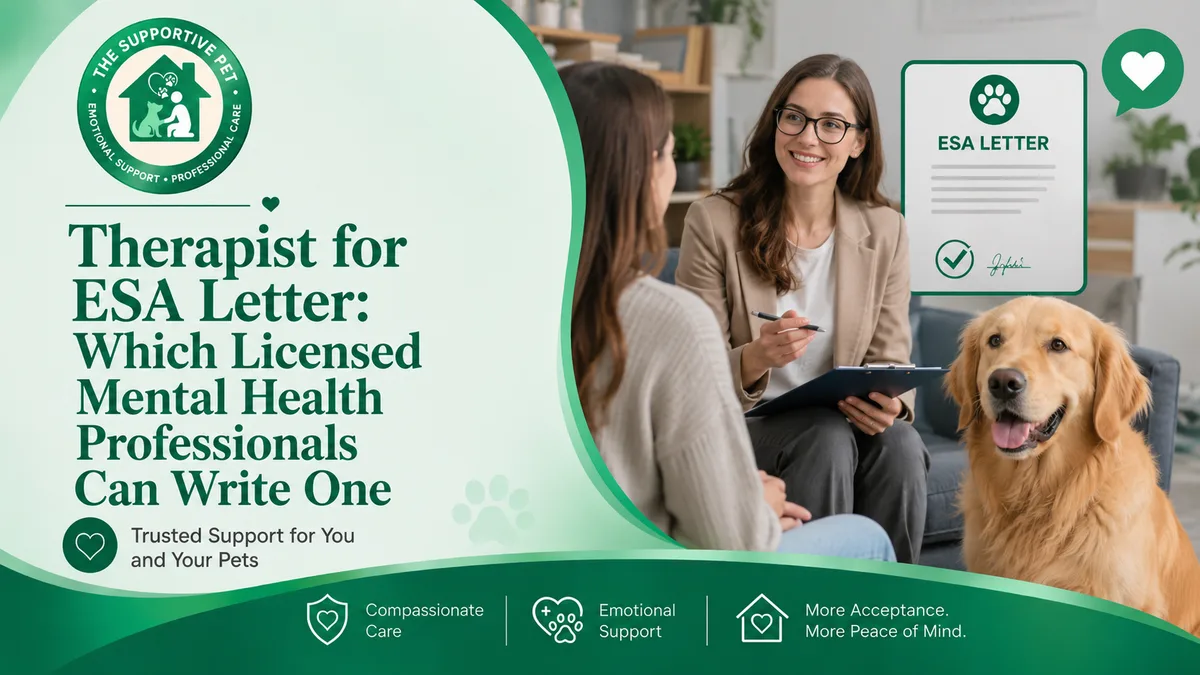
Under the Fair Housing Act, a valid ESA letter must come from a licensed healthcare professional who has personal knowledge of your disability. In practice, this means a licensed mental health professional (LMHP): a licensed clinical social worker (LCSW), licensed professional counselor (LPC), licensed marriage and family therapist (LMFT), psychologist (PhD or PsyD), or psychiatrist (MD or DO). Each of these providers holds a state-issued professional license with verifiable credentials. Primary care physicians (MDs/DOs) and other licensed medical doctors can also write ESA letters, but mental health professionals are the standard because they are specifically trained to evaluate and diagnose mental health conditions.
Key Takeaways
- The Fair Housing Act requires ESA documentation from a licensed healthcare professional who has personal knowledge of your condition - a non-licensed source cannot issue valid documentation.
- Qualifying licensed mental health professionals include LCSWs, LPCs, LMFTs, psychologists (PhD/PsyD), and psychiatrists (MD/DO) with active state licenses.
- Letters from life coaches, wellness coaches, unlicensed counselors, and online questionnaire services without a real LMHP are routinely rejected by landlords and have no FHA standing.
Medical Disclaimer: This article is for informational purposes only and does not constitute medical or legal advice. Consult a qualified mental health professional before making decisions about your care. If you or someone you know is in crisis, call or text 988 (Suicide & Crisis Lifeline, available 24/7).
Why the FHA Requires a Licensed Healthcare Professional
The Fair Housing Act (42 U.S.C. § 3604) gives landlords the right to request "reliable documentation" when a disability or the disability-related need for an ESA is not obvious. The FHA's implementing guidance describes reliable documentation as coming from a licensed healthcare professional who has personal knowledge of your disability and can confirm the need for the accommodation.
The licensing requirement exists for good reason. A licensed mental health professional has:
- Passed rigorous professional licensing examinations
- Completed supervised clinical training
- Agreed to state-level professional standards and ethics requirements
- A verifiable license number that a landlord can independently confirm through the state licensing board
- Professional accountability - a clinician who issues fraudulent ESA letters risks losing their license
These elements together make a licensed professional's letter "reliable" in the legal sense. A letter from an unlicensed source cannot be verified, involves no professional accountability, and cannot carry the same legal weight.
Who Qualifies as an LMHP for ESA Purposes
The following licensed mental health professionals can issue valid ESA letters in all US states (subject to state-specific requirements):
- Licensed Clinical Social Worker (LCSW): A master's-level social worker with advanced clinical training and supervised hours, licensed by the state. LCSWs are among the most common providers of ESA letters.
- Licensed Professional Counselor (LPC) / Licensed Mental Health Counselor (LMHC): Title varies by state. Master's-level mental health professionals licensed to diagnose and treat mental health conditions.
- Licensed Marriage and Family Therapist (LMFT): Master's-level therapist with specialized training in individual, couple, and family mental health treatment.
- Psychologist (PhD or PsyD): Doctoral-level mental health professional licensed to diagnose, test, and treat psychological conditions. Highest-level non-prescribing mental health licensure.
- Psychiatrist (MD or DO): A licensed medical doctor with specialization in psychiatry. Can diagnose mental health conditions and prescribe medication. Psychiatrists are licensed both as physicians and as mental health specialists.
- Licensed primary care physicians (MD/DO) may also issue ESA letters when they treat you for qualifying mental health conditions, though they are less standard for mental health-specific documentation.
Who Cannot Write a Valid ESA Letter
The following providers - despite how they may present themselves - cannot issue ESA letters that carry FHA weight:
- Life coaches and executive coaches: No mental health licensure. No authority to diagnose conditions.
- Wellness coaches and health coaches: Same issue. Coaching credentials are not state-issued mental health licenses.
- Unlicensed counselors: Counselors who have completed training programs but have not yet obtained licensure cannot issue valid ESA letters.
- Online questionnaire services without real clinicians: Services where you fill out a form and receive an instant letter without a licensed clinician reviewing your case and exercising clinical judgment are not providing valid ESA documentation - regardless of what they claim.
- Nurse practitioners (NPs) and physician assistants (PAs): This depends on state law and scope of practice. NPs and PAs may be authorized to diagnose and treat mental health conditions in some states, making their letters potentially valid. In others, their scope of practice limitations may make their letters legally weaker. If your NP or PA regularly treats your qualifying mental health condition, their letter may be accepted - but a licensed mental health professional's letter is stronger and less likely to be challenged.
Why Landlords Reject Non-LMHP Letters
Experienced property managers are familiar with the difference between a valid ESA letter and a certificate from an online service. When a letter arrives without a verifiable license number, without a real clinical assessment, or from an unlicensed source:
- They cannot verify the provider's credentials through the state licensing board
- There is no professional accountability if the letter was issued without a genuine evaluation
- Accepting non-compliant documentation exposes the landlord to legal risk if a dispute arises
Increasingly, property management companies have legal counsel review ESA letters and reject any that do not include verifiable LMHP credentials. This is why getting your letter from a licensed professional matters not just legally, but practically.
Getting Your ESA Letter from a Licensed Clinician
At The Supportive Pet, every ESA letter is issued by a licensed mental health professional holding an active license in your state. Your evaluation is conducted by a real clinician who reads your intake responses, exercises clinical judgment, and either approves or (in some cases) declines to issue a letter. You are only charged when your case is approved.
Your letter includes the clinician's full name, license type, license number, and state of licensure - everything needed for your landlord to verify its authenticity. That is what makes it a document your housing rights actually rest on.
Frequently Asked Questions
Who can write an ESA letter?
Under the Fair Housing Act, a valid ESA letter must come from a licensed healthcare professional who has personal knowledge of your disability. In practice, this means a licensed mental health professional (LMHP): a licensed clinical social worker (LCSW), licensed professional counselor (LPC), licensed marriage and family therapist (LMFT), psychologist (PhD or PsyD), or psychiatrist (MD or DO). Each of these providers holds a state-issued professional license with verifiable credentials. Primary care physicians (MDs/DOs) and other licensed medical doctors can also write ESA letters, but mental health professionals are the standard because they are specifically trained to evaluate and diagnose mental health conditions.
Can a life coach or wellness coach write an ESA letter?
No. Life coaches, wellness coaches, and health coaches are not licensed healthcare professionals - they do not hold state-issued mental health or medical licenses and are not qualified to diagnose mental health conditions. An ESA letter from an unlicensed provider has no standing under the Fair Housing Act. Landlords who encounter such letters may (and often should) reject them as insufficient documentation.
Can my regular doctor write my ESA letter?
Yes, if your doctor is a licensed medical doctor (MD or DO) and has personal knowledge of your mental health condition. Primary care physicians can write ESA letters, but they are most effective when they regularly treat you for your qualifying mental health condition - not when they simply agree to sign a form. A primary care physician who has treated your depression or anxiety and can document how an ESA supports your treatment has the standing to issue a valid letter. An urgent care doctor who has never seen you for a mental health condition does not.
What does 'personal knowledge of my condition' mean for an ESA letter?
The FHA requires that the documentation come from someone with personal knowledge of your disability. For a licensed mental health professional, this means they have evaluated your condition through a genuine clinical assessment - not just a checkbox questionnaire. They must be able to professionally attest that you have a qualifying disability and that an emotional support animal is necessary for your disability-related need. A clinician who has never evaluated you - who simply issues a letter based on your self-reported checkbox answers without any clinical judgment - does not have personal knowledge of your condition and their letter is legally vulnerable.
Do I need to be an existing patient of the LMHP?
Not necessarily. A new evaluation with a licensed clinician - including through telehealth - can establish the clinical relationship and personal knowledge the FHA requires, as long as the evaluation is genuine and the clinician exercises real professional judgment. Some states (California, Iowa, Louisiana, Arkansas) require a waiting period of 30 days between your first appointment and letter issuance. For most states, a thorough initial evaluation is sufficient.
See our articles highlighted in Google Search
Add The Supportive Pet as a preferred source - your results, your way.