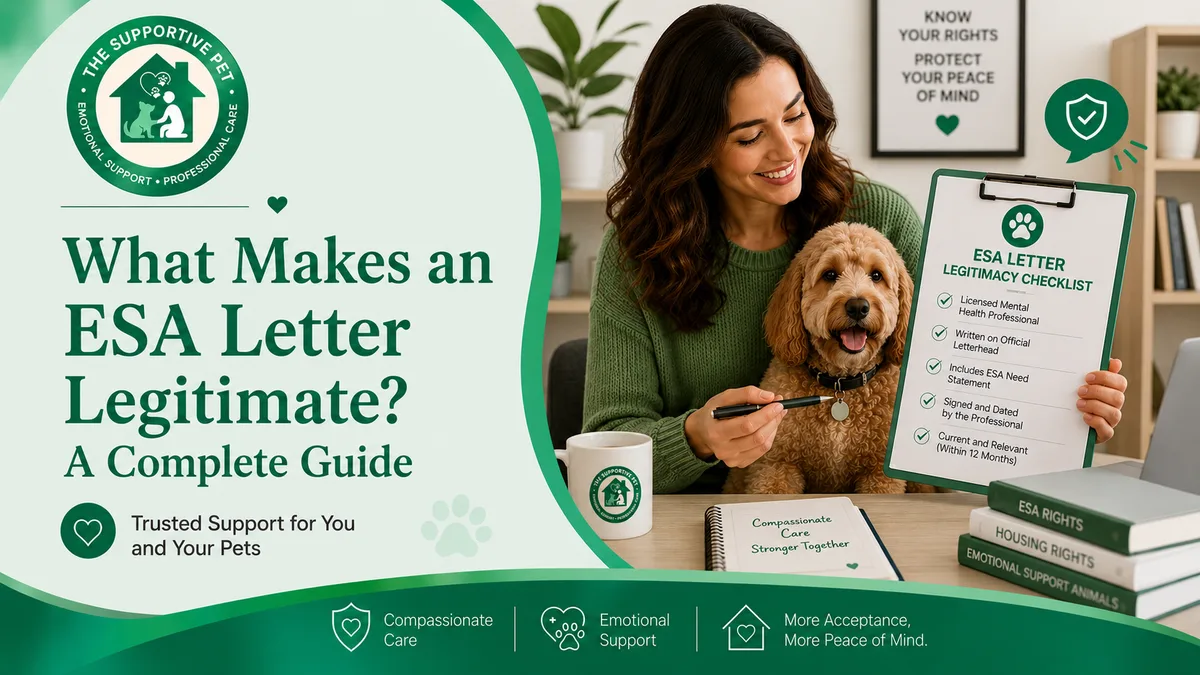


What do you need to qualify for an ESA letter?
To qualify for an ESA letter under the Fair Housing Act, you need two things: (1) a mental or emotional health condition that substantially limits a major life activity - such as sleeping, concentrating, caring for yourself, or interacting with others - and (2) a determination by a licensed mental health professional that your emotional support animal provides therapeutic benefit for that condition. You do not need a prior formal diagnosis, an existing therapist, or any specific documentation before starting the evaluation.
Key Takeaways
- There are two requirements to get an ESA letter: a mental health condition that substantially limits a major life activity, and a clinical evaluation by a licensed professional in your state.
- You do NOT need a prior formal diagnosis, an existing therapist, or an in-person visit - the evaluating clinician makes their own independent determination.
- The evaluation is straightforward: a thorough intake form followed by a licensed clinician review, with most letters issued the fast.
Medical Disclaimer: This article is for informational purposes only and does not constitute medical or legal advice. Consult a qualified mental health professional before making decisions about your care. If you or someone you know is in crisis, call or text 988 (Suicide & Crisis Lifeline, available 24/7).
Getting an ESA letter requires two things: a qualifying mental health condition and a clinical evaluation by a licensed mental health professional. The FHA does not require registration, certification, or a vest for your animal - only this documentation. Understanding exactly what the letter must contain, and what landlords can legally ask for, is the difference between a smooth accommodation process and one that gets held up by unnecessary back-and-forth.
The Two Requirements for an ESA Letter
Getting a legitimate ESA letter under the Fair Housing Act requires exactly two things:
- A qualifying mental health condition - a mental or emotional health condition that substantially limits one or more major life activities
- A licensed clinician evaluation - an assessment by a licensed mental health professional in your state confirming the condition and the therapeutic need for your animal
Both requirements must be satisfied. No other documents, prior diagnoses, or credentials are needed before you begin.
What Counts as a Qualifying Mental Health Condition
The Fair Housing Act uses a functional standard: your condition must substantially limit a major life activity. Major life activities include sleeping, concentrating, working, caring for yourself, interacting with others, and regulating your emotions. You do not need to be completely unable to perform an activity - substantial limitation is the legal threshold.
Conditions that commonly qualify include:
- Anxiety disorders (generalized anxiety, social anxiety, panic disorder)
- Depression and major depressive disorder
- Post-traumatic stress disorder (PTSD)
- ADHD / attention deficit disorders
- Bipolar disorder and mood disorders
- OCD (obsessive-compulsive disorder)
- Autism spectrum disorder
- Agoraphobia and specific phobias
- Insomnia and sleep disorders related to mental health
- Schizophrenia and other psychotic disorders
This is not an exhaustive list. Any diagnosed condition in the DSM-5 that substantially limits a major life activity can support an ESA letter. See our full qualifying conditions guide for details on each condition.
What the Clinical Evaluation Involves
The evaluation at The Supportive Pet has two stages:
- Clinical intake form (10–15 minutes) - You describe your mental health history, the symptoms you experience, and how your animal helps manage those symptoms. Be specific: rather than "my dog calms me down," describe what happens concretely - "when I start having a panic attack, my dog rests against my legs and I can feel my breathing slow within a few minutes." The more specific you are, the stronger your clinical picture.
- Licensed clinician review (1–4 hours on business days) - A licensed mental health professional in your state reviews your intake. They assess whether your condition meets the qualifying standard and whether the therapeutic nexus between your condition and your animal is credible. If your case is clear and your intake is thorough, most patients receive their letter the fast.
In some cases, the clinician may request a brief follow-up call for clarification. This is standard clinical practice and typically adds one business day at most.
What You Need to Have Ready
- A description of your symptoms - how your condition affects your daily life specifically
- A description of your animal's role - how your ESA helps manage those symptoms
- Your state of residence - your clinician must be licensed in your state
- 15–20 minutes of focused time - to complete the intake form thoroughly
That is all. You do not need medical records, a referral, an insurance card, or any prior documentation.
What You Do NOT Need
A common misconception is that getting an ESA letter requires prior therapy or a formal diagnosis from another provider. Here is what you do not need:
- A prior formal diagnosis - the evaluating clinician makes an independent determination. Symptoms and functional impairment are what matter, not a prior label
- An existing therapist or psychiatrist - The Supportive Pet's clinicians conduct the evaluation independently
- An in-person visit - telehealth evaluations are legal and valid in all 50 states under HUD guidance
- ESA registration or certification - these do not exist as legal requirements. See our guide on why ESA registration is meaningless
- A specific breed or trained animal - ESAs require no training. Any domestic animal species can qualify
After the Evaluation: Using Your Letter
Once you receive your ESA letter, submit it to your landlord alongside a formal reasonable accommodation request citing the Fair Housing Act. Your landlord must respond within a reasonable time (HUD guidance: 10 business days) and cannot charge pet fees, enforce breed restrictions, or deny your ESA without a legally valid reason.
For a template of what to write to your landlord, see our guide on ESA accommodation request letters. For what to do if your landlord pushes back, see our guide on what to do when a landlord denies your ESA.
Ready to Start?
How to Use Your ESA Letter With a Landlord
Submit in Writing - Always
When you present your ESA accommodation request, do it in writing - email is ideal because it creates a timestamp and paper trail. Include your ESA letter as an attachment and a brief cover note stating that you are requesting a reasonable accommodation under the Fair Housing Act. Your landlord has 10 business days to respond in most jurisdictions; if they do not respond, that itself may constitute a violation of the FHA's good-faith participation requirement.
What Your Landlord Can and Cannot Request
After receiving your ESA letter, your landlord can ask two follow-up questions if your disability is not apparent: (1) do you have a disability, and (2) does the animal provide assistance related to that disability? They cannot ask for your specific diagnosis, demand your therapy records, require an in-person evaluation, or insist that your letter come from a clinician in a specific state. They can verify the clinician's license number through the relevant state licensing board.
ESA Letter Requirements by State: What Changes
Federal FHA requirements apply in all 50 states, but a few states layer additional requirements on top. California's AB 468 requires a 30-day prior professional relationship before signing an ESA letter. Florida's SB 1084 makes it illegal to misrepresent an animal as an ESA and provides landlords tools to verify letters. These state laws affect how clinicians must interact with patients - they do not change your housing rights as an ESA owner with a legitimate letter.
Related: See verified customer reviews · ESA & PSD letter benefits
Frequently Asked Questions
What do you need to qualify for an ESA letter?
To qualify for an ESA letter under the Fair Housing Act, you need two things: (1) a mental or emotional health condition that substantially limits a major life activity - such as sleeping, concentrating, caring for yourself, or interacting with others - and (2) a determination by a licensed mental health professional that your emotional support animal provides therapeutic benefit for that condition. You do not need a prior formal diagnosis, an existing therapist, or any specific documentation before starting the evaluation.
Do I need a diagnosis to get an ESA letter?
No. You do not need a prior formal diagnosis from another provider to get an ESA letter. The licensed mental health professional who evaluates you at The Supportive Pet conducts an independent clinical assessment. If your symptoms and functional impairments meet the qualifying standard - regardless of whether you have a prior diagnosis - they can issue your letter. Many people who receive ESA letters have never seen a therapist before.
What mental health conditions qualify for an ESA letter?
Any mental or emotional health condition that substantially limits a major life activity can qualify. Common qualifying conditions include generalized anxiety disorder, social anxiety, panic disorder, depression, PTSD, ADHD, bipolar disorder, OCD, autism spectrum disorder, insomnia linked to mental health, agoraphobia, and others. The condition must be recognized in the DSM-5. The clinician evaluating your case makes the final determination based on how your specific condition affects your daily functioning.
Does my landlord need to be told what condition I have?
No. You are not legally required to disclose your specific diagnosis to your landlord - and you should not. Your ESA letter states that you have a disability under the Fair Housing Act and that your animal is therapeutically necessary. That is the only documentation your landlord is legally entitled to request. They cannot ask for your diagnosis, your treatment notes, or your medical records.
What happens if I don't qualify for an ESA letter?
If the clinician determines that your condition does not meet the qualifying standard, or that an ESA does not provide a credible therapeutic benefit for your situation, they will not issue a letter. The Supportive Pet does not charge you if you are not approved - the evaluation is risk-free. If you are denied, the clinician will explain the basis for the determination and you may address any gaps in a follow-up evaluation.
See our articles highlighted in Google Search
Add The Supportive Pet as a preferred source - your results, your way.