
Do I need to register my emotional support animal?
No. There is no official ESA registry, and registration is not required by the Fair Housing Act or any federal law. The only document that gives your emotional support animal legal housing protection is an ESA letter from a licensed mental health professional. Any website offering to "register" your ESA is selling a product that has no legal standing.
Medical Disclaimer: This article is for informational purposes only and does not constitute medical or legal advice. Consult a qualified mental health professional before making decisions about your care. If you or someone you know is in crisis, call or text 988 (Suicide & Crisis Lifeline, available 24/7).
What Is ESA Registration? (And Why the Term Is Misleading)
Search "register emotional support animal" and you will find dozens of websites offering to add your pet to an official-sounding database, issue a certificate, or provide an ID card for a fee ranging from $30 to $200. The term "ESA registration" implies there is a government program, an official database, or a legal process you need to complete. There is not.
The phrase was invented by private commercial services to describe a product they sell. The product - a certificate, a vest, an ID tag, a listing in a privately maintained database - has no legal standing under any federal law. It does not trigger your rights under the Fair Housing Act. It will not compel a landlord to allow your animal. Presenting one to a housing provider as if it were official documentation can actually undermine your credibility.
Why ESA Registration Doesn't Exist Under Federal Law
The Fair Housing Act (FHA) and the HUD guidance that implements it are the legal foundation for emotional support animal housing rights in the United States. Neither the FHA nor any HUD regulation creates a registration requirement, a registration process, or a database of registered ESAs. The word "registration" does not appear in the relevant HUD guidance at all.
What the FHA requires is this: when a person with a disability requests a reasonable accommodation to keep an emotional support animal, the housing provider may request documentation showing that the person has a disability and that the animal provides disability-related assistance. That documentation is an ESA letter from a licensed mental health professional. Nothing else.
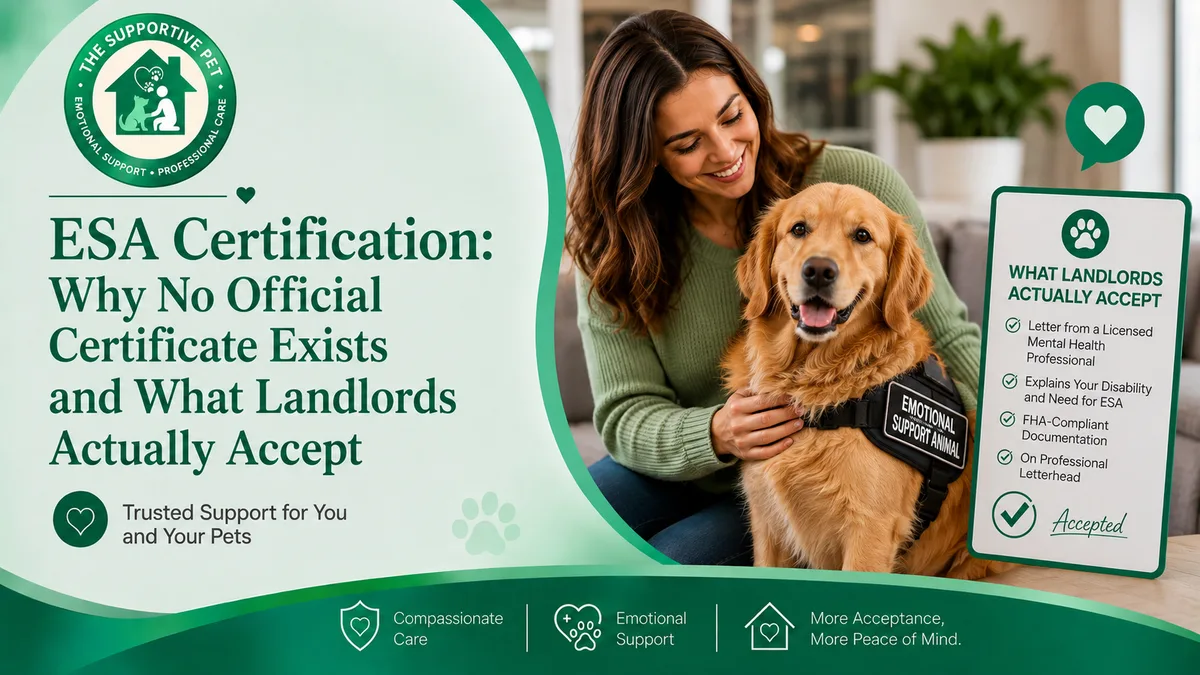
The HUD Guidance on Assistance Animals (2020) explicitly addresses this point: housing providers may not require that an assistance animal be trained, certified, or registered. The guidance also warns that online documents - including certificates and registration documents from websites - "are not, by themselves, sufficient to establish that a person has a disability-related need for an assistance animal."
What Online ESA Registries Are Actually Selling
Private ESA registry websites typically offer some combination of:
- A certificate or official-looking document with your pet's name, photo, and a registration number
- An ID card, vest, or tag identifying your animal as a "registered emotional support animal"
- A listing in a privately maintained database accessible to "verify" your registration
- Access to an ESA letter (sometimes bundled with the registration products)
The certificate, ID card, vest, and database listing are marketing products, not legal documents. They are designed to look official. They are not. The only item in that list with any potential legal weight is the ESA letter - and only if it was written by an actual licensed mental health professional who conducted a real clinical evaluation. Many registry services that bundle letters provide them through rubber-stamp approvals that do not meet HUD's "reliable" documentation standard.
What the Fair Housing Act Actually Requires
Under the FHA and HUD guidance, a housing provider may request documentation when (1) the disability is not apparent and (2) the disability-related need for the animal is not obvious. When documentation is appropriate, it should come from a reliable source. HUD identifies these as:
- A licensed health care professional (physician, psychiatrist, psychologist, therapist, counselor, social worker)
- A peer support group, a non-medical service agency, or a reliable third party who is in a position to know about the individual's disability
The documentation must establish: (1) that the person has a disability, and (2) that there is a disability-related therapeutic nexus - a connection between the condition and the animal's role. A registration certificate establishes neither of these things. An ESA letter from a licensed clinician who has conducted a real evaluation establishes both.
The Real Document: What an ESA Letter Contains
A legitimate ESA letter from a licensed mental health professional includes:
- The clinician's name, license type (LCSW, LMFT, LPC, MD, PhD, etc.), license number, and state of licensure
- A statement that the person has a mental health condition or disability under the DSM-5 or equivalent
- A statement that the emotional support animal provides therapeutic benefit related to that condition
- The date the letter was issued - most housing providers require a letter dated within the past 12 months
- The clinician's signature and contact information
A landlord receiving this letter can verify the clinician's license through their state licensing board. They can confirm the letter's authenticity. They can see that a real evaluation occurred. None of those verification steps are possible with a registration certificate.
Why Landlords Won't Accept ESA Registration Certificates
Sophisticated landlords and property managers are increasingly aware of the ESA documentation landscape. HUD guidance explicitly tells housing providers that online certificates and registration documents are not sufficient on their own. A landlord who rejects your registration certificate and asks for a proper clinical letter is acting exactly as HUD guidance directs them to act.
If you attempt to enforce housing rights with a registration certificate - through an HUD complaint or fair housing lawsuit - the certificate will not support your case. The legal question turns on whether you have a disability and whether you have documentation from a reliable source establishing a therapeutic nexus. An ID tag from an online registry answers neither question.
How to Get Documentation That Actually Works
If you have a diagnosed mental or emotional health condition - anxiety, depression, PTSD, ADHD, bipolar disorder, or other conditions that substantially limit daily functioning - you may qualify for an ESA letter. The process at The Supportive Pet is:
- Complete a brief intake assessment describing your condition and your relationship with your animal
- A licensed mental health professional reviews your case and, if appropriate, conducts a clinical evaluation
- If you qualify, the clinician issues an ESA letter on their letterhead with their license information
- You receive a digital letter you can present to your landlord or housing provider
The evaluation is the part that matters. It is what makes the letter reliable under HUD's standard. Approval is not guaranteed - the clinician makes an independent determination based on your clinical situation.
Warning Signs of ESA Registration Scams
Avoid any service that:
- Offers to "register" your ESA without any evaluation or mental health component
- Guarantees instant approval or a letter in minutes without a real evaluation
- Does not identify a specific licensed clinician responsible for your letter
- Sells certificates, vests, ID cards, or database listings as "official" documentation
- Charges you primarily for the registration product and then upsells the letter as an add-on
- Claims to operate under government authority or claims their database is officially recognized
The FTC has taken enforcement action against fraudulent ESA documentation services. HUD guidance warns housing providers specifically about unreliable online letter sources. Protect yourself by using a provider that is transparent about who is evaluating your case and what license they hold.
Related reading: ESA letter scam red flags · how to verify an ESA letter · ESA certification: why it doesn't exist · what is an ESA letter?
Frequently Asked Questions
Do I need to register my emotional support animal?
No. There is no official ESA registry, and registration is not required by the Fair Housing Act or any federal law. The only document that gives your emotional support animal legal housing protection is an ESA letter from a licensed mental health professional. Any website offering to "register" your ESA is selling a product that has no legal standing.
Is there an official ESA database or government registry?
No. The federal government does not maintain an ESA database. There is no USDA registry, HUD registry, or any other official government program for registering emotional support animals. Organizations that claim to offer "official" registration are private commercial services with no government affiliation or legal authority.
How do I register an emotional support animal?
You don't - because there is no registration process under U.S. federal law. What you can do is obtain a legitimate ESA letter from a licensed mental health professional who has evaluated your mental health needs. That letter is the only documentation that triggers your rights under the Fair Housing Act. No registration, certificate, or ID tag changes your legal status.
What is the difference between ESA registration and an ESA letter?
ESA "registration" is a private commercial product - typically a certificate, ID card, or database listing - sold by websites with no legal authority. An ESA letter is a clinical document issued by a licensed mental health professional that establishes a therapeutic nexus between your diagnosed condition and your animal. Only the ESA letter has legal standing under the Fair Housing Act.
Will an ESA registration certificate work with my landlord?
No. Landlords are not required to accept ESA registration certificates, vests, ID cards, or any other "registration" product. Under HUD guidance, the documentation landlords can rely on is an ESA letter from a licensed mental health professional. If you present only a registration certificate, your landlord is legally permitted to reject it and request a proper clinical letter.
See our articles highlighted in Google Search
Add The Supportive Pet as a preferred source - your results, your way.