
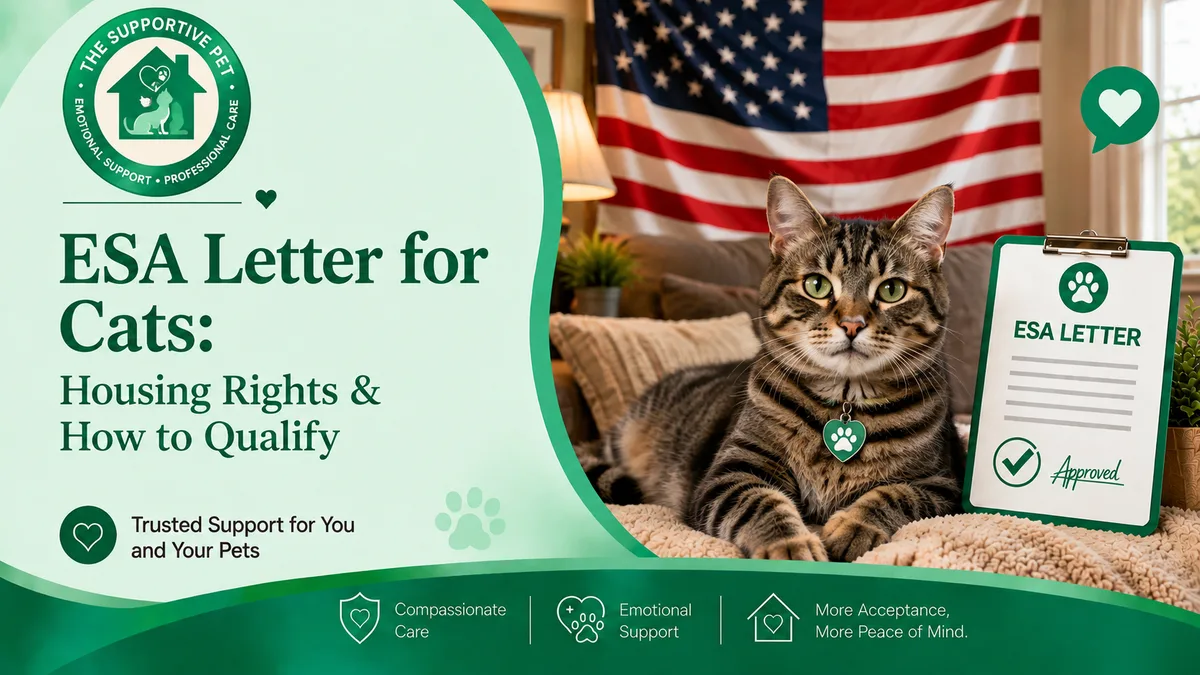
Can a cat be an emotional support animal?
Yes. The Fair Housing Act recognizes cats, dogs, and other animals as emotional support animals. The designation is based on the owner's diagnosed mental health condition and need - your cat qualifies without any specific training or certification.
Medical Disclaimer: This article is for informational purposes only and does not constitute medical or legal advice. Consult a qualified mental health professional before making decisions about your care. If you or someone you know is in crisis, call or text 988 (Suicide & Crisis Lifeline, available 24/7).
Cats are the most common emotional support animal after dogs, and they provide meaningful therapeutic benefits for owners managing anxiety, depression, insomnia, and PTSD. An ESA letter under the Fair Housing Act gives your emotional support cat the same housing protections as an ESA dog - overriding no-pet policies and eliminating all pet fees in any rental housing.
Why Cats Make Effective Emotional Support Animals
How Breed Restrictions Work
Research consistently shows that cat ownership reduces stress hormones, lowers blood pressure, and promotes feelings of calm. Cats' purring (20-140 Hz) has been associated with reduced anxiety and even pain relief in some studies. For owners managing depression or anxiety, a cat's quiet companionship and low-maintenance care routine can provide structure and connection without the demands of dog ownership.
What an ESA Letter Does for Your Cat
Key Protections Under the FHA
- Exempts from no-pet lease clauses - your landlord must grant reasonable accommodation for your ESA cat
- Eliminates all pet deposits and monthly pet rent - cat owners can save $200-$600 annually
- Protects against housing denial based on your cat's presence
- Applies to all cat breeds, including large breeds (Maine Coon, Norwegian Forest Cat) that may trigger size-based restrictions
Cats vs. Dogs as ESAs
Rights Comparison
Both cats and dogs qualify as ESAs under the Fair Housing Act. For renters in smaller apartments, those with limited mobility, or those who prefer lower-maintenance animals, cats are often the more practical choice. Any cat - regardless of breed, age, or temperament - can be designated as an ESA once the owner qualifies through a clinical evaluation.
How to Get a Cat ESA Letter
The Clinical Evaluation
The process is identical to getting an ESA letter for a dog: a licensed mental health professional evaluates you, documents your diagnosis and need for emotional support, and writes a letter. Your cat doesn't need any training or certification.
Start your evaluation at The Supportive Pet. Most patients receive their ESA letter the same business day.
Qualifying Mental Health Conditions for Cat ESA Letters
Who Qualifies
To get an ESA letter for your Cat, you need a mental health condition that substantially limits one or more major life activities. Common qualifying conditions include anxiety disorders, PTSD, major depression, panic disorder, bipolar disorder, OCD, ADHD, phobias, autism spectrum disorder, and schizophrenia. You don't need a severe diagnosis - moderate symptoms that affect your sleep, work performance, or daily functioning regularly qualify. What matters is that your condition is documented by a licensed clinician and that your cat provides genuine therapeutic benefit.
What the Clinical Evaluation Involves
A legitimate ESA letter comes from a real clinical evaluation - not a 2-minute online form. A licensed mental health professional (therapist, psychologist, psychiatrist, or LCSW) will evaluate your mental health history, current symptoms, and how an emotional support animal helps you manage your condition. The Supportive Pet conducts genuine evaluations by state-licensed clinicians via telehealth. Most patients receive their letter the same business day they complete their evaluation.
No Special Training Required for ESA Status
Unlike service dogs, ESAs do not need specialized training or certification. Your Cat's ESA status comes entirely from your clinician's letter - not from the animal's training, a registration website, or any ID card or vest. Websites selling ESA certificates, registry memberships, or ID packages provide documents with zero legal standing under the FHA. Your landlord cannot require any of these.
How to Use Your ESA Letter in Cat Housing
Submitting Your Accommodation Request
Once you have your ESA letter from a licensed clinician, submit a written reasonable accommodation request to your landlord. Include: your name, your unit address, a statement that you have a disability-related need for an emotional support animal, and a copy of your ESA letter. Send this in writing and keep copies. Your landlord must respond in a reasonable timeframe - HUD considers 10 business days a standard expectation.
What Your Landlord Can and Cannot Ask
Your landlord may ask for written documentation from a licensed mental health professional confirming your need for an ESA. They may verify the clinician's license and contact information. They may NOT demand your specific diagnosis, your full medical records, special ESA registration, or documentation from any particular provider. They also may not charge you a pet deposit, pet rent, or any other pet fee for your documented ESA - including your Cat.
If Your Landlord Denies Your ESA
Most ESA denials are illegal. If your landlord refuses a valid ESA accommodation request without legal justification - denying based on breed, charging pet fees, or ignoring your request - you can file a fair housing complaint with HUD at hud.gov/fairhousing. Complaints are free, and successful complaints can result in the landlord being required to grant the accommodation and pay damages. The Supportive Pet provides free landlord dispute support to every client who receives a letter through our clinicians.
Cats as Emotional Support Animals: The Therapeutic Science
Cats offer a unique combination of presence and independence that makes them ideal ESAs for people whose mental health conditions make intense social interaction draining. Unlike dogs, cats regulate their own interaction level - they approach when you need comfort and give space when you need quiet, which can be especially helpful for people with PTSD, social anxiety, or sensory processing differences.
A 2019 study published in Frontiers in Veterinary Science found that cat owners reported significantly lower loneliness scores and better sleep quality compared to non-pet-owning counterparts with similar mental health diagnoses. The tactile act of stroking a cat lowers cortisol levels in under ten minutes - a measurable physiological response, not just a perceived benefit.
Specific Therapeutic Benefits by Condition
- Depression: Daily feeding and grooming routines create structure and purpose, two protective factors against depressive episodes
- Anxiety: Purring at 25–50 Hz has been shown to trigger the same neurological relaxation response as slow, deep breathing
- PTSD: Cats' quiet alert presence helps hypervigilant owners feel less isolated without overstimulation from high-energy pets
- Insomnia: Controlled studies show pet co-sleeping (when the animal is calm) improves sleep efficiency in adults with anxiety disorders
- ADHD: Low-demand care tasks provide sensory feedback and routine without requiring sustained attention sessions
ESA Letter for Your Cat: How the Process Works
Getting an ESA letter for your cat is the same process as for any ESA - the documentation covers your mental health condition and your need for the animal, not the animal's species or behavior. Here is the step-by-step process:
- Complete an assessment: Answer a structured intake form about your mental health history and how your cat helps manage your symptoms
- Connect with a licensed clinician: A licensed therapist, psychologist, or psychiatrist reviews your case and conducts a telehealth consultation
- Receive your ESA letter: The letter is delivered on official letterhead with the clinician's license number, state, and signature - the exact format landlords and housing providers require
- Submit to your landlord: Provide the letter as a reasonable accommodation request; under the FHA your landlord must respond within 10 business days
Apartment Living With an ESA Cat
Cats are the easiest ESA for apartment living by nearly every metric. Here is how common landlord objections apply specifically to cats:
| Landlord Concern | Reality for ESA Cats |
|---|---|
| Allergies in other tenants | Reasonable accommodation standard requires landlord to assess actual impact, not hypothetical - HEPA filters and standard ventilation typically resolve this |
| Carpet damage | Scratch posts and nail trims are standard solutions; normal wear is covered by security deposits per state law |
| Noise complaints | Cats are among the quietest pets - rarely an actionable complaint |
| Multiple cats | Each cat requires its own ESA documentation; a second cat requires a second letter from a licensed clinician |
Breed Restrictions and ESA Cats
While cat breed restrictions are less common than dog breed bans, some properties attempt to restrict "wild hybrid" cats (Savannah, Bengal) or impose weight limits. Under the FHA, an ESA letter exempts you from breed and size restrictions for housing - your cat's breed or weight cannot be used to deny accommodation.
The only exception is truly dangerous behavior: a landlord may deny accommodation if your specific animal has caused documented harm. This is evaluated on an individual basis, not by breed profile.
Frequently Asked Questions: ESA Letters for Cats
Can any cat qualify as an ESA?
Yes. Any domestic cat can be designated as an ESA - there is no breed test, training requirement, or temperament assessment. The qualifying factor is your mental health need, not your cat's attributes. Indoor cats, outdoor cats, kittens, and senior cats all qualify equally.
Does my cat need any special training to be an ESA?
No. ESAs are not service animals and require no task-specific training. Your cat does not need to be certified, registered, or trained to provide emotional support. The FHA protection comes from your ESA letter, not from anything your cat does or learns.
Can I get an ESA letter for two cats?
Yes, but each cat requires separate documentation. Your clinician will assess whether both animals are part of your treatment plan. Two cats from the same household are commonly approved when each provides distinct support - for example, one cat for sleep and one for daytime anxiety grounding.
Will my landlord try to charge a pet deposit for my ESA cat?
Not legally. Once you present a valid ESA letter and submit a written reasonable accommodation request, your landlord cannot charge pet deposits, monthly pet rent, or any ESA-related fees. They can only charge for actual damage beyond normal wear at move-out - the same as for any tenant.
What happens if a new landlord takes over my building?
Your ESA rights transfer. The new landlord assumes the FHA obligations of the previous owner. You may need to re-submit your accommodation request to the new management, but your existing ESA letter remains valid for its duration (typically one year).
My cat sometimes scratches furniture - can my landlord evict me?
Not for that alone. Normal wear from ESA animals is treated differently from tenant-caused damage. Scratched furniture is considered normal pet wear; your landlord can hold your security deposit for damage that exceeds normal wear at move-out, but cannot evict you or revoke your accommodation for scratching that has not caused structural damage to the property.
Can I bring my ESA cat to a hotel?
Hotels are not covered by the FHA. The ADA governs hotel access, and service animals (not ESAs) get ADA protection in hotels. Some hotels voluntarily accept ESA documentation, but they are not required to. If you travel frequently with your cat, look for pet-friendly hotels rather than relying on ESA status.
Frequently Asked Questions
Can a cat be an emotional support animal?
Yes. The Fair Housing Act recognizes cats, dogs, and other animals as emotional support animals. The designation is based on the owner's diagnosed mental health condition and need - your cat qualifies without any specific training or certification.
Does an ESA letter eliminate pet fees for my cat?
Yes. Under the Fair Housing Act, landlords must waive all pet-related charges for documented ESA owners - deposits, monthly pet rent, and move-in fees - for ESA cats as well as dogs.
Can my landlord deny my ESA cat based on a no-pet policy?
No. A valid ESA letter from a licensed mental health professional requires your landlord to grant reasonable accommodation regardless of their no-pet policy. This applies to cats as well as dogs.
See our articles highlighted in Google Search
Add The Supportive Pet as a preferred source - your results, your way.