
Can a Labrador Retriever be an emotional support animal?
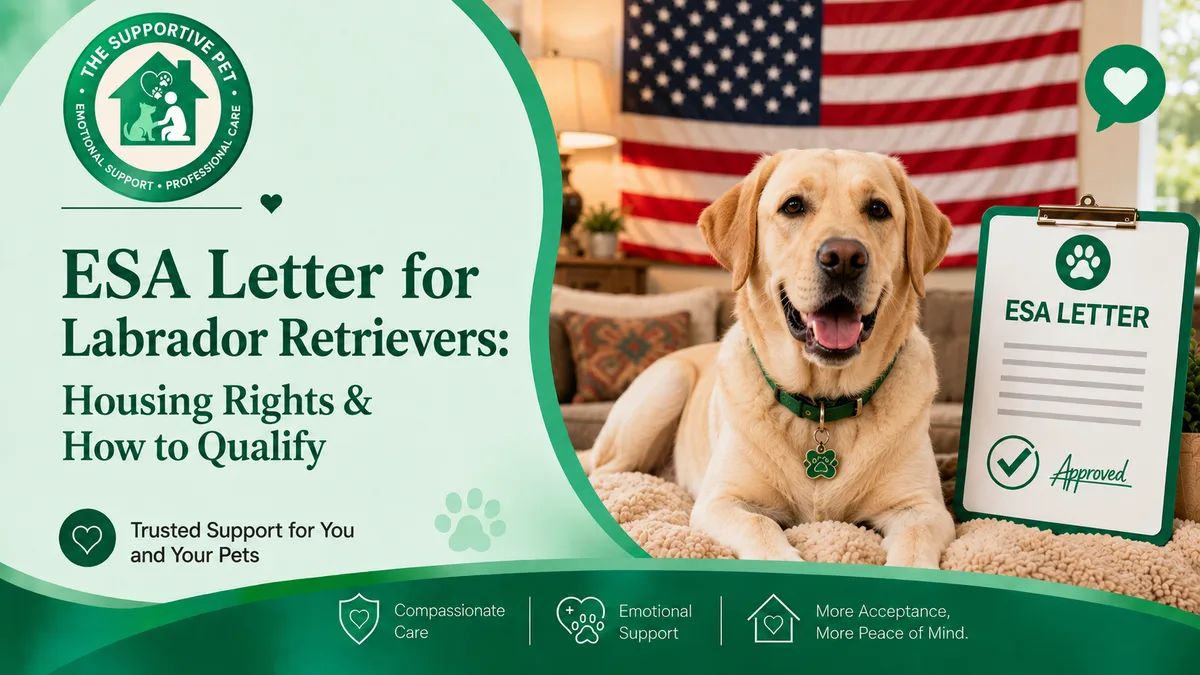
Yes. Any dog breed can be an ESA, including Labrador Retrievers. The designation is based on the owner's diagnosed mental health condition - not the dog's breed or training. Labs are among the most commonly designated ESAs in the United States.
Medical Disclaimer: This article is for informational purposes only and does not constitute medical or legal advice. Consult a qualified mental health professional before making decisions about your care. If you or someone you know is in crisis, call or text 988 (Suicide & Crisis Lifeline, available 24/7).
Labrador Retrievers have been America's most popular dog breed for over three decades, and their calm, loyal, and emotionally perceptive nature makes them outstanding emotional support animals. If your Lab helps you manage anxiety, depression, PTSD, or another qualifying mental health condition, an ESA letter gives your dog legal protection under the Fair Housing Act - overriding pet bans and eliminating pet fees.
Why Labradors Make Excellent ESAs
How Breed Restrictions Work
Labradors are highly attuned to human emotion, making them naturally effective support animals for owners managing mental health challenges. Research shows pet ownership generally reduces cortisol levels and increases oxytocin - Labradors' responsiveness to human affect amplifies this effect. Labs are also among the most commonly used psychiatric service dogs (PSDs) when task-trained for specific disability-mitigating functions.
What an ESA Letter Does for Your Labrador
Key Protections Under the FHA
- Exempts from no-pet lease clauses under the Fair Housing Act
- Eliminates all pet deposits and monthly pet rent
- Exempts from weight limits - many buildings cap pets at 25-50 lbs, which excludes most Labs; ESA status removes this restriction
- Prevents housing denial based on your dog's presence
Labrador Retrievers and Size Restrictions
Labs typically weigh 55-80 lbs. Most apartment buildings with pet policies impose weight limits of 25-50 lbs that would exclude a full-grown Labrador. An ESA letter under the Fair Housing Act completely qualifies you for exemptions from these weight limits - your landlord cannot enforce a weight cap against a documented ESA owner regardless of your dog's size.
Labs vs. Psychiatric Service Dogs
Rights Comparison
Labs are commonly trained as service dogs due to their intelligence and work ethic. If your Lab performs specific disability-mitigating tasks, consider whether a PSD letter is more appropriate - it covers housing rights plus ADA public access. Read the ESA vs. PSD comparison.
How to Get Your ESA Letter
The Clinical Evaluation
You need a licensed mental health professional to evaluate you and write an ESA letter based on your diagnosis and need. The letter is about your mental health - your Labrador qualifies simply by being designated. Start your evaluation at The Supportive Pet. Most patients receive their letter the same business day.
Qualifying Mental Health Conditions for Labrador Retriever ESA Letters
Who Qualifies
To get an ESA letter for your Labrador Retriever, you need a mental health condition that substantially limits one or more major life activities. Common qualifying conditions include anxiety disorders, PTSD, major depression, panic disorder, bipolar disorder, OCD, ADHD, phobias, autism spectrum disorder, and schizophrenia. You don't need a severe diagnosis - moderate symptoms that affect your sleep, work performance, or daily functioning regularly qualify. What matters is that your condition is documented by a licensed clinician and that your dog provides genuine therapeutic benefit.
What the Clinical Evaluation Involves
A legitimate ESA letter comes from a real clinical evaluation - not a 2-minute online form. A licensed mental health professional (therapist, psychologist, psychiatrist, or LCSW) will evaluate your mental health history, current symptoms, and how an emotional support animal helps you manage your condition. The Supportive Pet conducts genuine evaluations by state-licensed clinicians via telehealth. Most patients receive their letter the same business day they complete their evaluation.
No Special Training Required for ESA Status
Unlike service dogs, ESAs do not need specialized training or certification. Your Labrador Retriever's ESA status comes entirely from your clinician's letter - not from the animal's training, a registration website, or any ID card or vest. Websites selling ESA certificates, registry memberships, or ID packages provide documents with zero legal standing under the FHA. Your landlord cannot require any of these.
How to Use Your ESA Letter in Labrador Retriever Housing
Submitting Your Accommodation Request
Once you have your ESA letter from a licensed clinician, submit a written reasonable accommodation request to your landlord. Include: your name, your unit address, a statement that you have a disability-related need for an emotional support animal, and a copy of your ESA letter. Send this in writing and keep copies. Your landlord must respond in a reasonable timeframe - HUD considers 10 business days a standard expectation.
What Your Landlord Can and Cannot Ask
Your landlord may ask for written documentation from a licensed mental health professional confirming your need for an ESA. They may verify the clinician's license and contact information. They may NOT demand your specific diagnosis, your full medical records, special ESA registration, or documentation from any particular provider. They also may not charge you a pet deposit, pet rent, or any other pet fee for your documented ESA - including your Labrador Retriever.
If Your Landlord Denies Your ESA
Most ESA denials are illegal. If your landlord refuses a valid ESA accommodation request without legal justification - denying based on breed, charging pet fees, or ignoring your request - you can file a fair housing complaint with HUD at hud.gov/fairhousing. Complaints are free, and successful complaints can result in the landlord being required to grant the accommodation and pay damages. The Supportive Pet provides free landlord dispute support to every client who receives a letter through our clinicians.
Why Labrador Retrievers Are Among the Most Effective ESAs
Emotional Perception and Responsiveness
Labrador Retrievers consistently rank among the highest breeds in studies measuring responsiveness to human emotional cues. A 2019 study in Learning & Behavior found that Labs oriented toward humans displaying distress significantly more often than breeds with lower social drive. This isn't accidental: Labs were bred as working partners requiring sustained attentiveness to their human - a trait that transfers directly to emotional support roles.
Labs are also unusually forgiving of the behavioral irregularities that accompany mental health conditions: disrupted routines, low-energy days, reduced interaction. Where some higher-drive breeds develop anxious or destructive behaviors when their owner's routine becomes unpredictable, Labs tend to adapt, remaining consistent companionship through episodes of depression or acute anxiety that temporarily reduce daily structure.
Specific Therapeutic Functions Labradors Fill
- Anchoring for panic attacks - Lab's dense, warm physical presence during contact provides proprioceptive grounding that activates the vagus nerve and shortens panic episode duration
- Depression behavioral activation - Labs' persistent, gentle solicitation for walks and interaction creates an external pull toward activity that overcomes the motivational deficits of major depression
- PTSD nighttime support - Labs frequently position themselves at the foot of the bed or on the floor nearby, providing continuous reassurance during PTSD-associated nighttime hypervigilance
- Social anxiety bridge - Labs' universal approachability normalizes public and community interactions, building confidence over time through repeated positive encounters
Living with a Labrador ESA in Rented Housing
Size and Weight in Apartment Contexts
Adult Labradors weigh 55–80 lbs, placing them above the weight threshold in the majority of apartment pet policies (most cap pets at 25–50 lbs). Your ESA letter legally qualifies you for an exemption from this weight limit - full stop. You do not need to find a "large dog friendly" building, pay higher rent for a pet-permitting unit, or hide your Lab's size from management.
Labs adapt well to apartment living when given adequate exercise: two substantial walks daily (30+ minutes each) plus a shorter midday outing covers the minimum. Labs that receive adequate exercise are calm, low-anxiety apartment residents. Under-exercised Labs in confined spaces may become destructive - a behavior issue your landlord could cite - making exercise adherence both a welfare and tenancy concern.
Black Lab, Yellow Lab, Chocolate Lab - Does Color Matter for ESA Status?
No. Coat color has no bearing on ESA qualification, FHA protections, or any aspect of your accommodation request. Some landlords have expressed (legally irrelevant) preferences, but the FHA provides no color-based exceptions to reasonable accommodation requirements. All three color variants are identical for ESA documentation purposes.
Common Landlord Objections and Legal Responses
- "Your dog is too big for our building" - Weight limits apply to pets. ESAs are not pets under the FHA; they are reasonable accommodations for disability. Size restrictions do not apply.
- "We require a pet resume and references" - Pet resumes are a courtesy some tenants provide voluntarily. They are not legally required for an ESA. Your clinician's letter is the only documentation required.
- "We need proof your dog is trained" - ESAs do not require training or certification. This requirement applies to service animals under the ADA, not ESAs under the FHA. Your landlord cannot impose a training requirement on your ESA.
- "We'll allow it but need a pet addendum signed" - Landlords may document an ESA accommodation in writing. However, an ESA addendum cannot include pet deposit clauses, breed/size conditions, or liability waivers that go beyond what applies to other tenants. Review any addendum carefully before signing.
Frequently Asked Questions: ESA Letters for Labrador Retrievers
Can I get an ESA letter for my Lab if I haven't been formally diagnosed with a mental health condition?
You do not need a prior formal diagnosis to apply for an ESA evaluation. A licensed mental health professional at The Supportive Pet will evaluate your current symptoms, history, and functioning. If your symptoms qualify, the clinician will document the diagnosis and issue the letter. Many people who have never formally seen a therapist qualify through the evaluation process.
My Lab is a rescue with an unknown history - does that affect ESA eligibility?
No. ESA designation is based entirely on your mental health condition and your dog's current role in supporting you. Your dog's history, origins, training record, or paperwork have no bearing on ESA qualification. A rescue Lab with no documentation qualifies exactly as a Lab from a breeder would.
Can my Lab be both a pet (for one purpose) and an ESA (for housing)?
Your Lab is either your pet or your documented ESA in a given housing context - you cannot maintain both statuses simultaneously to get maximum benefit of each. Once you submit an ESA accommodation request, your Lab's housing status becomes that of a reasonable accommodation. In practice, this means no pet fees and no weight/breed restrictions. There is no downside to ESA status for a Labrador in most housing situations.
What if my building is dog-breed-restricted but lists Labs as acceptable - do I still need an ESA letter?
If Labs are already on your building's approved breed list, you may not need ESA status for breed-restriction purposes. However, if your building charges pet deposits, monthly pet rent, or imposes weight limits that your specific Lab exceeds, an ESA letter would eliminate those fees and restrictions entirely. Evaluate based on your specific lease terms.
My landlord is taking longer than 10 days to respond to my accommodation request - what should I do?
Send a follow-up in writing referencing your original request date and noting that HUD considers 10 business days a reasonable response timeframe. If you still receive no response or a denial without explanation, you can file a fair housing complaint with HUD (hud.gov/fairhousing) or contact your local HUD Fair Housing assistance program. Delays or non-responses are themselves potential FHA violations.
Can I have more than one ESA (e.g., my Lab plus a cat)?
There is no legal limit on the number of ESAs, but each must be individually documented in your clinician's letter and each must be therapeutically necessary. A landlord may apply a more careful review to multiple ESA requests if the therapeutic necessity of each animal is not clearly documented. Your clinician's letter should address each animal's specific role in supporting your mental health.
Will my Labrador ESA affect my homeowner's or renter's insurance?
ESA status does not change how insurance companies classify your dog. Some insurers do exclude certain breeds from liability coverage, but Labradors are almost universally covered. Your renter's or homeowner's insurance policy is a separate matter from FHA accommodation rights - your landlord cannot use an insurer's hypothetical exclusion as a basis to deny your ESA accommodation request.
Frequently Asked Questions
Can a Labrador Retriever be an emotional support animal?
Yes. Any dog breed can be an ESA, including Labrador Retrievers. The designation is based on the owner's diagnosed mental health condition - not the dog's breed or training. Labs are among the most commonly designated ESAs in the United States.
Does an ESA letter qualify my Labrador for a weight limit exemption?
Yes. Under the Fair Housing Act, landlords must waive weight restrictions for documented ESA owners. A typical Labrador (55-80 lbs) exceeds the 25-50 lb limits common in many apartment buildings, but an ESA letter completely removes this restriction.
Does my Labrador need special training to be an ESA?
No. ESAs do not require specific task training. Basic obedience and good behavior in the housing unit are expected, but no formal training or certification is required for ESA status. This is different from service dogs, which must be task-trained.
See our articles highlighted in Google Search
Add The Supportive Pet as a preferred source - your results, your way.