
Can a Golden Retriever be an emotional support animal?
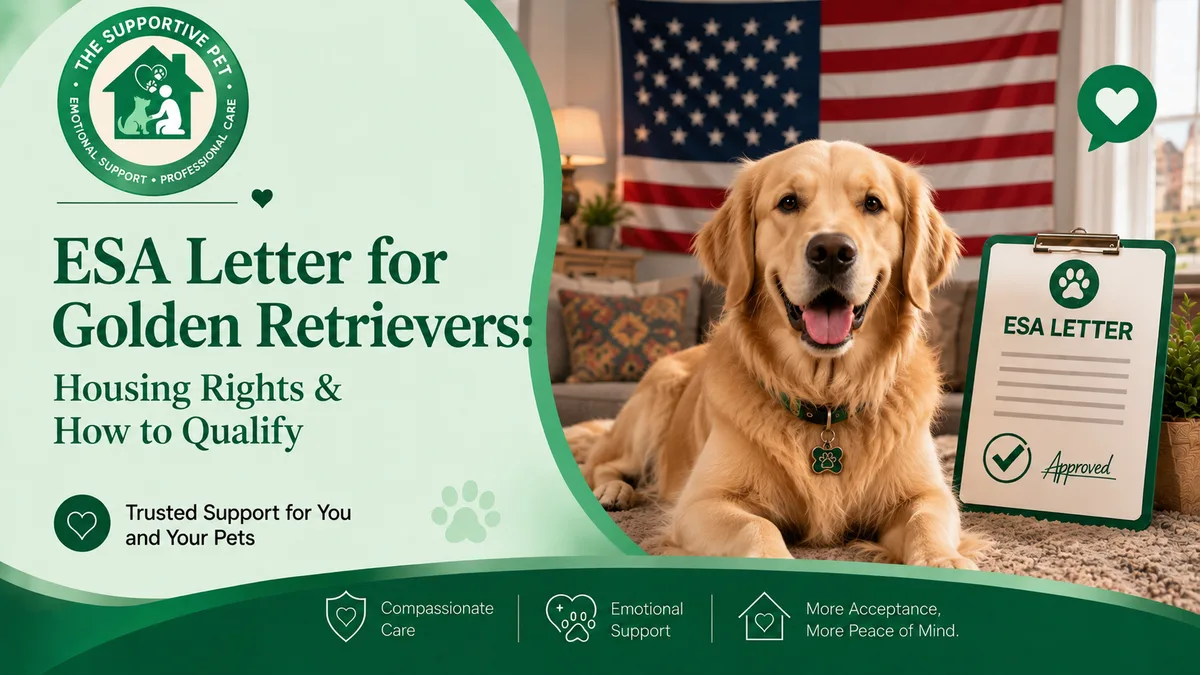
Yes. Any dog breed can be designated as an ESA, including Golden Retrievers. The ESA designation is based on the owner's diagnosed mental health condition and need - not the dog's breed, training, or temperament. Golden Retrievers are among the most commonly designated ESAs due to their empathetic, gentle nature.
Medical Disclaimer: This article is for informational purposes only and does not constitute medical or legal advice. Consult a qualified mental health professional before making decisions about your care. If you or someone you know is in crisis, call or text 988 (Suicide & Crisis Lifeline, available 24/7).
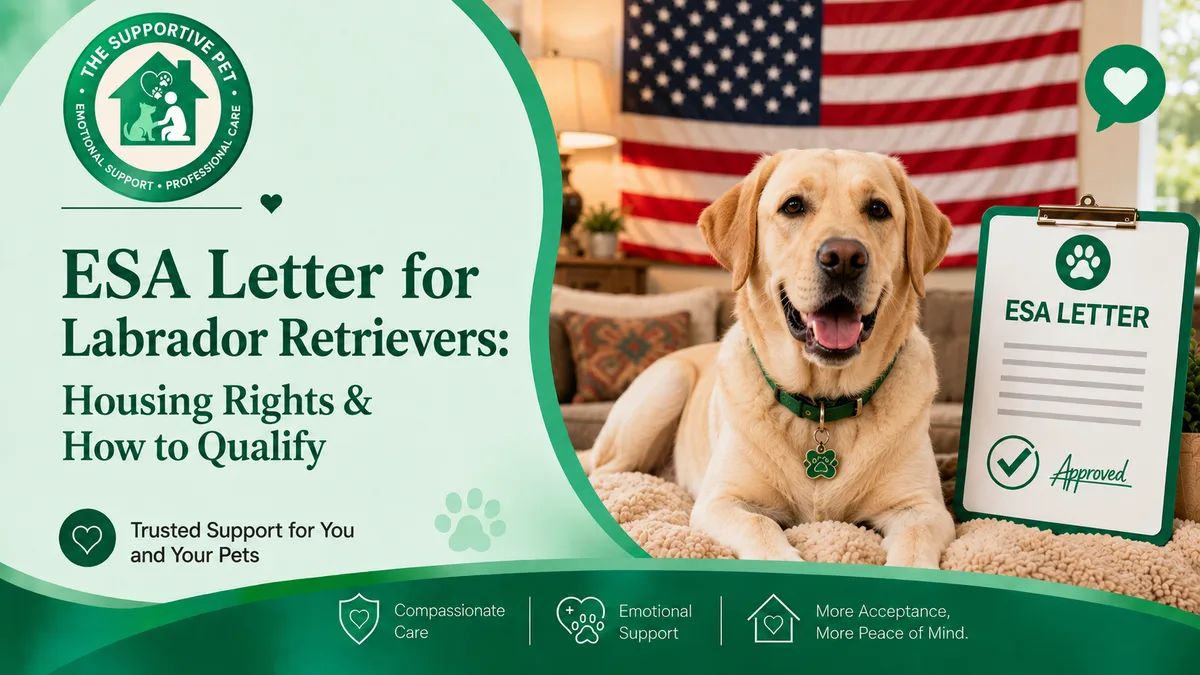
Golden Retrievers are one of the most widely recommended breeds for emotional support roles. Their calm temperament, empathetic nature, and sensitivity to human emotion make them naturally suited to support owners with anxiety, depression, PTSD, and other mental health conditions. If your Golden Retriever helps you manage a diagnosed mental health condition, an ESA letter gives your dog legal protection under the Fair Housing Act - overriding pet bans and eliminating pet fees in any rental housing.
Do Golden Retrievers Face Breed Restrictions?
Unlike breeds commonly targeted by weight or temperament restrictions (such as Pit Bulls, Rottweilers, or Dobermans), Golden Retrievers rarely trigger breed bans. However, many apartment buildings still impose strict no-pet policies or size limits that would prevent a large Golden from living with you. An ESA letter under the Fair Housing Act qualifies you for exemptions from all of these restrictions - no-pet clauses, size limits, and pet fees - for qualifying owners.
What Does an ESA Letter Do for Your Golden Retriever?
- Exempts from no-pet lease clauses - landlords must grant reasonable accommodation regardless of their pet policy
- Eliminates pet deposits and monthly pet rent - documented ESA owners pay zero pet fees
- Exempts from weight limits - Golden Retrievers often exceed the 25-50 lb limits set by many buildings; ESA status eliminates this restriction
- Protects against housing denial - landlords cannot refuse to rent to you based on your ESA
Do I Need an ESA Letter if My Golden Is Already a Pet?
Yes, if you want housing protections. A pet - even a well-behaved Golden Retriever - has no legal protection under the Fair Housing Act. An ESA letter changes your dog's legal status in housing from a pet subject to the landlord's discretion to a reasonable accommodation your landlord is legally required to grant. Many Golden Retriever owners who have been paying pet deposits for years switch to ESA status when they learn they qualify.
Golden Retrievers vs. Psychiatric Service Dogs
Rights Comparison
Golden Retrievers are also one of the most commonly trained psychiatric service dogs (PSDs). If your Golden is specifically trained to perform disability-mitigating tasks - interrupting anxiety spirals, providing deep pressure therapy during panic attacks, or alerting to distress signs - a PSD letter may give you broader protections including public access rights under the ADA. Read the full ESA vs. PSD comparison to see which applies.
How to Get an ESA Letter for Your Golden Retriever
The Clinical Evaluation
You need a letter from a licensed mental health professional (LMHP) who has evaluated you for a qualifying mental health condition. The ESA letter is about your diagnosis and need - not about your dog's training, temperament, or breed. Any dog, including Golden Retrievers, can be designated as an ESA once the owner qualifies.
The Supportive Pet connects you with a state-licensed clinician for a genuine clinical evaluation. Most patients receive their ESA letter the same business day. Start your evaluation here.
Qualifying Mental Health Conditions for Golden Retriever ESA Letters
Who Qualifies
To get an ESA letter for your Golden Retriever, you need a mental health condition that substantially limits one or more major life activities. Common qualifying conditions include anxiety disorders, PTSD, major depression, panic disorder, bipolar disorder, OCD, ADHD, phobias, autism spectrum disorder, and schizophrenia. You don't need a severe diagnosis - moderate symptoms that affect your sleep, work performance, or daily functioning regularly qualify. What matters is that your condition is documented by a licensed clinician and that your dog provides genuine therapeutic benefit.
What the Clinical Evaluation Involves
A legitimate ESA letter comes from a real clinical evaluation - not a 2-minute online form. A licensed mental health professional (therapist, psychologist, psychiatrist, or LCSW) will evaluate your mental health history, current symptoms, and how an emotional support animal helps you manage your condition. The Supportive Pet conducts genuine evaluations by state-licensed clinicians via telehealth. Most patients receive their letter the same business day they complete their evaluation.
No Special Training Required for ESA Status
Unlike service dogs, ESAs do not need specialized training or certification. Your Golden Retriever's ESA status comes entirely from your clinician's letter - not from the animal's training, a registration website, or any ID card or vest. Websites selling ESA certificates, registry memberships, or ID packages provide documents with zero legal standing under the FHA. Your landlord cannot require any of these.
How to Use Your ESA Letter in Golden Retriever Housing
Submitting Your Accommodation Request
Once you have your ESA letter from a licensed clinician, submit a written reasonable accommodation request to your landlord. Include: your name, your unit address, a statement that you have a disability-related need for an emotional support animal, and a copy of your ESA letter. Send this in writing and keep copies. Your landlord must respond in a reasonable timeframe - HUD considers 10 business days a standard expectation.
What Your Landlord Can and Cannot Ask
Your landlord may ask for written documentation from a licensed mental health professional confirming your need for an ESA. They may verify the clinician's license and contact information. They may NOT demand your specific diagnosis, your full medical records, special ESA registration, or documentation from any particular provider. They also may not charge you a pet deposit, pet rent, or any other pet fee for your documented ESA - including your Golden Retriever.
If Your Landlord Denies Your ESA
Most ESA denials are illegal. If your landlord refuses a valid ESA accommodation request without legal justification - denying based on breed, charging pet fees, or ignoring your request - you can file a fair housing complaint with HUD at hud.gov/fairhousing. Complaints are free, and successful complaints can result in the landlord being required to grant the accommodation and pay damages. The Supportive Pet provides free landlord dispute support to every client who receives a letter through our clinicians.
Why Golden Retrievers Are Especially Effective ESAs
Empathy Reading and Emotional Attunement
Golden Retrievers are among the few breeds that spontaneously orient toward human faces during moments of emotional distress - a behavior researchers call "social referencing." Studies at Goldsmiths University found that Golden Retrievers will approach a crying stranger before a calm one, making them unusually responsive to shifts in their owner's emotional baseline. For people managing PTSD hypervigilance, panic disorder, or treatment-resistant depression, a dog that notices deteriorating affect before the owner does can prompt grounding routines earlier in an episode.
This attunement is partly genetic - decades of selective breeding for cooperative hunting reinforced behaviors like sustained eye contact and responsiveness to human body language - and partly relational. Golden Retrievers that live in close daily contact with their owners develop individualized "emotional maps" of their person over time, becoming more accurate responders as the relationship matures.
Therapeutic Roles Golden Retrievers Fill Naturally
- Grounding during dissociation - physical contact and weight provide consistent sensory input that interrupts dissociative episodes common in PTSD and C-PTSD
- Routine anchoring - feeding schedules and walks impose external structure that supports behavioral activation in depression, where initiating activity is the primary barrier
- Social anxiety buffering - a Golden's approachability makes community interactions less threatening, gradually reducing avoidance behavior
- Panic interrupt - trained or untrained, many Golden Retrievers naturally seek physical closeness during panic attacks, which activates the parasympathetic nervous system
Living with a Golden Retriever ESA in an Apartment
Size and Space Management
Golden Retrievers weigh 55–75 lbs at maturity and need roughly 30–60 minutes of vigorous exercise per day, plus mental stimulation. In a smaller apartment this is entirely manageable with commitment to a twice-daily walk schedule and enrichment activities indoors. Many Golden Retriever ESA owners in urban areas report that city walking routes - more sensory variety, more human and dog interactions - actually provide richer enrichment than a suburban yard with limited stimulation.
Practical considerations for apartment Goldens: a crate or defined "den" space reduces separation anxiety; elevated food bowls reduce the gastrointestinal issues common in the breed; regular brushing (2–3 times weekly) keeps shedding manageable in smaller spaces; and enzymatic odor treatments on carpets prevent accumulation that could affect your tenancy.
Common Landlord Objections - and Your Legal Answers
Even though Golden Retrievers are not on any breed-restriction list, landlords may still push back on your ESA accommodation request on size or shedding grounds. Here's how each objection resolves legally:
- "Our policy is no dogs over 25 lbs" - Weight limits are a pet policy. Documented ESAs are reasonable accommodations, not pets. The FHA requires landlords to grant reasonable accommodations that modify their pet rules. Size-based pet policies do not apply.
- "We're worried about damage to the unit" - Landlords may charge for actual damage caused by an ESA (beyond normal wear and tear) after move-out. They may NOT charge a pre-emptive damage deposit. Your Golden's ESA status does not waive your existing security deposit obligations for damages; it waives pet deposits.
- "We need your dog to be certified" - No certification, registration, ID tag, or vest is required or legally meaningful for ESA status. Your clinician's letter is the only documentation required by the FHA.
- "Our building is excluded from the FHA" - Very few properties qualify for FHA exemption: owner-occupied buildings with four or fewer units, and single-family homes sold or rented without a real estate agent. If you live in an apartment building with five or more units, FHA protections apply.
Frequently Asked Questions: ESA Letters for Golden Retrievers
Can I get an ESA letter for my Golden Retriever if I don't currently have a therapist?
Yes. A telehealth ESA evaluation through The Supportive Pet connects you with a state-licensed clinician for a genuine assessment. You do not need an existing therapy relationship. The clinician evaluates your current symptoms, mental health history, and the therapeutic role your Golden plays in your life. If you qualify, you receive a signed letter the same business day in most cases.
My lease says "no pets of any kind" - does an ESA letter still work?
Yes. The Fair Housing Act requires landlords to make reasonable accommodations to their rules, policies, and practices for tenants with disabilities. A blanket no-pets policy is a rule your landlord is legally required to modify for a documented ESA. The only exceptions are if granting the accommodation would pose an undue financial or administrative burden on the landlord (extremely rare for a housing ESA) or if the specific animal poses a direct threat to others that cannot be mitigated.
Do I need a new ESA letter every year for my Golden Retriever?
ESA letters do not expire by law, but landlords may request updated documentation if a letter is more than 12 months old when you renew a lease or move to a new property. Most clinicians issue annual letters. The Supportive Pet provides a free annual renewal evaluation for clients whose original letter was issued by our clinicians.
My landlord accepted my ESA letter but is now charging a "cleaning fee" - is that legal?
No. Landlords cannot charge any pre-emptive or routine cleaning fees for an ESA. They may deduct from your security deposit after move-out for actual cleaning costs attributable to your dog - beyond normal wear and tear - but they cannot impose a recurring ESA cleaning fee or a move-in cleaning deposit. If your landlord is doing this, it is an FHA violation and you can file a fair housing complaint with HUD at hud.gov/fairhousing.
Can a condo HOA deny my ESA?
HOAs are covered by the FHA under most circumstances. Condominiums and planned communities where individual units are rented out, or where the HOA enforces rules affecting tenants, are subject to fair housing reasonable accommodation obligations. Submit your ESA accommodation request to both your landlord and the HOA in writing. If either denies it without legal justification, the HUD complaint process applies.
What if my Golden Retriever behaves aggressively on one occasion - can my landlord remove the ESA?
Landlords may take action if an ESA poses a direct threat to others that cannot be mitigated. A single incident is assessed in context. An isolated reactive moment is not necessarily a "direct threat." A pattern of serious aggressive behavior that cannot be managed through training, handling practices, or other mitigation measures could give a landlord legal grounds to request removal. In practice, well-socialized Golden Retrievers almost never trigger this provision.
Is a Golden Retriever ESA covered in hotels and on flights?
No. ESA protections apply only to housing under the Fair Housing Act. The Air Carrier Access Act no longer requires airlines to accommodate ESAs (as of 2021, all major U.S. carriers treat ESAs as pets). Hotels are governed by the ADA, which covers service animals only - not ESAs. If you need broad public access rights for your Golden Retriever, a PSD letter (which requires task training for a specific disability-related function) is the appropriate designation.
Frequently Asked Questions
Can a Golden Retriever be an emotional support animal?
Yes. Any dog breed can be designated as an ESA, including Golden Retrievers. The ESA designation is based on the owner's diagnosed mental health condition and need - not the dog's breed, training, or temperament. Golden Retrievers are among the most commonly designated ESAs due to their empathetic, gentle nature.
Does an ESA letter eliminate pet fees for my Golden Retriever?
Yes. Under the Fair Housing Act, landlords must waive all pet-related fees - deposits, monthly pet rent, and move-in fees - for documented ESA owners. This applies to Golden Retrievers regardless of the building's pet deposit policy or size restrictions.
What's the difference between a Golden Retriever ESA and a service dog?
An ESA (emotional support animal) provides support through companionship and does not need specific task training. A psychiatric service dog (PSD) is individually trained to perform specific disability-mitigating tasks and has broader public access rights under the ADA. Golden Retrievers can fill either role. Read our ESA vs. PSD comparison to determine which applies to your situation.
See our articles highlighted in Google Search
Add The Supportive Pet as a preferred source - your results, your way.