
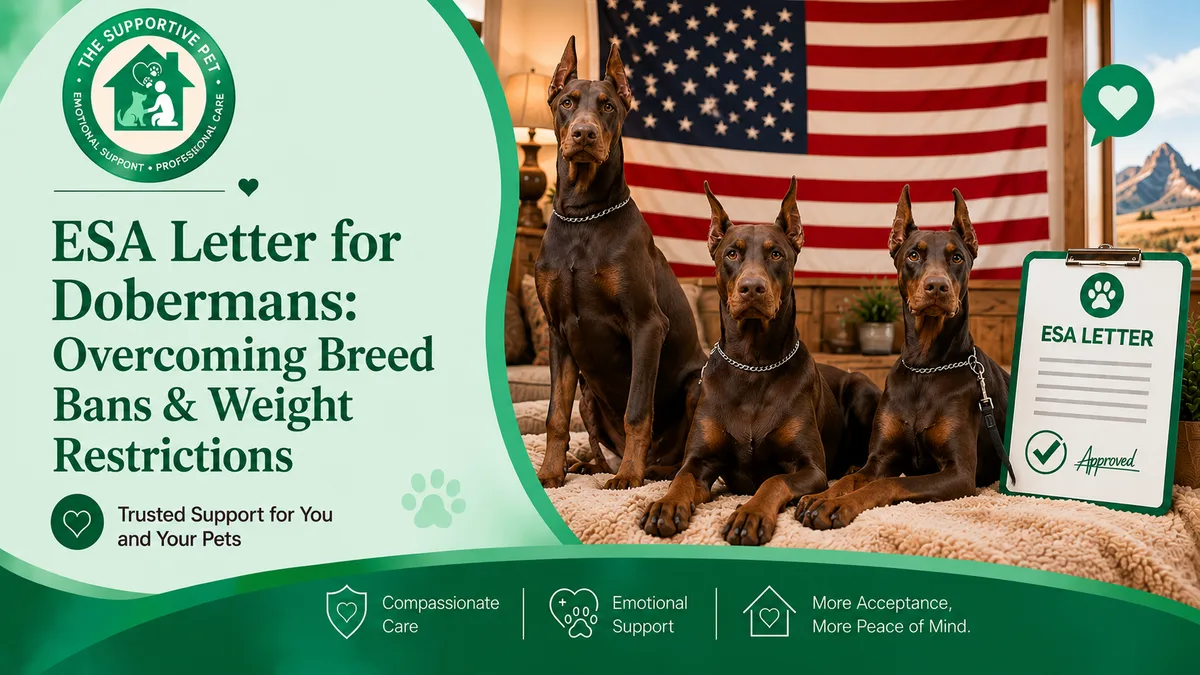
Can a landlord legally ban my Doberman ESA?
No. Under the Fair Housing Act, a valid ESA letter from a licensed mental health professional requires landlords to grant reasonable accommodation regardless of breed restrictions. A landlord can only deny accommodation based on documented evidence that your specific Doberman poses a direct, individualized threat - not a general breed assumption.
Medical Disclaimer: This article is for informational purposes only and does not constitute medical or legal advice. Consult a qualified mental health professional before making decisions about your care. If you or someone you know is in crisis, call or text 988 (Suicide & Crisis Lifeline, available 24/7).
Doberman Pinschers are one of the five breeds most commonly targeted by apartment breed restriction lists - alongside Pit Bulls, Rottweilers, German Shepherds, and Chow Chows. Many property managers ban Dobermans entirely, citing insurer requirements. Under the Fair Housing Act, however, documented ESA owners have the legal right to live with their Doberman regardless of what a lease or building policy says.
Why Dobermans Face Breed Bans
How Breed Restrictions Work
Dobermans are targeted primarily due to their historical association with guard and protection work and their classification on many insurance company restricted breed lists. These classifications are privately set and carry no legal authority over Fair Housing Act accommodations. No federal agency classifies Dobermans as inherently dangerous - individual behavior, not breed, is the legal standard under the FHA.
Dobermans as Emotional Support Animals
Dobermans are highly intelligent, extremely loyal, and deeply bonded to their primary owners. Their sensitivity to human mood and their consistent, attentive presence can be profoundly stabilizing for owners managing anxiety, depression, PTSD, and panic disorder. They thrive with routine and close human connection - qualities that align well with the emotional support role.
What Your ESA Letter Provides
- Breed ban exemption - landlords must accommodate your Doberman regardless of breed restriction policies once you present a valid ESA letter
- Weight limit exemption - Dobermans typically weigh 60–100 lbs, well above most apartment weight caps; ESA status removes this barrier
- Fee elimination - all pet deposits and monthly pet rent are waived for documented ESA owners
- Housing denial protection - landlords cannot refuse to rent to you based on your dog's breed
Responding to Landlord Concerns
When you present your ESA letter, your landlord must evaluate your specific accommodation request in good faith. They cannot deny based on breed alone - they would need documented evidence that your specific Doberman poses a direct threat to health or safety. If a landlord refuses your valid ESA letter, you can file a Fair Housing complaint with HUD. The Supportive Pet provides free landlord dispute support for all clients.
Dobermans vs. Psychiatric Service Dogs
Rights Comparison
Dobermans are task-trainable and can be excellent psychiatric service dogs (PSDs). If your Doberman performs specific trained tasks for your disability - such as guiding during dissociation, alerting before panic attacks, or providing deep pressure therapy - a PSD letter provides housing rights plus full ADA public access rights. Compare your options in our ESA vs. PSD guide.
Getting Your Doberman ESA Letter
Your ESA letter is issued by a licensed mental health professional based on your diagnosed condition - not your dog's breed, training, or credentials. The Supportive Pet works with state-licensed clinicians in all 50 states. Start your evaluation here - most patients receive their letter the same business day.
Qualifying Mental Health Conditions for Doberman ESA Letters
Who Qualifies
To get an ESA letter for your Doberman, you need a mental health condition that substantially limits one or more major life activities. Common qualifying conditions include anxiety disorders, PTSD, major depression, panic disorder, bipolar disorder, OCD, ADHD, phobias, autism spectrum disorder, and schizophrenia. You don't need a severe diagnosis - moderate symptoms that affect your sleep, work performance, or daily functioning regularly qualify. What matters is that your condition is documented by a licensed clinician and that your dog provides genuine therapeutic benefit.
What the Clinical Evaluation Involves
A legitimate ESA letter comes from a real clinical evaluation - not a 2-minute online form. A licensed mental health professional (therapist, psychologist, psychiatrist, or LCSW) will evaluate your mental health history, current symptoms, and how an emotional support animal helps you manage your condition. The Supportive Pet conducts genuine evaluations by state-licensed clinicians via telehealth. Most patients receive their letter the same business day they complete their evaluation.
No Special Training Required for ESA Status
Unlike service dogs, ESAs do not need specialized training or certification. Your Doberman's ESA status comes entirely from your clinician's letter - not from the animal's training, a registration website, or any ID card or vest. Websites selling ESA certificates, registry memberships, or ID packages provide documents with zero legal standing under the FHA. Your landlord cannot require any of these.
How to Use Your ESA Letter in Doberman Housing
Submitting Your Accommodation Request
Once you have your ESA letter from a licensed clinician, submit a written reasonable accommodation request to your landlord. Include: your name, your unit address, a statement that you have a disability-related need for an emotional support animal, and a copy of your ESA letter. Send this in writing and keep copies. Your landlord must respond in a reasonable timeframe - HUD considers 10 business days a standard expectation.
What Your Landlord Can and Cannot Ask
Your landlord may ask for written documentation from a licensed mental health professional confirming your need for an ESA. They may verify the clinician's license and contact information. They may NOT demand your specific diagnosis, your full medical records, special ESA registration, or documentation from any particular provider. They also may not charge you a pet deposit, pet rent, or any other pet fee for your documented ESA - including your Doberman.
If Your Landlord Denies Your ESA
Most ESA denials are illegal. If your landlord refuses a valid ESA accommodation request without legal justification - denying based on breed, charging pet fees, or ignoring your request - you can file a fair housing complaint with HUD at hud.gov/fairhousing. Complaints are free, and successful complaints can result in the landlord being required to grant the accommodation and pay damages. The Supportive Pet provides free landlord dispute support to every client who receives a letter through our clinicians.
Why Dobermans Excel as Emotional Support Animals
Doberman Pinschers are among the most intelligent, loyal, and emotionally responsive dogs ever bred. Originally developed as personal protection dogs, modern Dobermans have been selectively bred over 150 years toward exceptionally close human bonds - they are sometimes called "velcro dogs" because of how strongly they attach to their primary person. This intense bonding is one of the most therapeutically powerful traits in ESA dogs.
For owners managing depression, PTSD, or anxiety, a Doberman's constant awareness and responsiveness to emotional shifts can provide both comfort and a reliable grounding anchor. Their calm in familiar environments - alert without being reactive - creates a sense of security that is particularly valuable for people whose mental health conditions create hypervigilance or fear.
Specific Therapeutic Mechanisms
- Bonding depth: Dobermans form unusually strong single-owner attachments, providing reliable emotional consistency that is protective against depression and anxiety
- Intuitive attunement: They detect subtle behavioral changes in their owners (restlessness, changed breathing patterns, withdrawal) and respond proactively - approaching, leaning, or seeking eye contact
- Structural motivation: Their high exercise and engagement needs create daily routines that protect against the inertia and isolation that worsens depression
- Security presence: For PTSD survivors with hypervigilance, knowing a highly alert animal is monitoring their space allows genuine relaxation that would otherwise be impossible
ESA Letter Protections for Doberman Owners
Many landlords categorize Dobermans alongside pit bulls and Rottweilers as "restricted breeds." An ESA letter legally voids these restrictions. Under the Fair Housing Act, no breed restriction can be applied to a properly documented ESA - the landlord must evaluate your specific animal individually, not by breed profile.
For Doberman owners, the most common challenge is insurance-based breed restrictions. Landlords often cite liability insurance policies that exclude certain breeds. This does not override FHA obligations - the landlord must seek insurance accommodations separately, or face fair housing liability for denying your accommodation request.
Common Landlord Objections for Dobermans
| Objection | Legal Reality |
|---|---|
| "Dobermans are inherently dangerous" | Under FHA, breed generalizations are not sufficient grounds for denial. Only documented direct threat from your specific animal qualifies. |
| "Our other tenants are afraid" | Neighbor discomfort with a breed is not a legally defensible basis for denial. You cannot be penalized for others' breed prejudices. |
| "Our insurance excludes Dobermans" | Insurance policy restrictions do not supersede FHA obligations. Landlord must address insurance separately. |
| "We need proof of training" | ESAs do not require training certification. Basic vaccination and licensing is the only standard documentation a landlord can require. |
Apartment Living With an ESA Doberman
Dobermans can adapt well to apartment living with adequate daily exercise. Their calm indoors, once exercised, contrasts sharply with their reputation. A twice-daily walk of 30–45 minutes is typically sufficient for an adult Doberman. For ESA owners in urban settings:
- Mental enrichment (training games, puzzle feeders) reduces indoor restlessness more than space alone
- Dobermans are quiet indoors compared to many smaller breeds - they are not nuisance barkers when adequately stimulated
- Their short, low-shedding coat means minimal allergen impact in shared buildings
- Crate training a Doberman is straightforward due to their high trainability - important for complying with building rules when common areas must be navigated
Frequently Asked Questions: ESA Letters for Dobermans
Can a landlord deny my ESA Doberman because of the breed?
Not legally. Under the FHA, breed restrictions cannot be applied to ESAs. Your landlord must make an individualized assessment of your specific dog. If your Doberman has no documented history of dangerous behavior, denial based on breed alone is a fair housing violation you can report to HUD.
Does my Doberman need to be trained to be an ESA?
No training is required for ESA designation. Dobermans are highly trainable and basic obedience is recommended for practical management in housing, but no certification, Canine Good Citizen test, or task-specific training is required by law for an ESA.
Will my ESA letter protect my Doberman in a homeowners association?
Yes. HOAs are covered by the FHA. Submit your ESA letter and written accommodation request to the HOA board. They must respond and evaluate your request, and cannot deny solely based on breed. If denied, HUD complaint and state civil rights agency complaint are both available remedies.
My lease was signed before I got my Doberman - can I add them now?
Yes. Your ESA accommodation right exists independently of what your lease says. You can submit an ESA letter and reasonable accommodation request mid-lease. Your landlord cannot enforce the no-pets clause or breed restriction against you once the accommodation is properly submitted, even if the lease predates the dog.
Can my landlord charge an extra deposit because of my Doberman's size?
No. ESA owners cannot be charged any pet-related fees - deposits, monthly pet rent, or breed/size surcharges. Your landlord can only charge for actual documented damage beyond normal wear at move-out.
What if the HOA or landlord requires their own form instead of accepting my ESA letter?
The Fair Housing Act allows housing providers to request information on a standard form, but you are not required to use their form if your existing ESA letter contains the required information (clinician license number, state, diagnosis-related need, and signature). Submit your letter with a cover note explaining that it contains all required FHA documentation.
Can I get an ESA letter for my Doberman if I only have mild anxiety?
Yes. There is no severity threshold for ESA eligibility. Any mental health condition recognized in the DSM-5 that substantially limits a major life activity (including housing access) qualifies. Mild anxiety that causes you to avoid certain housing situations or lose sleep over housing security is a qualifying condition. The clinician's assessment determines eligibility, not a severity scale.
Frequently Asked Questions
Can a landlord legally ban my Doberman ESA?
No. Under the Fair Housing Act, a valid ESA letter from a licensed mental health professional requires landlords to grant reasonable accommodation regardless of breed restrictions. A landlord can only deny accommodation based on documented evidence that your specific Doberman poses a direct, individualized threat - not a general breed assumption.
My lease says 'no Dobermans.' Does an ESA letter qualify me for an exemption from my lease restriction?
Yes. Fair Housing Act protections are federal law and supersede lease provisions. A breed-specific ban in a lease does not override your FHA rights as a documented ESA owner. You are still entitled to request and receive reasonable accommodation even if your lease explicitly excludes your breed.
Does a Doberman ESA owner still pay pet rent?
No. Documented ESA owners pay zero pet fees - no deposit, no monthly pet rent, no move-in fee - under the Fair Housing Act. This applies to all breeds including Dobermans, regardless of the building's standard pet fee policy.
See our articles highlighted in Google Search
Add The Supportive Pet as a preferred source - your results, your way.