
Can a bird be an emotional support animal?
Yes. Birds - including parrots, cockatiels, budgies, and canaries - can be designated as emotional support animals under the Fair Housing Act. A licensed mental health professional must write an ESA letter based on your diagnosed condition and need. Once documented, your landlord must grant reasonable accommodation for your bird ESA regardless of no-pet policies.
Medical Disclaimer: This article is for informational purposes only and does not constitute medical or legal advice. Consult a qualified mental health professional before making decisions about your care. If you or someone you know is in crisis, call or text 988 (Suicide & Crisis Lifeline, available 24/7).
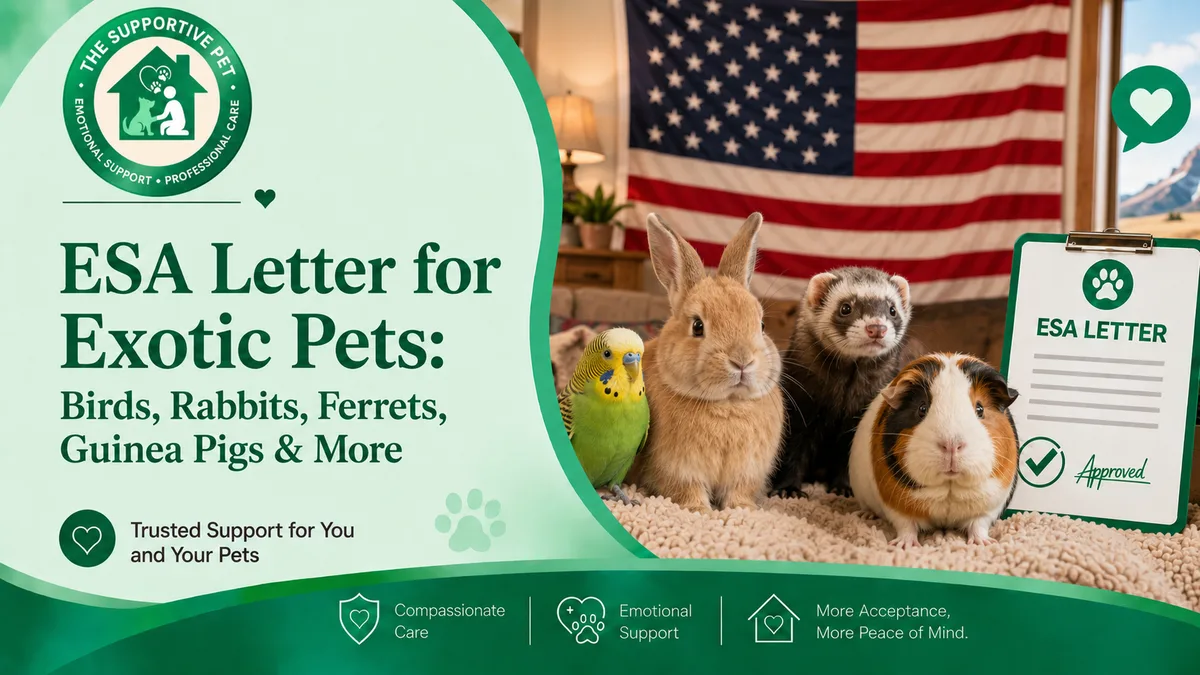
Emotional support animals are not limited to dogs and cats. Under the Fair Housing Act, a licensed mental health professional can designate virtually any domesticated animal as your ESA - including birds, rabbits, ferrets, guinea pigs, hamsters, reptiles, fish, and other small exotic animals. If your non-traditional pet provides genuine emotional support for a diagnosed mental health condition, you have the right to live with them in most housing - regardless of the building's no-pet policy.
Which Exotic Pets Can Be ESAs?
HUD guidance applies the ESA accommodation requirement to any animal that is not excluded by law (such as inherently dangerous exotic animals). Common non-dog, non-cat ESAs include:
- Birds (parrots, cockatiels, budgies, canaries) - many owners find birds' responsiveness, routine, and vocalizations deeply calming for anxiety and depression
- Rabbits - gentle, quiet, and responsive; widely used as ESAs for anxiety, depression, and trauma recovery
- Ferrets - playful and interactive; effective for owners who benefit from active engagement and companionship
- Guinea pigs and hamsters - low-maintenance and soothing; commonly used as ESAs for children and adults with anxiety disorders
- Reptiles (bearded dragons, leopard geckos) - quiet, low-allergy, and calming; effective for owners who find pet care routines grounding
- Fish - aquarium fish have documented stress-reducing effects; can qualify as ESAs when supported by clinical documentation
What Housing Rights Do Exotic Pet ESAs Have?
The same Fair Housing Act protections that apply to dog and cat ESAs apply to all designated ESAs:
- Landlords must grant reasonable accommodation regardless of no-pet policies
- Pet deposits and monthly pet rent are waived for documented ESA owners
- Species-specific bans in lease agreements do not override FHA accommodation rights
However, landlords can deny accommodation if the animal poses a direct health or safety threat, is not typically kept as a household pet, or if accommodation would cause undue hardship - a higher bar that must be individually assessed, not assumed by species.
Limits: What Exotic ESAs Cannot Do
Exotic ESAs generally do not have the same public access rights as service animals under the ADA. ADA public access (restaurants, stores, transit) is limited to service dogs trained to perform specific tasks for a person with a disability. Your bird, rabbit, or ferret ESA is protected in housing - but not in public spaces beyond housing.
How Landlords May Respond to Exotic ESA Requests
Landlords are less familiar with exotic ESA requests and may initially push back. They can ask for your documentation from a licensed mental health professional, but they cannot:
- Demand species-specific justification beyond your standard ESA letter
- Charge pet fees for a documented ESA of any species
- Deny accommodation based on species alone unless there is a specific direct threat or legal exclusion
If a landlord denies your exotic ESA accommodation, you can file a Fair Housing complaint with HUD. The Supportive Pet provides free landlord dispute support for all clients.
How to Get an ESA Letter for Your Exotic Pet
The Clinical Evaluation
The process is identical to any ESA letter: a licensed mental health professional evaluates you for a qualifying mental health condition and writes a letter confirming your disability-related need for your specific animal (or designating a specific animal). The letter is about your mental health - your bird, rabbit, or ferret is designated as the ESA once you qualify.
Start your evaluation at The Supportive Pet. Our clinicians are experienced with non-traditional ESA designations and can work with any domesticated animal.
Qualifying Mental Health Conditions for Exotic Pet ESA Letters
Who Qualifies
To get an ESA letter for your Exotic Pet, you need a mental health condition that substantially limits one or more major life activities. Common qualifying conditions include anxiety disorders, PTSD, major depression, panic disorder, bipolar disorder, OCD, ADHD, phobias, autism spectrum disorder, and schizophrenia. You don't need a severe diagnosis - moderate symptoms that affect your sleep, work performance, or daily functioning regularly qualify. What matters is that your condition is documented by a licensed clinician and that your exotic pet provides genuine therapeutic benefit.
What the Clinical Evaluation Involves
A legitimate ESA letter comes from a real clinical evaluation - not a 2-minute online form. A licensed mental health professional (therapist, psychologist, psychiatrist, or LCSW) will evaluate your mental health history, current symptoms, and how an emotional support animal helps you manage your condition. The Supportive Pet conducts genuine evaluations by state-licensed clinicians via telehealth. Most patients receive their letter the same business day they complete their evaluation.
No Special Training Required for ESA Status
Unlike service dogs, ESAs do not need specialized training or certification. Your Exotic Pet's ESA status comes entirely from your clinician's letter - not from the animal's training, a registration website, or any ID card or vest. Websites selling ESA certificates, registry memberships, or ID packages provide documents with zero legal standing under the FHA. Your landlord cannot require any of these.
How to Use Your ESA Letter in Exotic Pet Housing
Submitting Your Accommodation Request
Once you have your ESA letter from a licensed clinician, submit a written reasonable accommodation request to your landlord. Include: your name, your unit address, a statement that you have a disability-related need for an emotional support animal, and a copy of your ESA letter. Send this in writing and keep copies. Your landlord must respond in a reasonable timeframe - HUD considers 10 business days a standard expectation.
What Your Landlord Can and Cannot Ask
Your landlord may ask for written documentation from a licensed mental health professional confirming your need for an ESA. They may verify the clinician's license and contact information. They may NOT demand your specific diagnosis, your full medical records, special ESA registration, or documentation from any particular provider. They also may not charge you a pet deposit, pet rent, or any other pet fee for your documented ESA - including your Exotic Pet.
If Your Landlord Denies Your ESA
Most ESA denials are illegal. If your landlord refuses a valid ESA accommodation request without legal justification - denying based on breed, charging pet fees, or ignoring your request - you can file a fair housing complaint with HUD at hud.gov/fairhousing. Complaints are free, and successful complaints can result in the landlord being required to grant the accommodation and pay damages. The Supportive Pet provides free landlord dispute support to every client who receives a letter through our clinicians.
Frequently Asked Questions
Can a bird be an emotional support animal?
Yes. Birds - including parrots, cockatiels, budgies, and canaries - can be designated as emotional support animals under the Fair Housing Act. A licensed mental health professional must write an ESA letter based on your diagnosed condition and need. Once documented, your landlord must grant reasonable accommodation for your bird ESA regardless of no-pet policies.
Can a rabbit be an ESA?
Yes. Rabbits are among the most common non-dog, non-cat ESAs. They are quiet, gentle, and do not typically pose issues for apartment living. With a valid ESA letter from a licensed mental health professional, your landlord cannot deny accommodation for your rabbit or charge pet fees.
Does my ferret count as an ESA for housing?
Yes, in most states. Ferrets are considered domesticated animals and can qualify as ESAs under the Fair Housing Act. Note that ferrets are banned in California and Hawaii - in those states, ferret ESA accommodation cannot be claimed. In all other states, a valid ESA letter entitles you to reasonable accommodation for your ferret.
Can my landlord deny my exotic pet ESA?
A landlord can only deny an exotic ESA accommodation if: (1) the animal poses a direct threat to health or safety that cannot be reduced by accommodation, (2) keeping the animal would cause substantial physical damage to the property, or (3) the animal species is inherently dangerous or not typically kept as a household pet. They cannot deny based solely on species or a general no-exotic-pets policy.
See our articles highlighted in Google Search
Add The Supportive Pet as a preferred source - your results, your way.