
Can I have an ESA in a condo that does not allow pets?
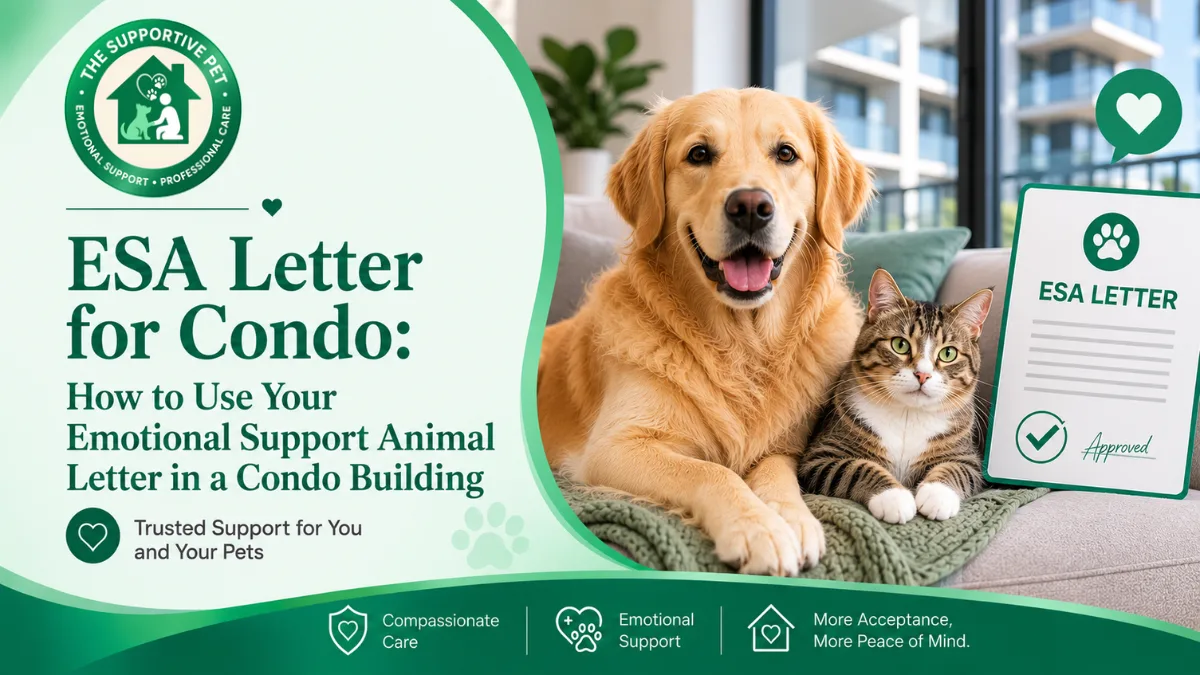
Yes, in most cases. The Fair Housing Act covers condominium buildings and requires condo associations to make reasonable accommodations for assistance animals, including ESAs. A condo no-pet policy cannot override FHA requirements. Submit your ESA letter to the condo association or management as a formal reasonable accommodation request.
Key Takeaways
- Condo associations must provide reasonable accommodation for ESAs under the FHA regardless of their no-pets policies or CC&R restrictions.
- Even owner-occupied condos are subject to FHA requirements when the condo association controls common areas and sets community rules that affect all residents.
- Your ESA letter and accommodation request should go to the condo board in writing; keep copies of all correspondence for any future HUD complaint or fair housing action.
Medical Disclaimer: This article is for informational purposes only and does not constitute medical or legal advice. Consult a qualified mental health professional before making decisions about your care. If you or someone you know is in crisis, call or text 988 (Suicide & Crisis Lifeline, available 24/7).
Condo associations present a unique ESA challenge: you may be dealing with both a condo board (which governs the building) and an individual unit owner landlord (who leases to you). Both must comply with the Fair Housing Act, but the process for requesting and enforcing your accommodation may involve two separate decision-makers. Understanding how condo structures work under the FHA is essential for anyone seeking ESA accommodation in a condo unit.
Condos and the Fair Housing Act
Condominium buildings - whether the unit owner lives there or rents to a tenant - are covered by the Fair Housing Act. This coverage extends to the condo association's rules and the individual unit owner's lease terms. Neither can override FHA disability accommodation requirements.
The specific party responsible for granting your accommodation depends on your housing arrangement:
- If you own your condo unit: Submit your ESA accommodation request to the condo association or HOA board. They must grant the accommodation regardless of building-wide pet restrictions.
- If you rent a condo unit: Submit to your landlord (the unit owner). Your landlord must grant the accommodation in your unit. For common areas, the condo association is the relevant authority - your landlord may need to submit a request on your behalf, or you may be able to submit directly to the association.
Step-by-Step: Submitting Your ESA Letter to a Condo Association
- Obtain your ESA letter from a licensed mental health professional at The Supportive Pet or your treating clinician. The letter should be recent (within the last 12 months), on the clinician's letterhead, and include their license number.
- Identify the correct recipient. For a condo you own, this is the association board or management company. For a rental condo, this is primarily your landlord, with a copy potentially going to the association if common areas are involved.
- Write a formal accommodation request letter. State that you are requesting a reasonable accommodation under the Fair Housing Act for your emotional support animal. Identify the animal (species, name, description) and attach your ESA letter. Keep the medical details brief - you do not need to disclose your diagnosis.
- Submit via certified mail or email with read receipt. Documentation of submission date and delivery is important if the association later claims they did not receive your request.
- Follow up within 10 business days if you do not receive a response. Associations must respond within a reasonable timeframe.
Condo Common Areas and Your ESA
Your FHA accommodation covers your use of your housing - including common areas you have a right to access as a resident. Common areas in condo buildings that your ESA can typically access include:
- Lobbies and hallways used to access your unit.
- Elevators (necessary to access your unit).
- Stairwells and other access areas.
Areas that might be contested (amenity-only areas like pools, gyms, or clubhouses) exist in a grayer zone - whether your ESA can access these depends on the specific circumstances and may require separate negotiation. For essential access to your unit, the FHA is clear.
Handling Condo Board Pushback
Condo associations are sometimes resistant to ESA accommodations, citing governing documents, deed restrictions, or other resident complaints. The approach is the same as for any FHA accommodation dispute:
- Provide your ESA letter and cite the FHA (42 U.S.C. § 3604) in your written request.
- Request that any denial be provided in writing with the stated reason.
- If denied, file a complaint with HUD at hud.gov or contact a fair housing attorney.
From the Clinician
Condo associations often present a specific set of complications. They argue that their CC&Rs were established by the original developer and cannot be overridden by individual accommodation requests. This is legally incorrect - the FHA supersedes HOA governing documents, including CC&Rs - but condo boards may need to see that stated explicitly. HUD's assistance animal guidance clarifies that housing providers must provide reasonable accommodations to residents with disabilities. This applies even when doing so requires a deviation from their stated policies. Condo associations are explicitly covered. My letters for condo residents frame the request as a statutory obligation, not a favor.
Client scenario: A client with PTSD was told by their condo association that "no animals of any kind" were permitted per their master deed. The association claimed that even service animals required board approval. I provided documentation framing the request as an FHA accommodation. The client filed a formal reasonable-accommodation request rather than asking the board for an "exception." The board approved within their legally required time frame. The client later told me that changing the framing made all the difference. Shifting from "can I have a pet?" to "I am requesting a reasonable accommodation under federal law" changed the entire tone of the interaction.
A Fair Look at the Other Side
Condo associations managing high-density buildings with shared amenities - pools, gyms, lobbies - sometimes have genuine safety or sanitation concerns that aren't pretextual. When those concerns are raised honestly, they may warrant a conversation about where and how the animal accompanies its handler. Residents who approach those conversations with specificity tend to reach faster resolution. Explaining what your animal does, describing its behavior in shared spaces, and presenting clear documentation all help move things forward.
Related guides: ESA letter for HOAs · ESA housing rights guide · Landlord denied your ESA
State-Specific Condo ESA Rules to Know
Florida Condos and SB 1084
Florida has a particularly high concentration of condo communities, and Florida's SB 1084 specifically addresses ESA documentation standards in housing contexts including condos. Florida condo associations can request verification that your ESA letter was issued by a licensed Florida mental health professional who evaluated you in accordance with clinical standards. A letter from a licensed Florida LCSW, LPC, psychologist, or psychiatrist following proper evaluation procedures is specifically what SB 1084 protects - it's fraudulent letters that face legal risk, not legitimate ones.
California Condos and AB 468
California condo associations are subject to the same AB 468 requirements as other California housing: the letter must come from a California-licensed mental health professional who has had an established relationship with you for at least 30 days. California condo boards that receive letters from online services issuing instant letters without proper relationships are within their rights under AB 468 to question the letter's validity. Working with a California-licensed clinician through a service that follows AB 468 procedures produces letters that California condo boards cannot legitimately reject.
New York Co-ops vs Condos: An Important Distinction
In New York City, co-op apartments (where you own shares, not a unit) are governed by co-op boards with broad discretion over residents. However, co-op boards must comply with the NYC Human Rights Law and NY State Human Rights Law on ESA accommodation requests - the board's discretionary powers do not override fair housing law. Condo unit owners in NYC can also rent their units subject to the same protections. ESA accommodation requests in both co-op and condo contexts should be submitted in writing to the managing entity.
Frequently Asked Questions
Can I have an ESA in a condo that does not allow pets?
Yes, in most cases. The Fair Housing Act covers condominium buildings and requires condo associations to make reasonable accommodations for assistance animals, including ESAs. A condo no-pet policy cannot override FHA requirements. Submit your ESA letter to the condo association or management as a formal reasonable accommodation request.
Who do I submit my ESA letter to in a condo building?
If you own your condo unit, submit to the condo association or HOA board. If you are renting a condo unit, submit to your landlord (the unit owner). Your landlord may also need to notify the condo association. In some cases, you may need to submit to both your landlord and the association - check your lease and the condo's governing documents to understand the reporting structure.
Can a condo association ban ESAs because of a master deed restriction?
No. Master deed restrictions, CC&Rs, and other governing documents cannot override the Fair Housing Act. Federal law supersedes these private contractual arrangements when it comes to disability accommodation. If your condo association claims a deed restriction prohibits ESAs, they are confusing private contract law with federal civil rights law - the FHA takes precedence.
What if my ESA makes noise or causes issues in a shared condo building?
Your ESA must be under your control and cannot cause a direct threat to others or significant damage to property. Nuisance behavior - excessive barking, aggressive behavior, or property damage - can be grounds for the association to modify the accommodation or require additional management. However, hypothetical or speculative concerns (a neighbor might be allergic, a neighbor might not like dogs) are not sufficient grounds for denial.
See our articles highlighted in Google Search
Add The Supportive Pet as a preferred source - your results, your way.