
Can a landlord ask for my medical records for an ESA?
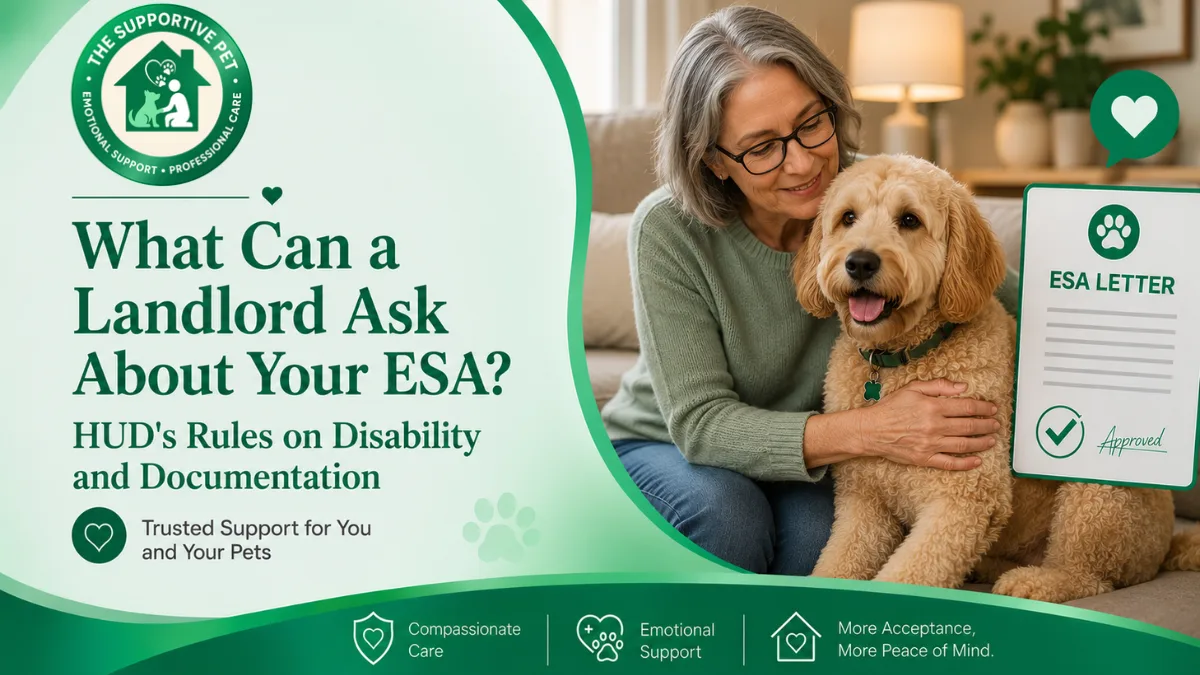
No. A landlord cannot ask for your medical records, clinical notes, or detailed psychiatric history as part of an ESA accommodation request. Under 2020 HUD guidance, a landlord may request reliable documentation if your disability is not obvious or known, but that documentation is a letter from a licensed clinician confirming disability and therapeutic nexus - not your medical records.
Key Takeaways
- A landlord may ask two questions: does the tenant have a disability, and does the animal provide disability-related support - they may not ask for a diagnosis or medical records.
- Under HUD guidance, a landlord can request reliable documentation of disability and nexus, which a licensed professional's letter satisfies - nothing more is required.
- Landlords cannot charge a pet deposit for an ESA, demand veterinary records, or require breed or weight exemptions - these requests exceed what HUD permits.
Medical Disclaimer: This article is for informational purposes only and does not constitute medical or legal advice. Consult a qualified mental health professional before making decisions about your care. If you or someone you know is in crisis, call or text 988 (Suicide & Crisis Lifeline, available 24/7).
One of the most confusing aspects of the ESA accommodation process is knowing what your landlord is legally permitted to ask - and what crosses the line into disability discrimination. The FHA framework is actually quite clear on this: landlords can ask two narrow questions, verify a clinician's license, and request the ESA letter itself. They cannot demand your medical records, insist on specific documentation formats, or require your animal to pass tests or evaluations. Here is the definitive breakdown.
The HUD Framework: What Landlords Are Allowed to Ask
The Department of Housing and Urban Development's January 2020 guidance on assistance animals (FHEO-2020-01) is the primary authority on what housing providers can and cannot do when evaluating ESA accommodation requests. Under this framework, landlords are permitted to ask two things:
- Whether the requesting person has a disability
- Whether the animal provides therapeutic support related to that disability
That is the scope of permissible inquiry. Everything else - specific diagnoses, medical records, treatment history, proof of registration, or behavioral testing of the animal - is outside the bounds of what landlords can require.
The Two-Track System: Obvious vs Non-Obvious Disabilities
HUD's 2020 guidance distinguishes between situations where the disability is obvious (e.g., a person with a visible physical disability) and where it is not obvious (e.g., a mental health condition). For non-obvious disabilities - which includes virtually all mental health conditions qualifying someone for an ESA - the landlord may request documentation from a licensed professional.
That documentation is a letter from a licensed mental health professional (psychiatrist, psychologist, LCSW, LPC, or LMFT) that:
- Confirms the person has a disability under the FHA's definition
- Confirms that the animal provides support related to that disability
- Is signed by a professional licensed in the state where the housing is located
This is exactly what The Supportive Pet provides. The letter does not need to - and should not - include your specific diagnosis, symptom details, treatment history, or other private medical information.
What Landlords Cannot Ask or Require
Under HUD guidance, landlords cannot require:
- Your specific mental health diagnosis
- Medical records or clinical notes
- Proof that you have seen a therapist for a minimum period of time
- That the clinician signing the letter has a preexisting relationship with you
- National registration certificates, ID cards, or vest requirements for your ESA
- Proof that the animal has specific training
- Behavioral testing or evaluation of the animal
- A letter from a specific type of provider (any licensed mental health professional qualifies)
What Landlords Can Legitimately Verify
Landlords can take these steps to verify your ESA accommodation request:
- Contact the clinician whose name and license number appear on the letter to confirm the letter is authentic
- Verify that the clinician is licensed in the relevant state through the state licensing board's public website
- Ask you to identify the specific animal your request covers (name, species, description)
- Confirm the letter is current - HUD guidance suggests letters should be within the last 12 months for ongoing accommodations
Responding When a Landlord Asks for Too Much
If your landlord asks for more than HUD allows - your diagnosis, medical records, or proof of a long-term treatment relationship - respond in writing:
"Thank you for your response. Under HUD's 2020 guidance on assistance animals (FHEO-2020-01), housing providers may request reliable documentation that confirms I have a disability and that my ESA provides therapeutic benefit related to that disability. I have provided this documentation in the form of a letter from a licensed mental health professional. I am not required to provide my specific diagnosis, medical records, or other health information. Please confirm that my accommodation request is being reviewed pursuant to the FHA."
If the landlord continues to require unauthorized information as a condition of reviewing your request, this may itself constitute an FHA violation. Contact HUD or a fair housing attorney.
From the Clinician
The question landlords are actually permitted to ask - "do you have a disability, and does the animal provide disability-related support?" - is narrower than most tenants realize, and narrower than most landlords act. HUD's 2020 guidance specifies that landlords cannot demand a diagnosis, ask about the severity of the disability, request the animal's training records, or require the animal to demonstrate its tasks. What they can do is request "reliable documentation" from a licensed professional - which is exactly what a clinical ESA letter provides. When I write these letters, I deliberately include the elements HUD says are reasonable: confirmation of a disability, the therapeutic nexus between the disability and the animal, and my licensure information. The goal is to answer the landlord's permissible questions before they ask them.
Client scenario: A client's landlord sent a list of twelve questions after receiving their ESA letter, including requests for medical records, the animal's vaccine history, and a signed statement from the client's psychiatrist. After I explained which questions the landlord was permitted to ask under HUD guidance, the client responded in writing citing specific HUD provisions, offered only the items HUD permitted (a copy of my licensure and a brief supplemental letter), and the landlord accepted the accommodation without further escalation.
A Fair Look at the Other Side
Landlords ask probing questions partly because ESA fraud is a real and documented problem - the FTC has noted the proliferation of fake ESA registries that sell meaningless certificates to people who want to bypass pet policies without a legitimate disability need. A landlord who receives a single-sentence letter from a provider they've never heard of and can't verify online has legitimate reason to ask follow-up questions. Tenants and clinicians who provide documentation that is thorough, verifiable, and specific - and who are patient with requests for clarification - are rarely the ones whose cases end in escalation.
Related guides: What to do if your ESA letter is rejected · Landlord denied your ESA · ESA housing rights guide
When Landlords Cross the Line: What to Do
Responding to Improper Questions
If your landlord asks improper questions - your specific diagnosis, details about your symptoms, or demands to see your therapy records - you are not obligated to answer. A professional, firm response: "Under the Fair Housing Act, landlords are not permitted to request medical records or details about a tenant's specific diagnosis. I am happy to provide my ESA letter from a licensed clinician and confirm that I have a disability-related need for my animal. Please let me know if you have specific concerns about the documentation provided." This response addresses the landlord's likely underlying concern (letter legitimacy) while clearly declining to answer impermissible questions.
Third-Party Verification Services: Red Flag
Some landlords and property management companies use third-party ESA verification services that charge tenants $25-$75 to verify their letter and create a profile in a database. These services have no legal standing under the FHA - there is no HUD-approved ESA verification registry, and landlords cannot require tenants to pay for or participate in such verification as a condition of accommodation. If your landlord requires third-party verification, this is a potential FHA compliance issue worth documenting and potentially raising with HUD.
Documenting Improper Requests for Future Use
If your landlord makes improper requests or asks discriminatory questions, document them in writing. Reply to verbal requests by email: "As a follow-up to our conversation, you asked [specific question]. I wanted to confirm in writing that under the FHA, this type of request is not permitted." This creates a paper trail that can be valuable if the accommodation is later denied and you need to file a fair housing complaint demonstrating a pattern of improper behavior during the request process.
Frequently Asked Questions
Can a landlord ask for my medical records for an ESA?
No. A landlord cannot ask for your medical records, clinical notes, or detailed psychiatric history as part of an ESA accommodation request. Under 2020 HUD guidance, a landlord may request reliable documentation if your disability is not obvious or known, but that documentation is a letter from a licensed clinician confirming disability and therapeutic nexus - not your medical records.
Can a landlord ask what my mental health diagnosis is?
No. Landlords cannot ask for your specific diagnosis. HUD guidance allows landlords to request confirmation that you have a disability and that the animal provides therapeutic benefit related to that disability - they cannot ask what type of disability or condition you have. If your landlord asks for a specific diagnosis, you can decline and state that this exceeds what HUD allows.
Can a landlord ask to meet my ESA or test it?
A landlord can ask that the animal be identified (name, species, description) and may request that you confirm the animal is housebroken, but they cannot require your ESA to pass a behavioral test, be evaluated by a trainer, or demonstrate specific behaviors. ESAs are not required to have any training, and landlords cannot impose training standards as a condition of accommodation.
Can a landlord verify my ESA letter?
Yes. Landlords may contact the clinician who signed your ESA letter to verify that the letter is authentic and that the clinician is licensed in your state. They cannot ask the clinician for details about your condition beyond what is in the letter. This is why obtaining a letter from a legitimately licensed clinician matters - verification should hold up to scrutiny.
Can a landlord charge an extra deposit or fee for an ESA?
No. Landlords cannot charge a pet deposit, pet fee, or additional monthly fee for an ESA. An ESA is an assistance animal, not a pet. A landlord can, however, hold you liable for actual damages caused by the animal - but they cannot charge a preemptive deposit as a condition of accommodation.
See our articles highlighted in Google Search
Add The Supportive Pet as a preferred source - your results, your way.