
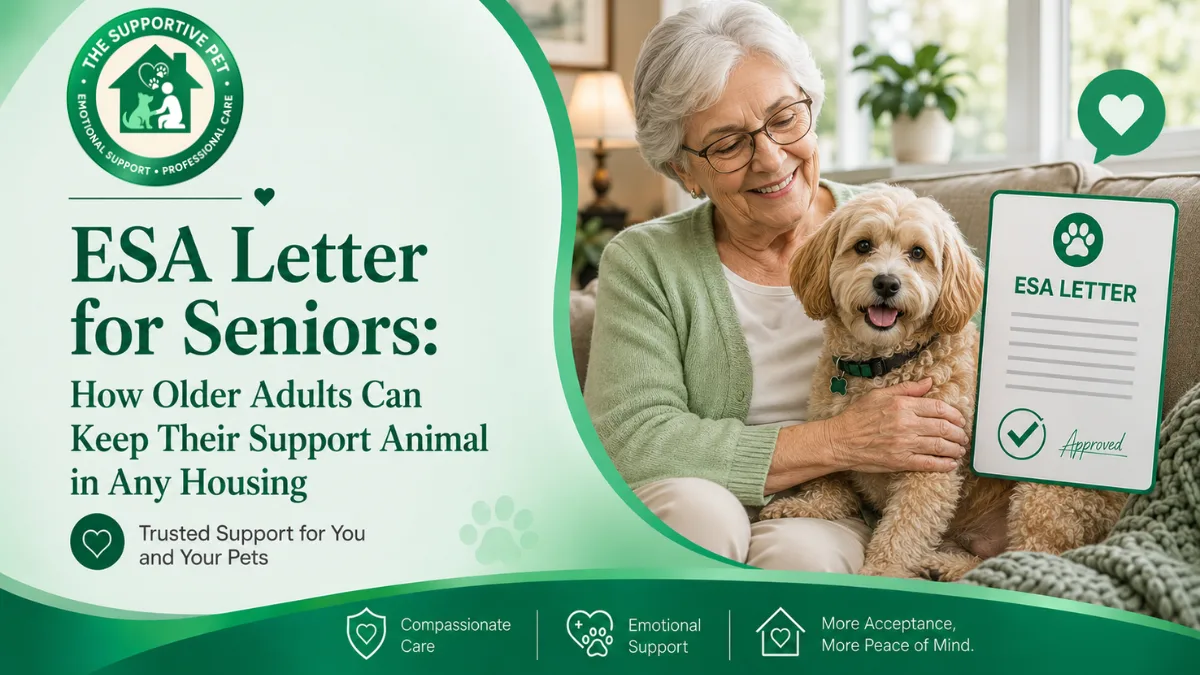
Can seniors keep their emotional support animal in a no-pet senior community?
Yes. Senior housing communities - including independent living communities, senior apartments, and age-restricted communities - are covered by the Fair Housing Act. A valid ESA letter from a licensed mental health professional entitles seniors to request a reasonable accommodation for their emotional support animal regardless of the community's no-pet policy.
Key Takeaways
- Senior housing communities - including age-55+ and age-62+ communities - must provide ESA accommodation under the FHA, even with strict no-pet policies in their governing documents.
- Research shows pet ownership among older adults can reduce depression, lower blood pressure, and combat loneliness - benefits clinicians can document as a therapeutic nexus for ESA letters.
- Seniors in assisted living or memory care settings may also request ESA accommodation; the process involves the clinical team and facility administrator, following FHA principles.
Medical Disclaimer: This article is for informational purposes only and does not constitute medical or legal advice. Consult a qualified mental health professional before making decisions about your care. If you or someone you know is in crisis, call or text 988 (Suicide & Crisis Lifeline, available 24/7).
In Brief
- Most senior housing is covered by the Fair Housing Act.
- You can request ESA housing rights even in no-pet senior housing.
- A licensed clinician writes your ESA letter after an online review.
- Landlords and housing staff must consider your request.
- Pet deposits and breed rules do not apply to ESAs.
- The review can be done from home - no in-person visit needed.
Why ESAs Matter More in Senior Years
The helpful benefits of animals are well-documented for older adults. Social isolation is a major risk factor for depression, anxiety, and cognitive decline. It is a particular issue for seniors in senior housing away from family. Companion animals provide:
- Social connection: Consistent, non-judgmental companionship that reduces loneliness.
- Physical routine: The care schedule of a pet imposes meaningful daily structure.
- Sense of purpose: Being responsible for another living being counters the loss of role and purpose. This is common after leaving work or moving.
- Physical activity: Pet ownership, mainly dogs, increases physical activity and reduces low-activity behavior.
- Mood improvement: The body-level effects of animal interaction - reduced cortisol, increased oxytocin - directly benefit mental health.
For many seniors, the prospect of losing their companion animal when moving to senior housing is a deep loss. The Fair Housing Act protects against that.
Research Snapshot: Pets and Senior Mental Health
- Nearly 1 in 4 adults aged 65+ experience clinically major social isolation. This raises the risk of depression, dementia, and early death by 26% (CDC, 2023).
- A 2020 study in Psychogeriatrics found that pet-owning adults 65+ scored 36% lower on standardized depression scales than non-pet-owners. This was measured in the same senior housing settings.
- Pet owners in senior living housing had a 31% lower rate of mood drug prescriptions than matched non-pet-owners. This was found in a 3-year University of Missouri study (2019).
Senior Housing and the FHA: What Is Covered
The FHA covers most senior housing, including:
- Age-55+ and age-62+ housing (senior apartments and senior living).
- Senior subsidized housing (HUD-assisted and Section 8 eligible senior housing).
- Senior condominiums and HOA housing.
- Continuing Care Retirement Communities (CCRCs) in their independent and assisted living sections.
Standard assisted living homes fall into a gray area. homes that provide primarily residential services may be FHA-covered. Those that function as medical homes may be covered by Section 504 of the Rehabilitation Act. This applies to federally funded homes. State regulations may also apply. If you are uncertain about a specific home type, contact HUD for guidance.
How to Request an ESA housing right in Senior Housing
- Get your ESA letter. A licensed mental health professional evaluates the senior's mental health condition and the helpful benefit of their animal. The online process at The Supportive Pet can be completed at home - no in-person visit required.
- Submit a written housing right request to the housing complex's management or staff. Attach the ESA letter and state that you are requesting a reasonable housing right under the Fair Housing Act.
- Reference the FHA explicitly if the complex initially resists based on their no-pet policy. Many senior housing staff are not familiar with FHA requirements for assistance animals. A clear, written request citing the law is often enough to resolve the issue.
- Get any denial in writing. If the complex denies your request, ask for the denial in writing with the stated reason. This record is essential for any subsequent complaint or legal action.
Special Situations in Senior Housing
Moving to a new senior complex: If you are moving to senior housing and currently have an ESA, request the housing right before signing the lease. Do not wait until after move-in to raise the issue. Do not wait until after move-in to raise the issue. See our guide: Moving with an ESA letter.
For those with dementia or cognitive conditions: Some residents cannot on their own describe the helpful relationship with their animal. In those cases, a family member, caregiver, or treating physician can provide context for the clinician's review.
From the Housing Specialist
Senior housing presents some of the hardest ESA cases I work on. The stakes are uniquely high - this may be the last housing situation a person ever chooses. Access to a companion animal matters deeply. Research from the CDC suggests that companion animals can reduce loneliness and support mental health in older adults - a finding that, in clinical terms, supports the helpful link I build for seniors. Many senior housing have "no pets" policies they believe are absolute. They are not, when FHA applies. And most senior housing - senior living, assisted living, age-55+ housing - does fall under FHA.
Client scenario: An 82-year-old client with major depressive disorder and grief from loss had lived with their cat for 14 years when they moved to a senior living complex that prohibited pets. A clinical review noted the helpful relationship and the impact of forced separation on the client's depression. A housing right request was then submitted. The complex approved the housing right, noting they had not previously considered their pet policy in the context of assistance animal law.
A Fair Look at the Other Side
Senior housing sometimes have pet restrictions that reflect genuine daily concerns - residents with allergies, shared dining areas, mobility considerations in common spaces, or limited staff capacity to assist with animal-related incidents. A one-size housing right response that doesn't acknowledge these dynamics can delay resolution. Residents and clinicians who address the complex's real concerns tend to get faster outcomes. In the request letter, note that the animal is well-behaved in shared spaces and fully vaccinated. Also state that your condition does not prevent you from managing its care.
Related guides: ESA letter for HOAs · ESA housing rights · What landlords can ask about your ESA
Why ESAs Are Particularly Valuable for Older Adults
Research on pet ownership and senior health outcomes is among the most robust in the human-animal bond literature. For adults 65 and older, companion animals provide measurable physical and psychological benefits that translate directly into ESA therapeutic value:
- Depression: Loneliness and isolation are leading drivers of late-life depression. Companion animals provide daily social engagement and routine that protects against isolation.
- Anxiety: Health-related anxiety, which is more prevalent in older adults, responds well to animal-assisted support. Tactile contact with animals reduces cortisol levels measurably.
- Cognitive function: Caring for an animal maintains cognitive engagement, executive function (planning, problem-solving), and sense of purpose — protective factors against cognitive decline.
- Physical activity: Dog ownership specifically is associated with increased physical activity in older adults, which has downstream effects on cardiovascular health and mobility.
Senior Housing and ESA Rights
Active Adult Communities (55+)
Age-restricted communities (designed for adults 55 or older) are covered by the FHA. They cannot deny ESA accommodation based on their community rules or lease terms. Many 55+ communities have pet policies that allow small animals — even where pet policies are restrictive, ESA accommodation must be offered regardless of general pet rules.
Independent Living Facilities
Independent living facilities that function as standard housing are covered by the FHA. Submit your ESA accommodation request to the facility management following the same process as any rental housing.
Assisted Living and Memory Care
This is more complex. Assisted living facilities are regulated as healthcare facilities, not just housing, and their licensing requirements and safety protocols may create legitimate competing concerns with ESA accommodation. Some facilities welcome animal companions enthusiastically; others have genuine health and safety reasons to limit animals. Consult with the facility's administration and your healthcare provider to navigate this situation.
Continuing Care Retirement Communities (CCRCs)
The residential portions of CCRCs are typically covered by FHA. As with assisted living, the healthcare portions of CCRCs introduce complexities. The residential apartment component should follow FHA reasonable accommodation standards.
Finding a Clinician for a Senior ESA Evaluation
Seniors seeking an ESA letter can work with:
- Their current psychiatrist or psychologist who manages mental health treatment
- Their primary care physician if a mental health diagnosis is part of their medical record
- A geriatric care specialist who treats late-life depression or anxiety
- Telehealth mental health services that serve senior patients
Telehealth options are particularly practical for seniors with mobility limitations — a video or phone consultation with a licensed clinician can be completed from home without transportation.
Common Senior Housing Scenarios
Moving to a Pet-Restricted Retirement Community
Submit your ESA accommodation request before or at the time of your lease signing. It is easier to establish ESA rights at move-in than to negotiate them after the fact. Present your current ESA letter and written accommodation request as part of your application materials.
Existing Tenant Adding an ESA
If you are already a resident and want to add an ESA, submit a reasonable accommodation request with your current ESA letter. Your landlord or facility must consider the request regardless of your existing lease terms.
Frequently Asked Questions: ESAs for Seniors
Can a senior care facility ban all animals for health and safety reasons?
A blanket ban on all animals in a facility may be justified in healthcare settings with specific sanitation and immunocompromised resident concerns. However, in the residential portions of a facility, FHA reasonable accommodation standards apply, and the facility must engage in individualized assessment rather than blanket prohibition.
What mental health conditions qualify a senior for an ESA?
The same conditions that qualify anyone: depression, anxiety, PTSD, adjustment disorder, grief-related disorder, bipolar disorder, and others recognized in the DSM-5 that substantially limit a major life activity. Late-life depression, which affects approximately 15–20% of adults over 65, is a qualifying condition.
My parent has dementia and wants to keep their cat — can an ESA letter help?
An ESA letter requires a licensed clinician's assessment of the person's mental health condition and their ability to benefit from and care for the animal. In advanced dementia where the person cannot maintain an animal safely, an ESA letter may not be appropriate. This situation requires careful coordination with the healthcare team and family members who can assist with animal care.
Can a nursing home refuse an ESA?
Nursing homes are primarily healthcare facilities and may have legitimate health and safety justifications for animal restrictions, including infection control requirements. However, facilities that include residential housing components may still be subject to FHA in those portions. A fair housing attorney can advise on the specific facility's legal status.
Frequently Asked Questions
Can seniors keep their emotional support animal in a no-pet senior community?
Yes. Senior housing communities - including independent living communities, senior apartments, and age-restricted communities - are covered by the Fair Housing Act. A valid ESA letter from a licensed mental health professional entitles seniors to request a reasonable accommodation for their emotional support animal regardless of the community's no-pet policy.
Is assisted living covered by the Fair Housing Act?
It depends. Standard independent living and senior apartment communities are clearly covered. Assisted living facilities (ALFs) occupy a gray area: those that primarily provide housing are covered by the FHA; those that function primarily as medical or care facilities may be covered by different regulations. If you are in an assisted living facility, check with a fair housing attorney or contact HUD for guidance specific to your situation.
Can an ESA help with senior loneliness and depression?
Yes - and research strongly supports this. Social isolation and loneliness are major risk factors for depression and cognitive decline in older adults. Companion animals provide consistent social connection, physical touch, meaningful routine, and a sense of purpose - all of which are therapeutically significant for seniors. These benefits can form the basis of a genuine therapeutic nexus for ESA documentation.
How can I help my elderly parent get an ESA letter for their senior housing?
You can assist your parent through the application process. The evaluation is conducted with the individual who has the qualifying condition - your parent - and the ESA letter documents their disability. You can help with technology, complete intake forms alongside them, or participate in the process as a support person. The clinician will assess your parent's mental health and therapeutic relationship with their animal.
See our articles highlighted in Google Search
Add The Supportive Pet as a preferred source - your results, your way.