
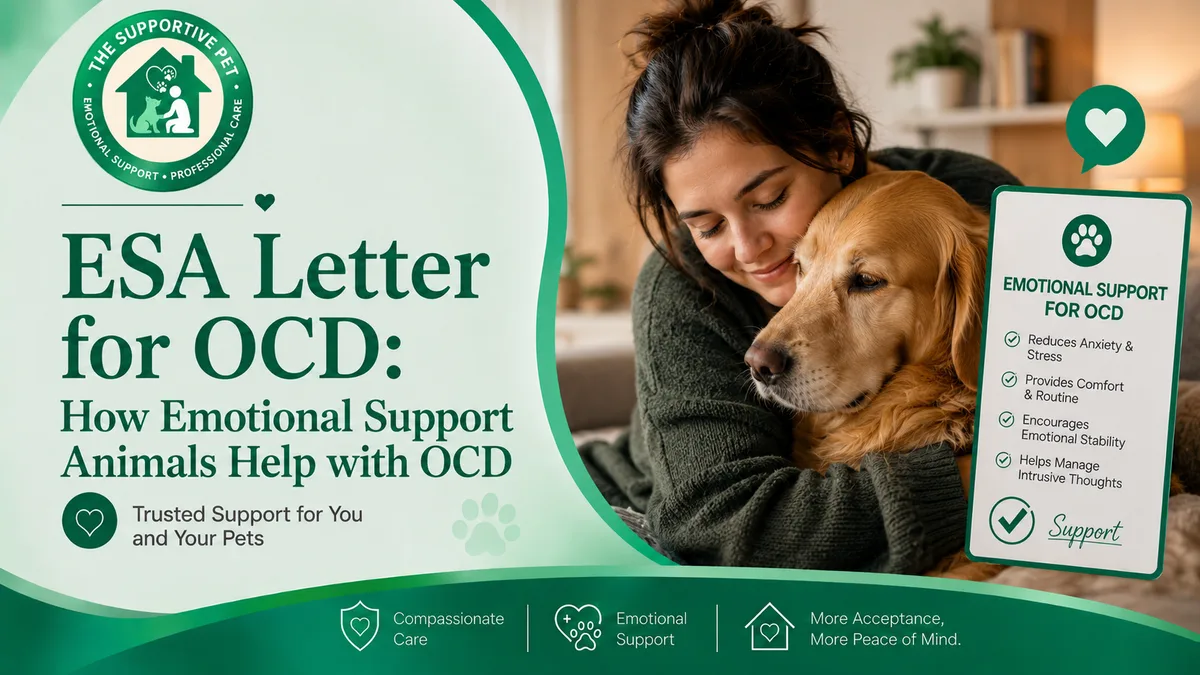
Does OCD qualify for an ESA letter?
Yes. OCD is a recognized DSM-5 mental health condition, and a licensed clinician may determine that an emotional support animal provides therapeutic benefit for your OCD. If so, you qualify for an ESA letter that gives you housing protections under the Fair Housing Act.
Medical Disclaimer: This article is for informational purposes only and does not constitute medical or legal advice. Consult a qualified mental health professional before making decisions about your care. If you or someone you know is in crisis, call or text 988 (Suicide & Crisis Lifeline, available 24/7).
Obsessive-compulsive disorder affects approximately 2.3% of the US population - about 1 in 40 people - and is classified as a DSM-5 mental health condition that qualifies for ESA accommodation under the Fair Housing Act. If your OCD significantly impacts your daily functioning and you find that your pet provides measurable relief from obsessions, compulsions, or anxiety spikes, you may qualify for an ESA letter from a licensed mental health professional. This guide explains how OCD qualifies, what the clinical evaluation looks like, and your housing rights once you have your letter.
Does OCD Qualify for an Emotional Support Animal?
Yes. Obsessive-Compulsive Disorder (OCD) is a recognized mental health condition under the DSM-5, and individuals with OCD may qualify for an ESA letter when a licensed clinician determines that an emotional support animal provides meaningful therapeutic benefit.
Under the Fair Housing Act, having a valid ESA letter from a licensed mental health professional entitles you to housing accommodations regardless of a property's no-pet policy - no pet deposits, no breed restrictions, no additional fees.
How OCD Affects Daily Life
OCD is characterized by persistent, unwanted intrusive thoughts (obsessions) and repetitive behaviors or mental acts performed to reduce the anxiety those thoughts create (compulsions). The cycle can consume hours of a person's day and significantly impair:
- Work performance and academic achievement
- Relationships and social functioning
- Personal hygiene, eating patterns, and sleep quality
- The ability to leave home or complete routine daily tasks
People with OCD often experience intense shame and social isolation. The constant mental effort required to manage intrusive thoughts is exhausting, and many avoid activities that trigger their obsessions. This isolation can worsen the condition over time.
How Emotional Support Animals Help with OCD
While emotional support animals are not trained to perform specific OCD-related tasks (that is the role of a psychiatric service dog), the presence of a companion animal can provide meaningful relief in several documented ways:
- Interrupting compulsive cycles - an animal's need for care, attention, and interaction can redirect focus away from compulsive behaviors and rumination
- Reducing baseline anxiety - petting and interacting with animals has been shown to lower cortisol levels and activate the parasympathetic nervous system, producing a calming effect
- Grounding during intrusive thoughts - the physical presence of an ESA provides sensory grounding, helping interrupt the cognitive spiral associated with OCD episodes
- Providing structured routine - caring for an animal requires predictable daily routines (feeding, exercise, grooming), which can be stabilizing for people with OCD who struggle with uncertainty and unpredictability
- Reducing loneliness and shame - ESAs provide unconditional companionship without judgment, reducing the isolation that OCD frequently creates
OCD Subtypes That Most Commonly Qualify
Contamination OCD
Contamination OCD involves intrusive fears of germs, disease, or pollution that drive excessive cleaning, handwashing, or avoidance behaviors. Animals have been shown to help interrupt contamination-OCD cycles by providing grounding stimulus - the physical sensation of petting an animal can redirect the nervous system away from the anxiety loop. Licensed clinicians evaluating contamination OCD for ESA documentation assess whether this therapeutic benefit is present and clinically meaningful for the individual.
Pure O (Pure Obsessional OCD)
Pure-O OCD involves intrusive, unwanted thoughts without outward compulsions visible to others - though the internal mental rituals can be exhausting and debilitating. For Pure-O sufferers, an ESA's non-judgmental presence can provide a grounding anchor during intrusive thought spirals. The therapeutic mechanism is different from contamination OCD but equally valid clinically when documented by a licensed professional.
OCD With Comorbid Conditions
OCD frequently co-occurs with anxiety disorders, depression, and PTSD. When OCD presents with comorbidities, the combined functional impairment can be significant - and ESA documentation may address the full diagnostic picture rather than OCD alone. A thorough clinical evaluation considers all presenting conditions when assessing ESA appropriateness.
ESA vs. Psychiatric Service Dog for OCD: What's the Difference?
It's worth understanding the distinction, since both can help people with OCD:
- Emotional Support Animal (ESA): Provides emotional comfort through companionship. No specialized training required. Any species qualifies. Protected under the Fair Housing Act for housing accommodations.
- Psychiatric Service Dog (PSD): Trained to perform specific tasks that mitigate OCD symptoms - for example, interrupting compulsive behaviors, retrieving medication, or providing deep pressure therapy during a crisis. Only dogs qualify. Protected under the ADA for public access rights in addition to housing. See our complete PSD letter guide.
Many people with OCD benefit significantly from an ESA without needing a PSD. A licensed clinician can help you determine which option is more appropriate for your specific situation and symptom profile.
What the Research Says
Research on animal-assisted intervention (AAI) suggests that interaction with animals can reduce anxiety and compulsive behaviors in people with OCD. Studies have found that sessions involving animals produce measurable reductions in anxiety markers and self-reported compulsive urges.
While an ESA is not a substitute for evidence-based OCD treatments like Exposure and Response Prevention (ERP) therapy or medication, many people find that their ESA complements their treatment plan - providing daily emotional regulation support between therapy sessions. For more on the documented benefits, see our post on how pets reduce anxiety.
How to Get an ESA Letter for OCD
- Complete a clinical evaluation - a licensed mental health professional evaluates your OCD symptoms and determines whether an ESA provides therapeutic benefit for your specific situation
- Receive your ESA letter - if you qualify, your clinician issues a signed letter on their professional letterhead, including their license number, name, and contact information
- Submit the letter to your landlord - your landlord must make reasonable accommodations under the Fair Housing Act; they cannot charge pet deposits or enforce no-pet policies against your ESA
At The Supportive Pet, we connect you with licensed clinicians who understand OCD and other anxiety-related conditions. Most residents receive their letter the fast their evaluation is complete. View pricing or start your evaluation here.
OCD, ESA Letters, and Your Housing Rights
Once you have an ESA letter for OCD, you have clear housing protections under the Fair Housing Act. Your landlord must accommodate your ESA as a reasonable accommodation regardless of their no-pet policy. This means no pet deposits, no pet rent, and no breed or size restrictions based on no-pet rules. Landlords can ask two questions: (1) do you have a disability-related need for the animal, and (2) does the animal perform work or provide assistance related to that need? They cannot ask for your OCD diagnosis details, require you to disclose your treatment history, or demand access to your medical records.
If your ESA accommodation is denied, you can file a complaint with HUD's Office of Fair Housing and Equal Opportunity. OCD is a recognized disability under the FHA, and letters from licensed clinicians are the standard form of documentation. See our complete guide to ESA housing rights and what to do if your landlord denies your ESA.
Frequently Asked Questions
Does OCD qualify for an ESA letter?
Yes. OCD is a recognized DSM-5 mental health condition, and a licensed clinician may determine that an emotional support animal provides therapeutic benefit for your OCD. If so, you qualify for an ESA letter that gives you housing protections under the Fair Housing Act.
What is the difference between an ESA and a psychiatric service dog for OCD?
An ESA provides emotional comfort through companionship - no specialized training is required. A psychiatric service dog (PSD) is trained to perform specific tasks that mitigate OCD symptoms, such as interrupting compulsive behaviors. ESAs are protected under the FHA for housing; PSDs have broader ADA public access rights.
Can an ESA help reduce OCD symptoms?
Research on animal-assisted intervention suggests that interaction with animals can reduce anxiety and compulsive behaviors associated with OCD. While not a replacement for therapy or medication, many individuals with OCD report that their ESA helps interrupt compulsive cycles, reduces baseline anxiety, and provides grounding during intrusive thought episodes.
How do I get an ESA letter for OCD?
Schedule an evaluation with a licensed mental health professional who will assess your OCD and determine whether an ESA provides therapeutic benefit. If you qualify, they will issue a signed ESA letter on their professional letterhead with their license information. At The Supportive Pet, most residents receive their letter the fast.
Can my landlord deny my ESA if I have OCD?
Your landlord cannot deny your ESA accommodation request simply because of your diagnosis. Under the Fair Housing Act, landlords must make reasonable accommodations for tenants with a valid ESA letter, regardless of no-pet policies. They can only deny in very limited circumstances, such as if the specific animal poses a direct threat.
See our articles highlighted in Google Search
Add The Supportive Pet as a preferred source - your results, your way.