
Does social anxiety qualify for an ESA letter?
Yes. Social Anxiety Disorder (SAD) is a recognized DSM-5 mental health condition. A licensed clinician can evaluate whether your social anxiety substantially limits a major life activity and whether an ESA provides therapeutic benefit - both of which support ESA qualification under the Fair Housing Act.
Medical Disclaimer: This article is for informational purposes only and does not constitute medical or legal advice. Consult a qualified mental health professional before making decisions about your care. If you or someone you know is in crisis, call or text 988 (Suicide & Crisis Lifeline, available 24/7).
Social anxiety disorder - also called social phobia - is the second most common anxiety disorder in the United States, affecting about 7% of the adult population. It's characterized by intense fear of social situations and scrutiny by others, going far beyond shyness. For many people with social anxiety, having an animal present at home provides a non-judgmental safe space that measurably reduces baseline anxiety and helps them recover after difficult social interactions. If your social anxiety substantially limits your daily life and your pet provides this kind of therapeutic benefit, you may qualify for an ESA letter from a licensed mental health professional.
In Brief
- Social anxiety disorder can qualify for an ESA letter.
- The Fair Housing Act protects your right to keep an ESA in no-pet housing.
- A licensed clinician reviews your case and writes the letter.
- Your landlord cannot charge a pet deposit for your ESA.
- Breed and size rules do not apply to ESAs.
- The review is done online - most letters are ready the fast.
Does Social Anxiety Qualify for an ESA?
Yes. Social Anxiety Disorder (SAD) - also called social phobia - is a recognized DSM-5 mental health condition. It can qualify for an ESA letter. A licensed clinician must determine that an emotional support animal provides real benefit.
Social anxiety is far more than shyness. It is a chronic, severe fear of social situations in which a person believes they will be judged or humiliated. For many, it greatly limits the ability to work, maintain bonds, or do daily tasks. This can qualify it as a disability under the Fair Housing Act.
How Social Anxiety Affects Daily Life
People with social anxiety disorder often experience:
- Intense fear and avoidance of social contact, including conversations, meetings, and public tasks.
- Physical symptoms during social situations: rapid heartbeat, sweating, trembling, nausea, and trouble speaking.
- Pre-event worry that can begin days or weeks before a social event.
- Significant interference with work, school, and bonds.
- loneliness from avoiding social contact.
- trouble with basic tasks like making phone calls, eating in public, or mixing with neighbors.
The avoidance that social anxiety creates often becomes its own trap - avoiding social situations temporarily reduces anxiety but reinforces the fear over time, making the condition progressively more limiting.
How Emotional Support Animals Help with Social Anxiety
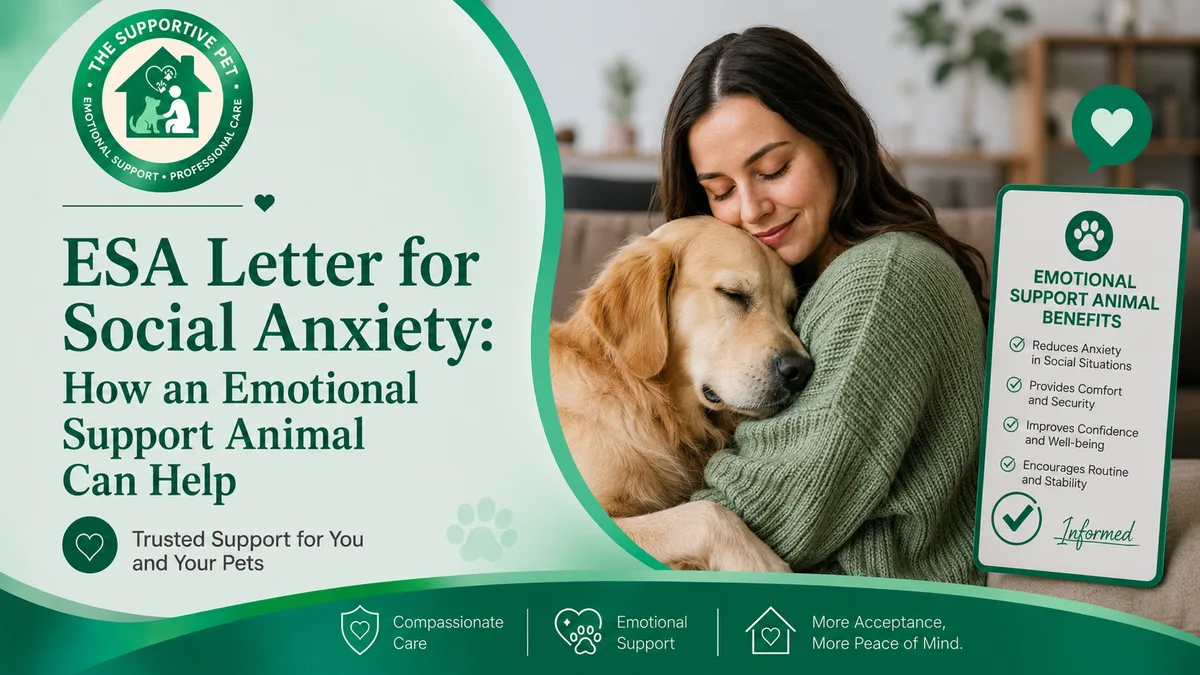
An ESA provides several forms of support that are particularly beneficial for people with social anxiety:
- Patient, caring company - animals do not evaluate, criticize, or judge, which is exactly the opposite of what social anxiety fears. The bond with an ESA provides a safe, steady form of social connection.
- Reducing loneliness - social anxiety often leads to withdrawal and loneliness. An ESA provides consistent company that breaks that cycle without the fear of social judgment.
- Lowering anxiety in the home setting - having a calming animal presence can reduce the general anxiety level that makes social contact so challenging.
- Providing a social "bridge" - mixing with neighbors or acquaintances about a pet can be lower-stakes than direct social contact, helping people with social anxiety practice small social connections.
- Grounding during anxiety spikes - petting an animal turns on the calming system. This leads to lower heart rate and less stress hormone (see: how pets reduce anxiety).
Why Animals Specifically Help with Social Anxiety
The Oxytocin Connection
Research published in peer-reviewed journals shows that positive human-animal interaction triggers the release of oxytocin - the same bonding hormone released during human social connection - without the social evaluation threat that makes those interactions difficult for social anxiety sufferers. Interacting with a pet activates the social bonding circuitry without the performance anxiety component, providing therapeutic benefit through a unique neurochemical pathway.
Safe Return Base
Attachment theory describes a "secure base" from which anxious individuals can venture out. For social anxiety sufferers, a pet functions as a non-judgmental secure base - something consistent and accepting to return to after the demands of social interaction. This is especially meaningful for people who live alone and might otherwise have no safe emotional space to recover in after difficult days.
Routine and Structure
Social anxiety often disrupts healthy routine - avoidance can lead to isolation and withdrawn daily patterns. A pet's needs impose a gentle external structure: feeding schedules, exercise, regular care. This structure provides entry points back into organized daily living, which therapeutic frameworks for social anxiety (like behavioral activation therapy) consider an important part of recovery.
ESA Alongside Treatment for Social Anxiety
An ESA is not a replacement for proven treatment of social anxiety. The most effective approaches include:
- Cognitive Behavioral Therapy (CBT) with exposure exercises - the top proven treatment for social anxiety.
- Medication - SSRIs and SNRIs are often prescribed for social anxiety.
- Group therapy - provides a supportive setting for practicing social skills.
Many people find that their ESA adds to these treatments. It provides daily mood support between sessions and reduces the background worry that makes therapy possible.
How to Get an ESA Letter for Social Anxiety
- Complete a clinical review with a licensed mental health clinician. They assess your social anxiety and decide whether an ESA provides real benefit.
- Receive your letter - if you qualify, your clinician issues a signed ESA letter on their clinician letterhead with their name, license number, and contact details.
- Present your letter to your landlord - they must allow your ESA under the Fair Housing Act, regardless of no-pet policies.
At The Supportive Pet, a licensed clinician will review your case and, if you qualify, issue your letter the fast. Your details are kept private. Once you have your letter, our ESA apartment guide walks you through submitting it to your landlord. View pricing or start your review here.
Social Anxiety, Housing, and ESA Rights
Social anxiety disorder is a DSM-5 classified condition that qualifies as a disability under the Fair Housing Act when it substantially limits major life activities. Once you have an ESA letter for social anxiety, your landlord must accommodate your ESA under the FHA - waiving pet deposits, pet rent, and no-pet restrictions. Your landlord cannot demand your clinical records or details about your social anxiety diagnosis.
Social anxiety can also make the confrontational aspects of asserting ESA rights particularly stressful. If your landlord denies or delays your accommodation request, you don't have to negotiate directly - you can file a fair housing complaint with HUD or your state's fair housing agency, which handles the process on your behalf. See also our guide on ESA housing rights and what landlords can and cannot do.
If your social anxiety affects university life, our guide on ESA letters for college housing covers the Section 504 and FHA protections that apply to on-campus accommodations.
Frequently Asked Questions
Does social anxiety qualify for an ESA letter?
Yes. Social Anxiety Disorder (SAD) is a recognized DSM-5 mental health condition. A licensed clinician can evaluate whether your social anxiety substantially limits a major life activity and whether an ESA provides therapeutic benefit - both of which support ESA qualification under the Fair Housing Act.
How does an ESA help with social anxiety?
An emotional support animal provides consistent, non-judgmental companionship. For people with social anxiety, this reduces the loneliness and isolation the condition creates, lowers baseline anxiety levels, and provides a calming presence during stressful situations. Many people with social anxiety also find that having an ESA gives them a social "buffer" when navigating social situations at home or with neighbors.
Can an ESA make social anxiety worse?
For most people with social anxiety, an ESA is beneficial rather than harmful. However, if someone becomes overly dependent on their animal to avoid all social situations, it can potentially reinforce avoidance behaviors. This is why ESA care works best alongside therapy - particularly Cognitive Behavioral Therapy (CBT), which directly addresses social anxiety.
What is the fastest way to get an ESA letter for social anxiety?
Complete an evaluation with a licensed mental health professional who can issue your letter the fast. At The Supportive Pet, most residents receive their ESA letter the same business day they complete their evaluation - the process takes under an hour from start to finish (excluding states with waiting period requirements).
Will my landlord accept an ESA letter for social anxiety?
Yes. A properly documented ESA letter from a licensed clinician is accepted by landlords under the Fair Housing Act regardless of the underlying diagnosis. Your landlord cannot discriminate based on your mental health condition or demand to know your specific diagnosis.
See our articles highlighted in Google Search
Add The Supportive Pet as a preferred source - your results, your way.