
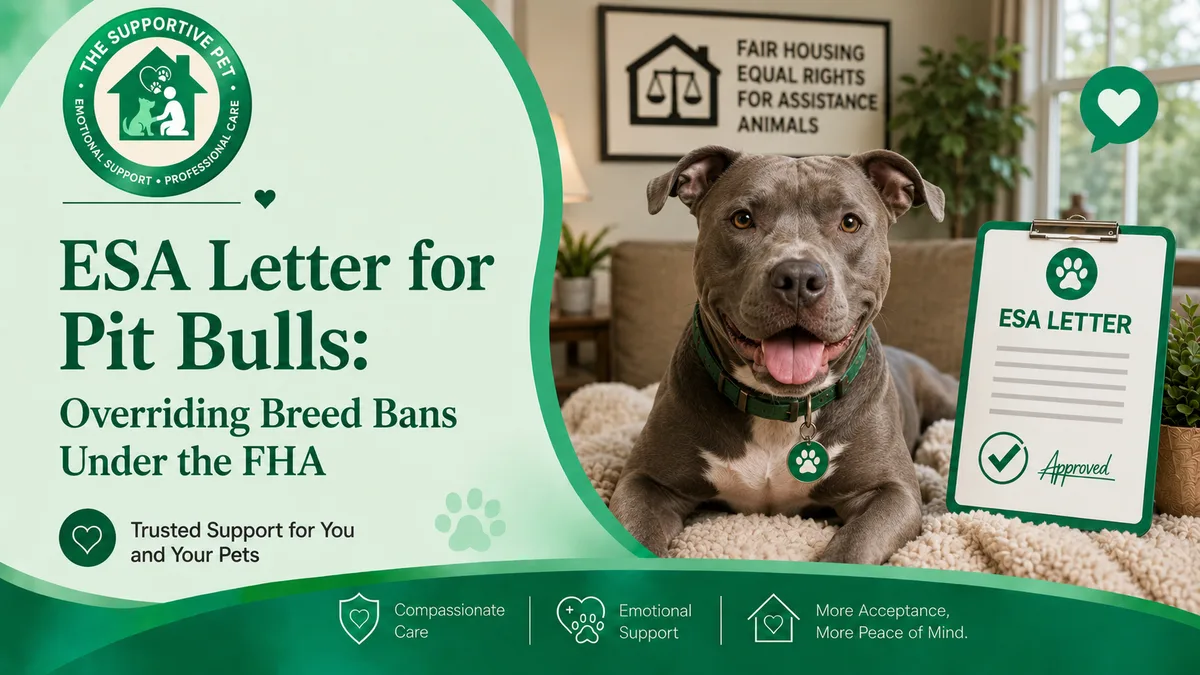
Can an ESA letter provide an exemption from a Pit Bull breed ban?
Yes, for private landlord and HOA restrictions. Under the Fair Housing Act, landlords must grant reasonable accommodation for documented ESA owners regardless of breed bans. However, municipal breed-specific legislation (city/county laws) may still apply in some jurisdictions - verify your local BSL status.
Medical Disclaimer: This article is for informational purposes only and does not constitute medical or legal advice. Consult a qualified mental health professional before making decisions about your care. If you or someone you know is in crisis, call or text 988 (Suicide & Crisis Lifeline, available 24/7).
Pit Bulls - including American Pit Bull Terriers, American Staffordshire Terriers, Staffordshire Bull Terriers, and mixed-breed dogs identified as "Pit Bull type" - are the most commonly breed-banned dogs in rental housing. Many apartment complexes, property management companies, and HOAs categorically prohibit Pit Bulls regardless of the individual dog's temperament or history. An ESA letter under the Fair Housing Act legally provides exemptions from these breed bans.
Why the Fair Housing Act Overrides Pit Bull Breed Bans
How Breed Restrictions Work
Private breed restriction policies - set by landlords, property managers, or HOAs - have no authority over the Fair Housing Act's reasonable accommodation requirements. When a licensed mental health professional determines that you have a disability and need an emotional support animal, your landlord must grant a reasonable accommodation regardless of:
- The building's no-pet policy or breed restriction list
- HOA rules that prohibit certain breeds
- Insurance requirements that exclude certain breeds
- Local breed-specific legislation (BSL) - note: BSL can override FHA in some municipalities; see below
Important: Municipal Breed-Specific Legislation (BSL)
While the FHA provides exemptions from private landlord breed bans, municipal breed-specific legislation (BSL) - city or county laws that restrict or ban specific breeds - is a different matter. Courts have generally held that BSL can coexist with the FHA in some jurisdictions. If you live in a city with active BSL targeting Pit Bulls (e.g., Miami-Dade County, FL), an ESA letter may not fully protect you from that municipal law, though it still protects you from private landlord restrictions. Always verify your local BSL status.
What a Pit Bull ESA Letter Does
- Provides exemptions from private landlord and HOA breed bans under the FHA
- Eliminates all pet deposits, monthly pet rent, and pet fees
- Prevents housing denial based on your dog's breed (subject to BSL limitations above)
- Requires landlords to engage in a good-faith interactive process on your accommodation request
How to Get a Pit Bull ESA Letter
The Clinical Evaluation
You need a letter from a licensed mental health professional based on your diagnosed mental health condition. The process is the same as any ESA - the letter is about your need, not your dog's breed or training.
Start your evaluation at The Supportive Pet. Our state-licensed clinicians conduct genuine clinical evaluations. Most patients receive their letter the same business day.
Qualifying Mental Health Conditions for Pit Bull ESA Letters
Who Qualifies
To get an ESA letter for your Pit Bull, you need a mental health condition that substantially limits one or more major life activities. Common qualifying conditions include anxiety disorders, PTSD, major depression, panic disorder, bipolar disorder, OCD, ADHD, phobias, autism spectrum disorder, and schizophrenia. You don't need a severe diagnosis - moderate symptoms that affect your sleep, work performance, or daily functioning regularly qualify. What matters is that your condition is documented by a licensed clinician and that your dog provides genuine therapeutic benefit.
What the Clinical Evaluation Involves
A legitimate ESA letter comes from a real clinical evaluation - not a 2-minute online form. A licensed mental health professional (therapist, psychologist, psychiatrist, or LCSW) will evaluate your mental health history, current symptoms, and how an emotional support animal helps you manage your condition. The Supportive Pet conducts genuine evaluations by state-licensed clinicians via telehealth. Most patients receive their letter the same business day they complete their evaluation.
No Special Training Required for ESA Status
Unlike service dogs, ESAs do not need specialized training or certification. Your Pit Bull's ESA status comes entirely from your clinician's letter - not from the animal's training, a registration website, or any ID card or vest. Websites selling ESA certificates, registry memberships, or ID packages provide documents with zero legal standing under the FHA. Your landlord cannot require any of these.
How to Use Your ESA Letter in Pit Bull Housing
Submitting Your Accommodation Request
Once you have your ESA letter from a licensed clinician, submit a written reasonable accommodation request to your landlord. Include: your name, your unit address, a statement that you have a disability-related need for an emotional support animal, and a copy of your ESA letter. Send this in writing and keep copies. Your landlord must respond in a reasonable timeframe - HUD considers 10 business days a standard expectation.
What Your Landlord Can and Cannot Ask
Your landlord may ask for written documentation from a licensed mental health professional confirming your need for an ESA. They may verify the clinician's license and contact information. They may NOT demand your specific diagnosis, your full medical records, special ESA registration, or documentation from any particular provider. They also may not charge you a pet deposit, pet rent, or any other pet fee for your documented ESA - including your Pit Bull.
If Your Landlord Denies Your ESA
Most ESA denials are illegal. If your landlord refuses a valid ESA accommodation request without legal justification - denying based on breed, charging pet fees, or ignoring your request - you can file a fair housing complaint with HUD at hud.gov/fairhousing. Complaints are free, and successful complaints can result in the landlord being required to grant the accommodation and pay damages. The Supportive Pet provides free landlord dispute support to every client who receives a letter through our clinicians.
The Therapeutic Value of Pit Bull Type Dogs
Pit bull type dogs - a loose category that includes American Pit Bull Terriers, American Staffordshire Terriers, Staffordshire Bull Terriers, and mixed-breed dogs that share their physical traits - are among the most loyal, affectionate, and emotionally attentive dogs when properly socialized. Their high social drive, sensitivity to human emotion, and physical presence make them particularly effective emotional support animals for owners managing depression, PTSD, and anxiety.
Research on canine emotional attunement (the ability of dogs to synchronize stress responses with their owners) consistently shows that breeds bred for close human cooperation - a category that includes pit bull type dogs - score in the highest tiers. Their responsiveness to owner emotional states is a therapeutic asset, not a liability.
Condition-Specific Benefits
- Depression: Their high social energy counters isolation, which is a primary driver of depressive episodes; owners consistently report that the dog's obvious need for interaction creates a daily reason to engage with the world
- PTSD: Physical size and alert presence provide genuine feelings of security, particularly for trauma survivors who feel vulnerable at night or in unfamiliar spaces
- Anxiety: Deep pressure stimulation - leaning against or resting on the owner - provides proprioceptive calming similar to a weighted blanket
- Social anxiety: Counter-intuitively, visibly friendly pit bulls often become social bridges, initiating interactions with strangers in ways that can gradually reduce avoidance behaviors
How an ESA Letter Provides Exemptions from Breed Bans
This is the core legal protection that matters most for pit bull owners. Many properties prohibit pit bulls, Staffordshire terriers, and "bully breeds" by name. Under the Fair Housing Act, an ESA letter issued by a licensed mental health professional grants your pit bull full housing protection - the breed ban cannot be applied to an ESA.
The FHA reasonable accommodation requirement means a landlord must make an individualized assessment of your specific dog, not apply a blanket breed ban. The legally relevant questions are:
- Does this specific animal pose a direct threat based on objective evidence?
- Has this specific animal exhibited dangerous behavior at this property?
Breed alone is not sufficient grounds for denial under HUD guidelines. Landlords who deny accommodation solely based on breed face fair housing complaints and potential civil liability.
Landlord Objections and How to Handle Them
Common Scenarios
"Our insurance doesn't cover pit bulls." Insurance restrictions do not override FHA obligations. The landlord must pursue insurance accommodations separately; your housing right is not contingent on the landlord's insurance arrangements.
"Our lease has a no-bully-breed clause." Lease clauses cannot contract around federal law. The FHA supersedes lease restrictions for ESAs. The clause remains in the lease but is legally unenforceable against you as an ESA owner with valid documentation.
"Other tenants are afraid of pit bulls." Fear of a breed is not a legally sufficient basis to deny accommodation. The landlord would need documented evidence of direct threat from your specific animal - not neighbor discomfort with the breed generally.
"We need to see vaccination and training records." Landlords may request vaccination and licensing records to confirm your dog is legally kept. They cannot require special training certification for an ESA - basic vaccination and licensing is the standard.
Cities and States With Breed-Specific Legislation
BSL (breed-specific legislation) banning pit bulls exists in some municipalities. Under the FHA, federal housing law generally supersedes local BSL for rental housing - your ESA letter provides protection even in BSL jurisdictions for housing. However, local ordinances may still apply in public spaces. Always check your local municipal code for non-housing restrictions.
States that have prohibited BSL statewide (where local municipalities cannot ban breeds): California, Florida, Texas, Illinois, Pennsylvania, and approximately 20 others. In these states, no landlord can ban pit bulls regardless of ESA status.
Frequently Asked Questions: ESA Letters for Pit Bulls
Can a landlord refuse my ESA pit bull even with a valid letter?
Only if your specific dog poses a documented direct threat - meaning it has caused harm or exhibited objectively dangerous behavior at the property. The landlord must document the specific behavior, not cite breed generalizations. If your dog has no history of aggression, denial on breed alone is a fair housing violation.
What if my building has a weight limit that excludes my pit bull?
Weight limits are treated the same as breed restrictions for ESA purposes. An ESA letter qualifies you for exemptions from weight limit restrictions. Your landlord cannot deny accommodation based on your dog's weight when you have submitted a valid reasonable accommodation request.
My pit bull is a mix - does breed identification matter?
No. Many "pit bull bans" apply to any dog that "looks like" a pit bull, regardless of actual genetics. Under FHA, breed identification methods (visual assessment, DNA testing) are not required from you. Your ESA letter covers your specific animal regardless of how their breed is classified.
Can my landlord require my pit bull to wear a muzzle?
Only if there is documented evidence of a direct threat specific to your animal. A blanket muzzle requirement for all pit bulls is not a reasonable accommodation condition - it is effectively a continuation of the breed restriction. If your dog has no aggression history, a muzzle requirement is challengeable as a fair housing violation.
Does my ESA letter protect my pit bull in a condo or HOA?
Yes. HOAs and condo associations are covered by the FHA. If your condo rules prohibit pit bulls, the FHA reasonable accommodation process applies. Submit your ESA letter and accommodation request to your HOA in writing; they must respond and cannot deny solely on breed.
What should I do if my landlord denies my accommodation request?
File a complaint with HUD (hud.gov/complaints) within one year of the denial. You may also file with your state's civil rights agency. HUD complaints are free, and the agency investigates and can impose civil penalties on landlords who violate the FHA. Many landlords reverse their denials once a formal complaint is filed.
How long is my ESA letter valid for my pit bull?
ESA letters are typically valid for one year from the date of issuance. After that, you should renew with a new assessment to ensure the documentation reflects your current mental health status. Annual renewal is the standard landlords expect when requesting updated documentation.
Frequently Asked Questions
Can an ESA letter provide an exemption from a Pit Bull breed ban?
Yes, for private landlord and HOA restrictions. Under the Fair Housing Act, landlords must grant reasonable accommodation for documented ESA owners regardless of breed bans. However, municipal breed-specific legislation (city/county laws) may still apply in some jurisdictions - verify your local BSL status.
Does a Pit Bull ESA letter work against HOA breed restrictions?
Yes. HOAs must comply with the Fair Housing Act just as apartment landlords do. A valid ESA letter requires HOAs to waive breed restrictions and pet fees for documented ESA owners throughout the United States.
Does my Pit Bull need special training to be an ESA?
No. ESAs do not require specific task training or certification. However, your dog should be well-behaved and not pose a direct threat to others or their property. Basic obedience is advisable, especially for Pit Bulls whose behavior may be scrutinized more heavily by landlords.
See our articles highlighted in Google Search
Add The Supportive Pet as a preferred source - your results, your way.