
Can an apartment deny my Husky ESA because of weight limits?
No. Under the Fair Housing Act, landlords must waive weight restrictions for documented ESA owners. A typical Siberian Husky (35–60 lbs) exceeds many apartment buildings' 25–50 lb pet limits, but a valid ESA letter completely removes those restrictions. Your landlord cannot enforce a weight cap against a documented ESA owner.
Medical Disclaimer: This article is for informational purposes only and does not constitute medical or legal advice. Consult a qualified mental health professional before making decisions about your care. If you or someone you know is in crisis, call or text 988 (Suicide & Crisis Lifeline, available 24/7).
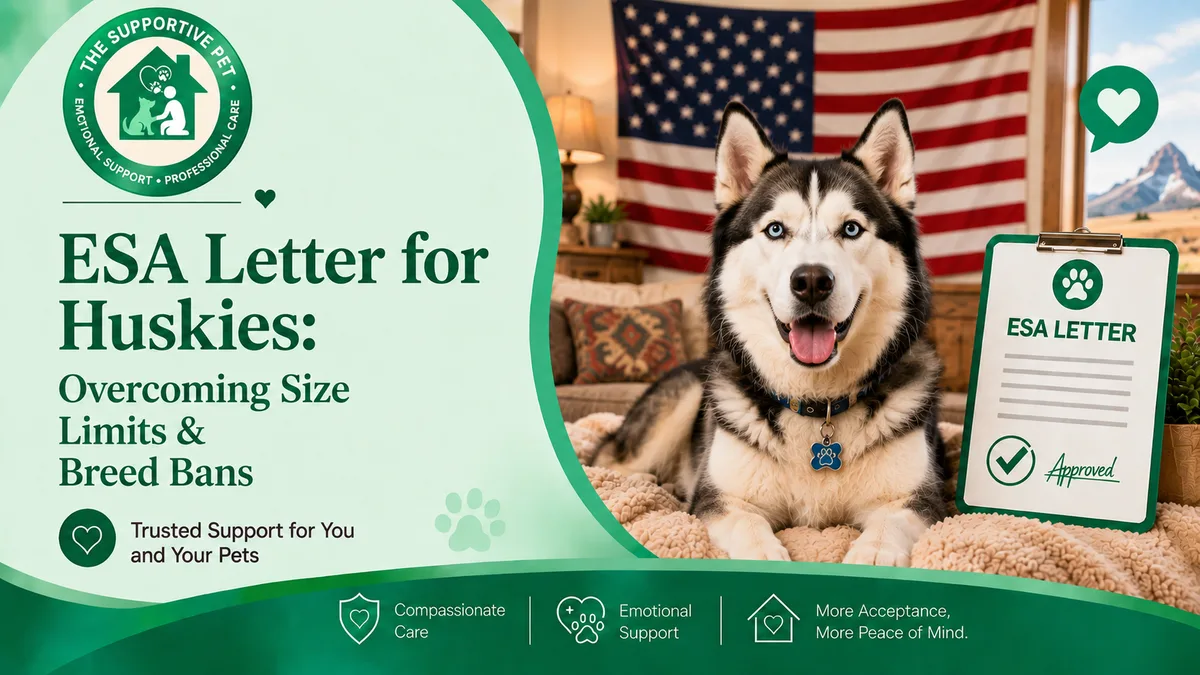
Siberian Huskies are loyal, empathetic, and deeply attuned to their owners' emotional states - qualities that make them naturally effective emotional support animals. Despite their temperament, Huskies often face apartment restrictions based on size (they typically weigh 35–60 lbs) or because they appear on some insurers' restricted breed lists. An ESA letter under the Fair Housing Act gives your Husky legal protection against both weight limits and breed bans.
Why Huskies Struggle with Housing Restrictions
How Breed Restrictions Work
Huskies face two types of housing restrictions. First, many apartment buildings cap pets at 25–50 lbs - a limit that excludes most adult Huskies. Second, some insurers group Huskies with "wolf-like" breeds on restricted lists. An ESA letter from a licensed mental health professional qualifies you for exemptions from both restrictions for qualifying owners under the Fair Housing Act.
Huskies as Emotional Support Animals
Huskies form powerful bonds with their human companions. Their sensitivity to human emotion, consistent affection, and playful nature have been shown to reduce anxiety, lower cortisol levels, and combat isolation - making them effective companions for owners managing depression, anxiety disorders, PTSD, and mood disorders. Their high energy also encourages physical activity and structure, which supports mental health recovery.
What an ESA Letter Does for Your Husky
Key Protections Under the FHA
- Overrides apartment weight limits - no 25 lb cap can exclude your Husky with a valid ESA letter
- Exempts from breed restrictions - insurers' breed lists have no authority over Fair Housing Act rights
- Eliminates all pet fees - deposits, monthly pet rent, and move-in fees are waived
- Prevents housing denial based on your dog's presence or breed
Husky-Specific Considerations for ESA Housing
Landlords may request information about whether your Husky poses a direct threat - based on specific documented behavior, not breed assumptions. Huskies are not classified as dangerous breeds by any federal agency or the American Veterinary Medical Association. Reasonable landlord concerns about noise (Huskies are vocal) or exercise needs do not constitute grounds to deny an ESA accommodation.
How to Get Your Husky ESA Letter
The Clinical Evaluation
Schedule an evaluation with a licensed mental health professional who can assess your qualifying condition and write an ESA letter. The letter is about your mental health and your need for emotional support - your Husky automatically qualifies as the designated animal once the letter is issued.
Start your evaluation at The Supportive Pet. Licensed clinicians in all 50 states, same-day delivery, and free landlord dispute support included.
Qualifying Mental Health Conditions for Husky ESA Letters
Who Qualifies
To get an ESA letter for your Husky, you need a mental health condition that substantially limits one or more major life activities. Common qualifying conditions include anxiety disorders, PTSD, major depression, panic disorder, bipolar disorder, OCD, ADHD, phobias, autism spectrum disorder, and schizophrenia. You don't need a severe diagnosis - moderate symptoms that affect your sleep, work performance, or daily functioning regularly qualify. What matters is that your condition is documented by a licensed clinician and that your dog provides genuine therapeutic benefit.
What the Clinical Evaluation Involves
A legitimate ESA letter comes from a real clinical evaluation - not a 2-minute online form. A licensed mental health professional (therapist, psychologist, psychiatrist, or LCSW) will evaluate your mental health history, current symptoms, and how an emotional support animal helps you manage your condition. The Supportive Pet conducts genuine evaluations by state-licensed clinicians via telehealth. Most patients receive their letter the same business day they complete their evaluation.
No Special Training Required for ESA Status
Unlike service dogs, ESAs do not need specialized training or certification. Your Husky's ESA status comes entirely from your clinician's letter - not from the animal's training, a registration website, or any ID card or vest. Websites selling ESA certificates, registry memberships, or ID packages provide documents with zero legal standing under the FHA. Your landlord cannot require any of these.
How to Use Your ESA Letter in Husky Housing
Submitting Your Accommodation Request
Once you have your ESA letter from a licensed clinician, submit a written reasonable accommodation request to your landlord. Include: your name, your unit address, a statement that you have a disability-related need for an emotional support animal, and a copy of your ESA letter. Send this in writing and keep copies. Your landlord must respond in a reasonable timeframe - HUD considers 10 business days a standard expectation.
What Your Landlord Can and Cannot Ask
Your landlord may ask for written documentation from a licensed mental health professional confirming your need for an ESA. They may verify the clinician's license and contact information. They may NOT demand your specific diagnosis, your full medical records, special ESA registration, or documentation from any particular provider. They also may not charge you a pet deposit, pet rent, or any other pet fee for your documented ESA - including your Husky.
If Your Landlord Denies Your ESA
Most ESA denials are illegal. If your landlord refuses a valid ESA accommodation request without legal justification - denying based on breed, charging pet fees, or ignoring your request - you can file a fair housing complaint with HUD at hud.gov/fairhousing. Complaints are free, and successful complaints can result in the landlord being required to grant the accommodation and pay damages. The Supportive Pet provides free landlord dispute support to every client who receives a letter through our clinicians.
Why Siberian Huskies Can Be Powerful ESAs
Unique Emotional Impact and Therapeutic Presence
Siberian Huskies have a distinctive psychological presence that some ESA owners find uniquely effective for specific mental health conditions. Their independent, non-subordinate temperament - unlike breeds that default to anxious compliance - creates a different relational dynamic: Huskies respond to genuine distress with physical proximity and attentiveness without mirroring the owner's anxiety, which some people find more grounding than a dog that absorbs and amplifies their emotional state.
Huskies were bred to work cooperatively in pack environments, maintaining awareness of the pack's collective state over long distances. This background produces dogs that are unusually attuned to changes in group dynamics and individual member states - an attunement that transfers to monitoring their owner's emotional condition when they live in close domestic contact.
Specific Therapeutic Functions Huskies Fill
- Active engagement for depression - Huskies' high energy and persistent solicitation for exercise and play create an unavoidable external pull toward activity, which is particularly effective for the motivational deficits of major depression where self-generated motivation is chronically impaired
- Grounding through physical size and weight - at 35–60 lbs, a Husky provides substantial grounding pressure during contact, which activates parasympathetic responses useful in panic disorder and PTSD
- Vocalization and connection - Huskies' expressive vocalizations (howling, "talking") create an interactive dynamic that many people with depression or social isolation report as combating the silence and emptiness associated with depressive episodes
- Outdoor anchoring - Huskies require significant outdoor exercise, which in turn ensures their owners maintain a minimum level of outdoor exposure and physical activity - beneficial across virtually all mental health conditions
Huskies and Breed Restrictions: The Biggest Housing Challenge
Why Huskies Are Frequently Restricted
Siberian Huskies appear on the breed restriction lists of many apartment buildings and insurance policies. This is partly due to their classification as a "high energy" or "destructive" breed when under-exercised, and partly because some insurance actuarial models group them with higher-bite-risk breeds despite Huskies' generally non-aggressive temperament toward humans. Whatever the origin of the restriction, an ESA letter under the Fair Housing Act qualifies you for an exemption from it.
The Fair Housing Act explicitly prohibits landlords from applying blanket breed restrictions to valid ESA accommodation requests. Your landlord must evaluate the specific animal in your specific circumstances - they cannot deny your accommodation based solely on the breed name. The FHA's reasonable accommodation standard applies to all policies, including breed restrictions, without breed-based exceptions.
How to Respond to a Husky-Based ESA Denial
If a landlord denies your Husky ESA accommodation citing their breed restriction policy, your response should:
- Reference the FHA's reasonable accommodation requirement (42 U.S.C. § 3604(f)(3)(B)) and the Fair Housing Act (42 U.S.C. § 3604), which explicitly requires individualized assessment and exempts you from breed restrictions
- Offer to provide information about your specific dog - vaccination records, training records, behavioral history, and veterinary documentation of temperament - to assist the landlord's individual assessment
- Note that HUD complaints for FHA violations are filed free at hud.gov/fairhousing and are investigated by HUD's Office of Fair Housing and Equal Opportunity
Most landlords who understand the legal landscape will grant the accommodation upon receiving a written response citing the relevant law. Those who do not should be treated as potential FHA violations.
Living with a Husky ESA in Rented Housing
Exercise Requirements and Tenancy Protection
Siberian Huskies require 60–90 minutes of vigorous exercise daily - off-leash running is ideal, with extended on-leash walks as a substitute. In apartment settings, this requires genuine commitment. An under-exercised Husky in a small apartment may howl, destroy furniture, or dig at flooring - behaviors that a landlord could cite regardless of ESA status, because ESA protections do not exempt an animal from causing genuine nuisance or property damage.
The most effective tenancy protection for a Husky ESA is a well-exercised, well-managed dog. Practical strategies for urban Husky owners: early morning runs (Huskies prefer cooler temperatures); dog park visits for off-leash exercise; urban mushing or bikejoring as high-output exercise options; and enrichment feeders, nose work games, and training sessions for mental fatigue on lower-activity days.
Husky Vocalization in Apartment Settings
Huskies are vocal - they howl, "talk," and express themselves audibly in ways that other breeds do not. In apartment buildings with thin walls or sound-conscious neighbors, this can become a tenancy issue. ESA status does not exempt your Husky from noise-related complaints. Noise management strategies - exercise timing, separation anxiety protocols, white noise machines in adjacent rooms - should be proactively implemented if your building has noise-sensitive neighbors. Documenting your noise management efforts is protective if a complaint is ever filed.
Frequently Asked Questions: ESA Letters for Siberian Huskies
My building specifically bans Huskies along with Pit Bulls and Rottweilers - can my ESA letter override this?
Yes. the Fair Housing Act (42 U.S.C. § 3604) addresses this directly: breed restrictions in housing policies do not override reasonable accommodation obligations under the FHA. Your landlord cannot deny your ESA accommodation based on Huskies being named on their restricted breed list. They must assess your specific accommodation request on its merits - your disability-related need for the animal and whether granting the accommodation poses an undue burden or direct threat (based on that specific animal's behavior, not breed reputation).
My landlord's insurance company excludes Huskies - can they use this to deny my ESA?
No. Insurance exclusions are a business issue for the landlord to resolve with their insurer. They are not a legal basis to deny a reasonable accommodation under the FHA. Numerous insurance companies (including State Farm, USAA, and several specialty insurers) do not exclude Huskies or provide endorsements for restricted breeds. A landlord claiming insurance grounds for ESA denial should be directed to the Fair Housing Act framework, which does not recognize insurance exclusions as a legitimate denial basis.
Can my Husky be a psychiatric service dog instead of an ESA?
If your Husky has been specifically trained to perform a task that directly mitigates your disability - for example, deep pressure therapy during panic attacks, nightmare interruption for PTSD, or tactile grounding for dissociation - it may qualify as a psychiatric service dog (PSD). PSDs have broader rights than ESAs, including ADA public access rights. However, PSD designation requires genuine task training. If your Husky provides comfort and support but has not been trained to perform a specific disability-mitigating task, ESA designation is the appropriate documentation for housing purposes.
My Husky howls when I leave for work - my neighbor has complained. What are my rights?
ESA status does not exempt your Husky from noise complaints. Excessive howling is a genuine nuisance that affects other tenants, and landlords can require you to address it regardless of your ESA documentation. Your obligation is to mitigate the noise - through behavioral modification, exercise, anti-anxiety aids, or management strategies - not to simply cite ESA protections. Document your mitigation efforts. If you are making good-faith efforts and the noise complaint is disproportionate, that context matters; if the howling is genuinely disruptive and unaddressed, your tenancy may be at risk regardless of ESA status.
How do I document my Husky's good behavior to strengthen my ESA accommodation request?
Voluntary documentation in your accommodation request is not legally required but can facilitate landlord approval, particularly for restricted breeds. Useful documentation includes: current vaccination records, veterinary records showing routine care and no bite history, a Canine Good Citizen (AKC CGC) certificate if your Husky has been tested, and a statement from a trainer if your dog has completed obedience training. None of this is legally required - but for a restricted breed in a hesitant landlord situation, proactively supplying behavioral evidence often resolves the accommodation more quickly than citing legal rights alone.
I live in California or Arkansas - do the 30-day ESA evaluation period rules apply to my Husky ESA letter?
California and Arkansas require that clinicians maintain a patient relationship for a minimum period before issuing an ESA letter in some contexts. This affects the timing of your ESA letter issuance, not the underlying FHA housing rights. The Supportive Pet's clinicians are aware of and comply with state-specific rules in all 50 states. When you complete your evaluation, your clinician will ensure your letter is issued in compliance with your state's requirements.
Can I have a Husky ESA in a vacation rental or Airbnb?
No. ESA housing protections under the FHA apply to long-term rental housing - not to short-term vacation rentals, hotels, or Airbnb properties. These are governed by different laws (primarily the ADA, which covers service animals but not ESAs). For travel accommodations, service animal designation (which requires task training) is the only federal protection. ESA protections are specific to residential housing under the FHA.
Frequently Asked Questions
Can an apartment deny my Husky ESA because of weight limits?
No. Under the Fair Housing Act, landlords must waive weight restrictions for documented ESA owners. A typical Siberian Husky (35–60 lbs) exceeds many apartment buildings' 25–50 lb pet limits, but a valid ESA letter completely removes those restrictions. Your landlord cannot enforce a weight cap against a documented ESA owner.
Are Huskies on restricted breed lists?
Some insurance companies classify Huskies alongside wolf-like breeds on restricted lists. However, these insurer classifications carry no legal weight under the Fair Housing Act. A valid ESA letter from a licensed mental health professional qualifies you for exemptions from all privately set breed restrictions for qualifying owners.
Do I need to prove my Husky won't bother neighbors to get ESA housing?
No. You need to show your licensed mental health professional has evaluated you and issued an ESA letter - not prove your Husky's behavior to your landlord. Landlords can only deny accommodation based on your specific animal's documented direct threat to health or safety, not general assumptions about noise or energy level.
See our articles highlighted in Google Search
Add The Supportive Pet as a preferred source - your results, your way.