
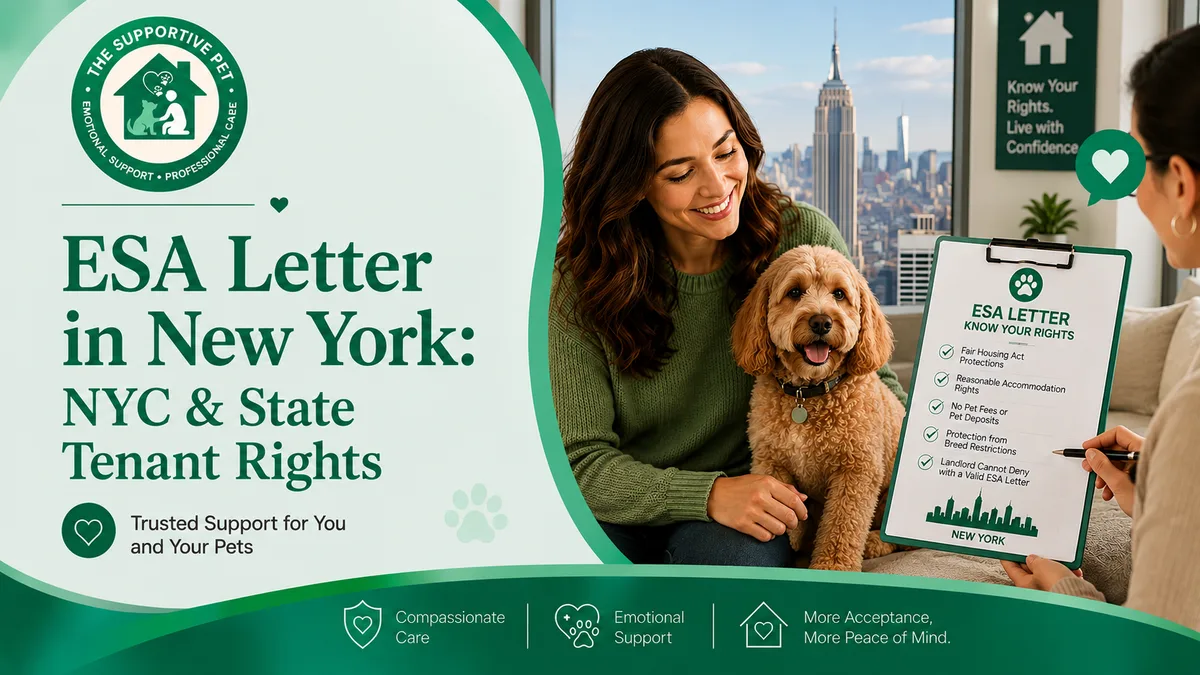
Does New York have special ESA laws beyond federal FHA?
Yes. New York State has the New York State Human Rights Law (NYSHRL), which provides disability housing protections that parallel and in some cases exceed the federal Fair Housing Act. New York City additionally has the New York City Human Rights Law (NYCHRL), which is considered one of the strongest local anti-discrimination laws in the country. NYC's law covers almost all housing (with very limited exceptions), imposes a lower burden of proof on tenants, and is enforced by the NYC Commission on Human Rights.
Key Takeaways
- New York State's Human Rights Law and New York City's Human Rights Law both provide ESA protections that are stronger and broader than the federal Fair Housing Act.
- NYC's Human Rights Law is among the strongest tenant protection laws in the country - it covers nearly all housing types and gives tenants a lower burden of proof.
- New York does not have AB 468-style restrictions on online evaluations, so a fast evaluation with a NY-licensed clinician is fully compliant.
Medical Disclaimer: This article is for informational purposes only and does not constitute medical or legal advice. Consult a qualified mental health professional before making decisions about your care. If you or someone you know is in crisis, call or text 988 (Suicide & Crisis Lifeline, available 24/7).
New York has the most layered ESA housing protection framework in the United States. Renters in New York City benefit from three overlapping laws - the federal Fair Housing Act, the New York State Human Rights Law, and the New York City Human Rights Law - creating protection that goes far beyond what most other states offer. Whether you rent in Manhattan, Brooklyn, Queens, the Bronx, or anywhere across New York State, your landlord cannot legally reject a valid ESA letter. This guide explains exactly what those protections mean for you in 2026.
ESA Letters in New York: Three Layers of Protection
New York ESA owners benefit from three overlapping legal frameworks - each providing protection, and together making New York one of the most ESA-friendly states in the country for housing rights:
New York renters benefit from some of the strongest tenant protections in the US. For related guidance see ESA housing rights, what to do if denied, and ESA letter requirements.
- Federal Fair Housing Act - applies in all 50 states
- New York State Human Rights Law (NYSHRL) - state-level amplification of federal FHA protections
- New York City Human Rights Law (NYCHRL) - applies within NYC; widely considered the strongest local anti-discrimination law in the US
As a New York ESA owner, you can invoke whichever framework gives you the strongest protection for your specific situation.
New York State Human Rights Law
The NYSHRL prohibits housing discrimination based on disability across New York State, including the obligation to provide reasonable accommodations for assistance animals. Key points for ESA owners:
- Covers a broad range of housing types throughout New York State
- Enforced by the New York State Division of Human Rights (dhr.ny.gov)
- Provides a state-level alternative to federal HUD enforcement
- Does not require paying pet fees or following pet policies for documented ESAs
New York City Human Rights Law: The Strongest Protection
If you live in New York City (the five boroughs), you have access to the NYC Human Rights Law - one of the broadest anti-discrimination laws in the country:
- Near-universal housing coverage - covers almost all housing types in NYC, including owner-occupied buildings with fewer than four units and SROs that federal law may not cover
- Lower burden of proof - the NYCHRL uses a broader definition of disability and is interpreted more favorably for complainants than federal law
- Active enforcement - the NYC Commission on Human Rights investigates complaints and can impose civil penalties and damages on landlords who violate the law
- Free legal support - the NYC Commission on Human Rights offers free resources and guidance for tenants facing housing discrimination
What New York Landlords Cannot Do
Under all three frameworks combined, New York landlords cannot:
- Enforce no-pet policies against a documented ESA
- Charge pet deposits or pet rent for an ESA
- Apply breed, weight, or size restrictions to an ESA
- Demand your specific diagnosis or full medical records
- Require ESA registration, certification, or ID cards
- Retaliate against you for requesting accommodation
- Deny accommodation in rent-stabilized or rent-controlled apartments
New York City Rent-Stabilized Apartments and ESAs
A common question for NYC renters: do rent-stabilization rules affect ESA rights? No. ESA accommodation rights under the FHA and NYCHRL apply regardless of whether your apartment is rent-stabilized, rent-controlled, or market-rate. Your landlord cannot deny your ESA because of the stabilized nature of your lease.
New York City: How the NYC Human Rights Law Strengthens ESA Rights
Lower Threshold for Disability
New York City's Human Rights Law defines "disability" more broadly than the federal FHA. Under the NYCHRL, any condition that causes physical, medical, or psychological impairment qualifies - a lower bar than the ADA's "substantially limits a major life activity" standard. This means some New Yorkers who might not qualify under federal law do qualify under city law.
Interactive Process Requirement
Under the NYCHRL, landlords are required to engage in a cooperative interactive process with ESA accommodation requesters. They cannot simply reject your request - they must communicate, ask questions if they have concerns, and demonstrate a good-faith effort to find an accommodation. Landlords who skip this process face heightened liability at the NYC Commission on Human Rights.
Stronger Enforcement and Penalties
The NYC Commission on Human Rights can award compensatory damages, civil penalties up to $250,000, and attorney's fees in housing discrimination cases. This dramatically stronger enforcement regime means New York City landlords - especially larger apartment operators - are highly motivated to honor valid ESA accommodation requests rather than risk a complaint.
How to Get Your New York ESA Letter
New York does not have California's AB 468-style waiting period requirement. A fast evaluation with a New York-licensed clinician is fully compliant with all applicable laws. The Supportive Pet connects New York residents with NY-licensed mental health professionals for online evaluations.
Co-ops, Condos, and HOAs in New York
Co-op Boards and ESA Requests
New York City is famous for its co-op apartment buildings, where a board of shareholders controls residency decisions. Despite their gatekeeping authority, co-op boards must comply with the FHA, NYSHRL, and NYCHRL on ESA requests. A co-op board cannot reject a shareholder's ESA accommodation request based on a no-pet policy or breed restriction. If a co-op board denies your ESA without a documented, legally valid reason, you can file a complaint with the NYC Commission on Human Rights, the New York State Division of Human Rights, or HUD.
Condo Associations
Condo associations in New York are subject to the same three-layer ESA protection framework as landlords. Your ESA letter overrides condo association no-pet rules, pet deposit requirements, and breed restrictions throughout New York State and New York City.
Small Landlords (1-2 Family Homes)
The FHA excludes owner-occupied buildings with four or fewer units from its requirements (the "Mrs. Murphy exemption"). However, the New York City Human Rights Law does not contain this exemption - it covers virtually all housing in New York City regardless of size. Upstate New York small landlords may benefit from the federal exemption, but NYC landlords with even a two-unit building must still honor ESA accommodations under city law.
Start your New York ESA evaluation at The Supportive Pet. Most NY patients receive their letter the same business day. If your NYC landlord pushes back after you submit, our landlord dispute support team will help you respond.
Frequently Asked Questions
Does New York have special ESA laws beyond federal FHA?
Yes. New York State has the New York State Human Rights Law (NYSHRL), which provides disability housing protections that parallel and in some cases exceed the federal Fair Housing Act. New York City additionally has the New York City Human Rights Law (NYCHRL), which is considered one of the strongest local anti-discrimination laws in the country. NYC's law covers almost all housing (with very limited exceptions), imposes a lower burden of proof on tenants, and is enforced by the NYC Commission on Human Rights.
What housing does NYC Human Rights Law cover for ESAs?
The NYC Human Rights Law covers virtually all housing in New York City, including buildings with fewer than four units, owner-occupied buildings, and even single-room occupancies (SROs) in many cases. This is significantly broader coverage than the federal FHA, which has exemptions for owner-occupied buildings with four or fewer units and some single-family homes. If you are a New York City tenant, you have some of the strongest ESA housing protections available anywhere in the US.
Can my NYC landlord deny my ESA?
In New York City, the grounds for denying an ESA accommodation are narrow. A landlord can only deny if the specific animal poses a direct threat to others or would cause substantial property damage that cannot be mitigated. No-pet policies, breed restrictions, size limits, and pet fees do not apply to documented ESAs. If your NYC landlord denies your request, you can file a complaint with the NYC Commission on Human Rights, which actively enforces housing discrimination cases.
Does my New York ESA letter need to come from a NY-licensed clinician?
Yes. Your ESA letter must come from a mental health professional licensed in New York State. New York-licensed credentials include LCSW (licensed through the New York State Education Department Office of Professions), LMHC, LMFT, licensed psychologist, and psychiatrists licensed in New York. The Supportive Pet connects New York residents with NY-licensed clinicians for fast telehealth evaluations.
How do I file a housing complaint in New York?
New York residents have multiple enforcement options: (1) NYC Commission on Human Rights (nyc.gov/cchr) - fastest for NYC residents; actively investigates ESA discrimination. (2) New York State Division of Human Rights (dhr.ny.gov) - covers all of New York State. (3) HUD (hud.gov/fairhousing) - federal option available in all states. NYC residents generally get faster responses through the NYC Commission on Human Rights than through federal HUD.
See our articles highlighted in Google Search
Add The Supportive Pet as a preferred source - your results, your way.