
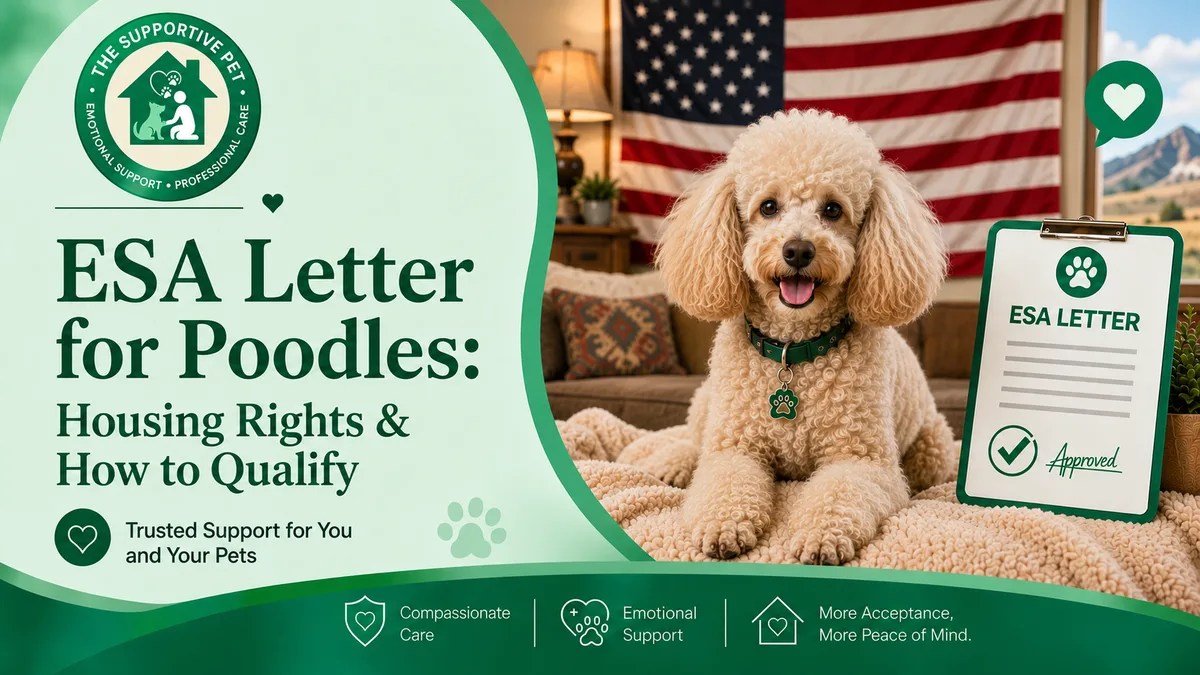
Can a Standard, Miniature, or Toy Poodle be an emotional support animal?
Yes. All three Poodle varieties can be designated as ESAs. The designation is based on the owner's diagnosed mental health condition and need - Poodles of all sizes qualify without any specific training requirement.
Medical Disclaimer: This article is for informational purposes only and does not constitute medical or legal advice. Consult a qualified mental health professional before making decisions about your care. If you or someone you know is in crisis, call or text 988 (Suicide & Crisis Lifeline, available 24/7).
Poodles - whether Standard (40-70 lbs), Miniature (10-20 lbs), or Toy (under 10 lbs) - are among the most intelligent, adaptable, and emotionally perceptive dog breeds. Their low-shedding, hypoallergenic coats make them especially well-suited for apartment living, and their high intelligence means they can pick up on subtle emotional cues from their owners. An ESA letter ensures your Poodle is protected from pet fees and no-pet policies under the Fair Housing Act.
Why Poodles Make Excellent ESAs
How Breed Restrictions Work
Poodles consistently rank among the most trainable dog breeds, and their sensitivity to human emotion is well-documented. They tend to mirror their owner's mood, which makes them naturally responsive emotional support companions. Miniature and Toy Poodles are particularly popular ESAs for apartment dwellers in dense urban markets like New York, San Francisco, and Chicago, where space is at a premium.
Poodles and Size Restrictions
Standard Poodles often exceed the weight limits set by apartment pet policies (typically 25-50 lbs). An ESA letter qualifies you for exemptions from these weight limits entirely. Miniature and Toy Poodles generally fall within weight limits, but still benefit from ESA protection - eliminating all pet deposits and monthly pet rent.
What an ESA Letter Does for Your Poodle
Key Protections Under the FHA
- Exempts from no-pet lease clauses for all Poodle sizes
- Eliminates all pet deposits, monthly pet rent, and pet fees
- Exempts from weight limits for Standard Poodles
- Prevents housing denial based on your dog's presence
How to Get Your Poodle ESA Letter
The Clinical Evaluation
You need a letter from a licensed mental health professional documenting your diagnosed condition and need for emotional support. No special Poodle training or certification is required for ESA status.
Start your evaluation at The Supportive Pet. Most patients receive their ESA letter the same business day.
Qualifying Mental Health Conditions for Poodle ESA Letters
Who Qualifies
To get an ESA letter for your Poodle, you need a mental health condition that substantially limits one or more major life activities. Common qualifying conditions include anxiety disorders, PTSD, major depression, panic disorder, bipolar disorder, OCD, ADHD, phobias, autism spectrum disorder, and schizophrenia. You don't need a severe diagnosis - moderate symptoms that affect your sleep, work performance, or daily functioning regularly qualify. What matters is that your condition is documented by a licensed clinician and that your dog provides genuine therapeutic benefit.
What the Clinical Evaluation Involves
A legitimate ESA letter comes from a real clinical evaluation - not a 2-minute online form. A licensed mental health professional (therapist, psychologist, psychiatrist, or LCSW) will evaluate your mental health history, current symptoms, and how an emotional support animal helps you manage your condition. The Supportive Pet conducts genuine evaluations by state-licensed clinicians via telehealth. Most patients receive their letter the same business day they complete their evaluation.
No Special Training Required for ESA Status
Unlike service dogs, ESAs do not need specialized training or certification. Your Poodle's ESA status comes entirely from your clinician's letter - not from the animal's training, a registration website, or any ID card or vest. Websites selling ESA certificates, registry memberships, or ID packages provide documents with zero legal standing under the FHA. Your landlord cannot require any of these.
How to Use Your ESA Letter in Poodle Housing
Submitting Your Accommodation Request
Once you have your ESA letter from a licensed clinician, submit a written reasonable accommodation request to your landlord. Include: your name, your unit address, a statement that you have a disability-related need for an emotional support animal, and a copy of your ESA letter. Send this in writing and keep copies. Your landlord must respond in a reasonable timeframe - HUD considers 10 business days a standard expectation.
What Your Landlord Can and Cannot Ask
Your landlord may ask for written documentation from a licensed mental health professional confirming your need for an ESA. They may verify the clinician's license and contact information. They may NOT demand your specific diagnosis, your full medical records, special ESA registration, or documentation from any particular provider. They also may not charge you a pet deposit, pet rent, or any other pet fee for your documented ESA - including your Poodle.
If Your Landlord Denies Your ESA
Most ESA denials are illegal. If your landlord refuses a valid ESA accommodation request without legal justification - denying based on breed, charging pet fees, or ignoring your request - you can file a fair housing complaint with HUD at hud.gov/fairhousing. Complaints are free, and successful complaints can result in the landlord being required to grant the accommodation and pay damages. The Supportive Pet provides free landlord dispute support to every client who receives a letter through our clinicians.
Poodle Size, Housing Restrictions, and Your ESA Letter
Standard Poodles and Weight Limits
Standard Poodles typically weigh 40–70 lbs - above the 25–35 lb weight limits common in many rental properties. A valid ESA letter from a licensed clinician qualifies you for exemptions from all weight-based restrictions under the FHA, regardless of whether your Poodle is Standard, Miniature, or Toy. Your landlord cannot enforce a weight limit against a documented ESA.
Breed Restrictions and Poodles
Poodles are rarely subject to breed bans specifically, but they are sometimes named in "designer breed" restrictions at certain properties. If your Poodle is a Doodle mix (Goldendoodle, Labradoodle), the underlying breed restrictions targeting the mix breed are also overridden by an ESA letter. An ESA letter eliminates all breed-based restrictions, not just the ones that specifically name your breed.
Why Poodles Are Among the Most Versatile ESAs
Intelligence, Routine, and Emotional Attunement
Poodles consistently rank first or second in canine intelligence assessments, a trait that translates directly into ESA effectiveness: highly intelligent dogs learn their owner's patterns and needs faster, develop more nuanced responses to emotional cues, and adapt more readily to the behavioral irregularities that accompany mental health conditions. A Poodle living with a person managing depression will typically learn, within months, which behaviors prompt their owner toward activity (requesting walks, dropping toys) and which signal distress that requires closer proximity.
Poodles also have unusually low arousal baselines relative to their intelligence level - a combination that makes them particularly effective for anxiety disorders. High-intelligence breeds with high arousal (like Border Collies) can inadvertently amplify their owner's anxiety through their own behavioral intensity. Poodles' calm attentiveness provides the therapeutic benefit of a perceptive companion without the ambient stimulation of a high-drive working breed.
Hypoallergenic Advantage in Shared Housing
Poodles are among the most reliably low-shedding breeds. Their single-layer, tightly curled coat releases minimal dander, making them the most practical ESA choice for buildings with shared HVAC systems, textile-heavy common areas, or multi-unit buildings where allergen transmission between units is a concern. This hypoallergenic quality also addresses a common landlord concern proactively - many objections to in-unit dogs center on shedding and allergen impact on other tenants, which Poodles largely eliminate as a practical matter.
Note that no dog is fully allergen-free, but Poodles' coat type dramatically reduces the primary allergen vector (airborne dander from shed hair). For landlords expressing allergen concerns, this factual distinction is worth noting in your accommodation request.
Specific Therapeutic Functions Poodles Fill
- Routine scaffolding - Poodles thrive on routine and will actively seek it, creating consistent external structure that supports behavioral activation in depression
- Cognitive engagement - training sessions with a Poodle require focused attention that interrupts rumination cycles characteristic of anxiety and depression
- Tactile grounding - Poodles' non-shedding coat is unusually pleasant for extended tactile contact, which activates oxytocin pathways without the dander issues that make prolonged contact with other breeds impractical for allergy sufferers
- Social facilitation - Poodles (especially Miniature and Standard) are universally regarded as approachable, conversation-inviting dogs, making them effective social anxiety bridges in community settings
Miniature vs. Standard Poodle: ESA Considerations
Size and Housing Practicality
Standard Poodles (45–70 lbs) provide the physical presence and grounding weight that some therapeutic uses require - particularly for anxiety disorders where physical contact is a key mechanism. They exceed the weight limits of many apartment pet policies, which an ESA letter overrides. Standard Poodles need 45–60 minutes of vigorous exercise daily, which is manageable but requires commitment in a city apartment.
Miniature Poodles (10–15 lbs) and Toy Poodles (under 10 lbs) pass most building weight limits as pets, meaning their primary ESA housing benefit is fee elimination rather than breed/size restriction override. Their exercise needs are modest (20–30 minutes daily) and they adapt exceptionally well to apartment living. For people whose mental health conditions make sustained outdoor activity difficult, smaller Poodle variants reduce the daily commitment required to maintain a healthy ESA relationship.
Common Landlord Objections - and Your Legal Answers
- "We don't allow Standard Poodles - they're too big" - Weight and size restrictions apply to pets, not to documented ESAs. Your ESA letter exempts you from weight limits regardless of your Poodle's size.
- "Poodles need grooming - we're worried about the unit condition" - Grooming is your responsibility as a pet owner and has no bearing on your ESA accommodation request. Poodles' non-shedding coat actually reduces in-unit hair accumulation compared to most breeds.
- "Our other tenants are allergic to dogs" - Tenant allergies do not override FHA reasonable accommodation obligations. The FHA balances the rights of both tenants; the accommodation analysis focuses on whether the specific accommodation (your ESA in your unit) is reasonable. A landlord cannot deny your ESA based on other tenants' pet allergies, particularly for a low-dander breed like a Poodle.
Frequently Asked Questions: ESA Letters for Poodles
My Toy Poodle already qualifies as a pet in my building - is an ESA letter worth getting?
If your building allows small dogs but charges pet deposits and pet rent, yes - an ESA letter eliminates these fees. In New York City, for example, pet deposits of $500–$1,500 and monthly pet rent of $50–$100 are common; over a two-year lease, that's $1,700–$3,900 in savings. Evaluate your specific lease terms to determine whether the ESA designation changes your financial position.
Can my groomer or vet certify my Poodle as an ESA?
No. ESA letters must be written by a licensed mental health professional (therapist, psychologist, psychiatrist, or LCSW) who has evaluated you and documented a qualifying mental health condition. Veterinarians, groomers, trainers, and general practitioners cannot write legally valid ESA letters for housing purposes under the FHA.
Do I need a separate ESA letter for each property if I'm moving frequently?
No. Your ESA letter is not property-specific. You submit a new reasonable accommodation request to each new landlord, but you can use the same letter as long as it is current (most landlords request letters issued within the past 12 months). If you move frequently, an annual renewal through The Supportive Pet ensures your documentation stays current.
My Poodle has been registered on an online ESA registry - does this count as documentation?
No. Online ESA registries, ESA certificates, and ESA ID cards have no legal standing under the FHA. Landlords are not required to accept them, and in many cases these registries are misleading consumers about the nature of ESA documentation. Only a letter from a licensed mental health professional who has evaluated you constitutes valid ESA documentation.
Can I get an ESA letter if I'm already on a waitlist for mental health services?
Yes. Many people on mental health service waitlists receive ESA evaluations through telehealth providers in the interim. The Supportive Pet's licensed clinicians can evaluate you and issue a letter based on your current symptoms regardless of whether you are in ongoing therapy. The ESA letter and ongoing therapy are separate; neither requires the other.
What's the difference between an ESA letter and a "doctor's note" for housing?
They are effectively the same thing under the FHA, but the specific requirements matter. The FHA requires documentation from a licensed healthcare professional that: (1) confirms you have a disability (a physical or mental impairment that substantially limits a major life activity), and (2) establishes a disability-related need for the assistance animal. A general "doctor's note" that doesn't address both elements may not satisfy the legal standard. ESA letters are structured specifically to meet this standard.
My landlord says they need to call my clinician to verify my ESA letter - is this allowed?
Landlords may verify that a clinician's license is current and that the clinician provided the letter. They may contact the clinician to confirm they issued the letter. They may NOT discuss your diagnosis, treatment details, or medical history with the clinician without your explicit consent. The Supportive Pet's clinicians are available to confirm letter issuance to landlords, and our letters include verifiable license information.
Frequently Asked Questions
Can a Standard, Miniature, or Toy Poodle be an emotional support animal?
Yes. All three Poodle varieties can be designated as ESAs. The designation is based on the owner's diagnosed mental health condition and need - Poodles of all sizes qualify without any specific training requirement.
Does an ESA letter qualify my Standard Poodle for a weight restriction exemption?
Yes. Standard Poodles (40-70 lbs) often exceed apartment weight limits of 25-50 lbs. An ESA letter under the Fair Housing Act completely qualifies you for exemptions from these weight restrictions for qualifying owners.
Are Poodles considered hypoallergenic ESAs?
Poodles are among the most hypoallergenic dog breeds due to their low-shedding, curly coats. This makes them a common recommendation for ESA owners with allergies or who share housing with allergy-sensitive individuals, though no dog breed is completely allergen-free.
See our articles highlighted in Google Search
Add The Supportive Pet as a preferred source - your results, your way.