
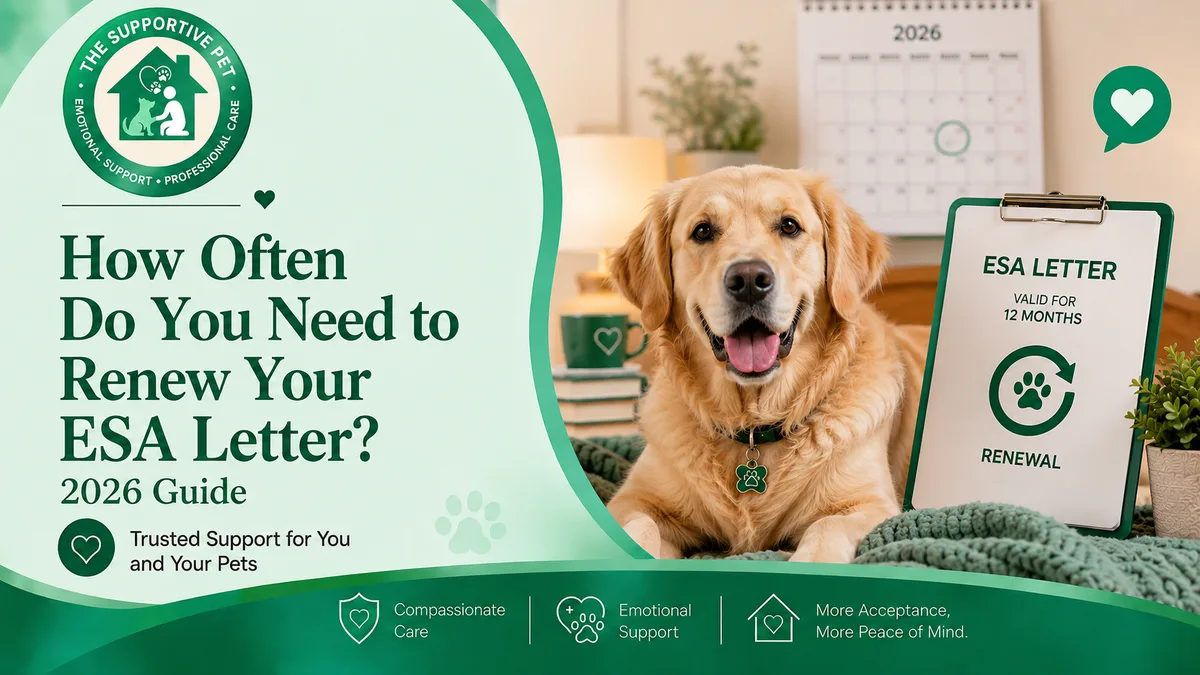
How often do you need to renew an ESA letter?
Most ESA letters should be renewed annually. While there is no federal law specifying an expiration date, HUD allows landlords to request updated documentation after a reasonable period. The industry standard is 12 months, and most landlords treat letters older than one year as expired.
Medical Disclaimer: This article is for informational purposes only and does not constitute medical or legal advice. Consult a qualified mental health professional before making decisions about your care. If you or someone you know is in crisis, call or text 988 (Suicide & Crisis Lifeline, available 24/7).
Your ESA letter was a key step in protecting your housing rights - but how long does it last? Can landlords require a newer letter? And what happens if your letter expires mid-lease? This guide answers the most common questions about ESA letter renewal.
How Long Does an ESA Letter Last?
There is no federal law specifying an expiration date for ESA letters. However, the Fair Housing Act permits landlords to require updated documentation if a significant amount of time has passed since the initial request, or if the disability or need for an ESA is not readily apparent. Industry standard - and the standard most landlords and property managers use - is one year. Most clinicians date ESA letters with an issuance date for this reason.
When Can a Landlord Ask for a Newer ESA Letter?
A landlord can request updated ESA documentation if:
- Your existing letter is more than 12 months old
- You are applying to a new rental property (even if your current letter is recent)
- Your current lease is renewing and significant time has passed since your original request
- There is a genuine, non-retaliatory question about whether your need for an ESA continues
A landlord cannot repeatedly demand new letters mid-tenancy as a harassment tactic, or require documentation more frequently than reasonable under the circumstances.
Do You Need a New Clinical Evaluation for Renewal?
Renewal typically involves a shorter check-in evaluation with your licensed clinician - confirming that you have an ongoing mental health condition and continuing need for your ESA. If you have an established relationship with a clinician, renewal is usually a brief follow-up appointment. The Supportive Pet's renewal appointments are shorter and more streamlined than initial evaluations.
What Changes Between Renewals?
The renewed letter will have an updated issuance date. The clinician may update their assessment language to reflect your current status. Everything else - the nature of the letter, the animal description, and the legal protections it provides - remains the same.
Renew Your ESA Letter at The Supportive Pet
The Supportive Pet makes ESA letter renewal straightforward. Returning patients receive priority scheduling and a streamlined renewal evaluation. Most renewal letters are issued the same business day.
Renew your ESA letter at The Supportive Pet.
Qualifying Mental Health Conditions for ESA Renewal
Do Your Conditions Still Qualify?
Most ESA letters need to be renewed annually because landlords and housing providers may request current documentation. Mental health conditions that previously qualified - anxiety, depression, PTSD, bipolar disorder, ADHD, OCD - continue to qualify as long as they substantially limit one or more major life activities. Even if your condition has improved with treatment, if symptoms still affect your daily functioning, you continue to qualify.
What Changes at Renewal
At renewal, a licensed clinician re-evaluates your current symptoms and confirms that your ESA continues to provide therapeutic benefit. The evaluation is typically shorter than the initial assessment since your history is already documented. The Supportive Pet conducts renewal evaluations via telehealth, and most clients receive their renewed letter the same business day.
When You Need to Renew Your ESA Letter
Landlord Renewal Requests
Landlords may request updated ESA documentation on an annual basis. The Fair Housing Act allows landlords to ask for renewal documentation when there is a reasonable basis to believe the condition or need for accommodation may have changed. A landlord who demands renewal documentation without basis may be overstepping, but providing a current letter is generally the faster path to protecting your rights.
Moving to a New Property
When you move, your new landlord can request ESA documentation independently of what you provided to a previous landlord. A letter that is more than 6–12 months old may be questioned. Having a current letter (within the past year) from a licensed clinician ensures you can present documentation that meets any landlord's reasonable request. The Supportive Pet makes renewal fast - most clients complete their evaluation and receive a new letter in under an hour.
Common Renewal Mistakes to Avoid
Using an Expired Letter
Presenting a landlord with an ESA letter that is more than 12 months old invites pushback. While an expired letter doesn't automatically lose legal force, landlords are permitted to request updated documentation when they have reasonable basis to believe the need for accommodation may have changed. Keeping a current letter avoids this friction entirely.
Using a Non-Licensed Provider
Many online services sell ESA letters from providers who are not licensed to practice in your state, or whose "letters" lack the required clinical content. These letters may not hold up if a landlord challenges them. The Supportive Pet only connects clients with clinicians who are properly licensed in the client's state of residence. Renew your ESA letter here.
Renewal FAQs
Does my ESA need to be re-evaluated by the same clinician?
No. You can get your renewal letter from any licensed mental health professional, not just the one who issued your original letter. The Supportive Pet makes renewal easy - state-licensed clinicians, telehealth evaluation, and same-day delivery for those who qualify. Renew your ESA letter here.
Why ESA Letters Have Expiration Dates
ESA letters are not permanent documents. While no federal law sets a mandatory expiration date, most licensed clinicians issue letters valid for one year, and housing providers routinely request documentation that is current. The reason is practical: mental health treatment plans change, and an ESA letter should reflect an ongoing clinical assessment of your need, not a one-time evaluation from years ago.
The Fair Housing Act framework acknowledges that housing providers may request reliable documentation of a disability-related need, and that a letter from a clinician with whom you have an established relationship carries more weight than one-time documentation. Annual renewal reinforces that relationship and keeps your documentation credible.
When to Renew Your ESA Letter
- At 10–11 months: Initiate your renewal so the new letter is ready before the old one expires
- When moving: Always present a current letter to a new landlord, even if your previous letter is technically still valid
- When a landlord requests updated documentation: This is a legitimate request; provide a current letter promptly
- After a significant change in your mental health treatment: If your diagnosis, treatment approach, or clinician changes, update your ESA letter to reflect current clinical reality
The Renewal Process
With Your Current Clinician
If you have an ongoing therapeutic relationship with a therapist, psychologist, or psychiatrist, ask them to issue an updated ESA letter at your next appointment. Clinicians who have been treating you have the most defensible basis for renewal - they have direct, ongoing knowledge of your condition and treatment needs.
Telehealth ESA Renewal
If your original letter came from a telehealth ESA service, renewal involves a brief re-assessment with a licensed clinician - often a 15–30 minute video consultation reviewing whether your mental health condition continues and whether the ESA remains part of your treatment plan. When renewing through telehealth, confirm that the clinician is licensed in your state of residence, and is licensed as a mental health professional (LMFT, LCSW, LPC, PhD in psychology, or psychiatrist).
What a Valid Renewed ESA Letter Must Include
- Clinician's name, professional title, and license type
- Clinician's license number and state of licensure
- Date of issuance (must be current - within 12 months is the practical standard)
- Statement that you have a disability (without specifying diagnosis unless you choose to disclose)
- Statement that an ESA is recommended as part of your treatment or is therapeutically beneficial
- Clinician's signature on professional letterhead
Renewing After a Change in Clinician
If you switch therapists or discontinue treatment, ESA renewal requires establishing a clinical relationship with a new provider. A new clinician cannot simply re-issue your previous letter without their own assessment - they are staking their professional license on the letter's content. The new provider will need to review your history and form their own clinical opinion about your ongoing need for an ESA.
Frequently Asked Questions: ESA Letter Renewal
My landlord says my letter must be renewed every year. Is that legally required?
No federal law requires annual renewal, but landlords may reasonably request documentation that is current. Annual renewal is the standard practice. If your letter has expired and your landlord requests updated documentation, provide it promptly rather than disputing the request - it is reasonable, even if not legally mandated.
Can I use the same ESA letter for multiple housing applications?
Yes, as long as it is current. Your ESA letter is not single-use - you can provide it to multiple housing providers. Keep a digital copy and provide it as needed. Once it expires (typically at one year), renew before submitting to new providers.
Does my ESA letter renewal require a new assessment even if nothing has changed?
Yes. A renewal should reflect a current clinical assessment, even if your condition and ESA relationship are stable. Your clinician is confirming that your need is ongoing, not just that it existed a year ago. Most renewals are brief for stable, long-term patients but should involve at least a check-in consultation.
What if my mental health condition has changed since my original letter?
Renewal is still possible - what matters is your current need for the ESA, not whether your original condition has evolved. If your diagnosis has changed, your new clinician can write a letter reflecting the current condition and ongoing ESA need. ESA letters do not require continuity with previous documentation.
I moved to a new state. Does my ESA letter from my previous state clinician remain valid?
The letter itself remains valid - there is no requirement that the issuing clinician be licensed in your current state of residence, only that they hold a valid license in whatever state they practice. When you seek renewal, choose a clinician licensed in your new state for consistency and practicality.
Can my landlord reject a renewal that looks identical to my previous letter?
If the renewal is valid on its face (current date, valid license number, professional letterhead), a landlord cannot reject it just because the content is similar to a previous letter. They accepted the previous letter's terms, and renewal on the same clinical basis is legitimate.
Frequently Asked Questions
How often do you need to renew an ESA letter?
Most ESA letters should be renewed annually. While there is no federal law specifying an expiration date, HUD allows landlords to request updated documentation after a reasonable period. The industry standard is 12 months, and most landlords treat letters older than one year as expired.
Can my landlord require a new ESA letter mid-lease?
Landlords can request updated documentation if significant time has passed since the original request. They cannot repeatedly demand new letters as a harassment tactic. If your letter is current (within 12 months) and you haven't moved, a landlord generally cannot require renewal mid-lease without a legitimate reason.
Do I need a full evaluation to renew my ESA letter?
Renewal typically involves a shorter follow-up appointment with your licensed clinician - not a full initial evaluation. If your condition is ongoing and your need for an ESA continues, renewal is usually straightforward. The Supportive Pet's renewal appointments are streamlined for returning patients.
See our articles highlighted in Google Search
Add The Supportive Pet as a preferred source - your results, your way.