
Can a landlord deny my Rottweiler ESA based on breed restrictions?
No. Under the Fair Housing Act, a valid ESA letter requires landlords to grant reasonable accommodation regardless of breed restrictions. A landlord can only deny accommodation if your specific Rottweiler poses a direct, documented threat - not a general breed assumption. Breed restrictions do not override Fair Housing Act rights.
Medical Disclaimer: This article is for informational purposes only and does not constitute medical or legal advice. Consult a qualified mental health professional before making decisions about your care. If you or someone you know is in crisis, call or text 988 (Suicide & Crisis Lifeline, available 24/7).
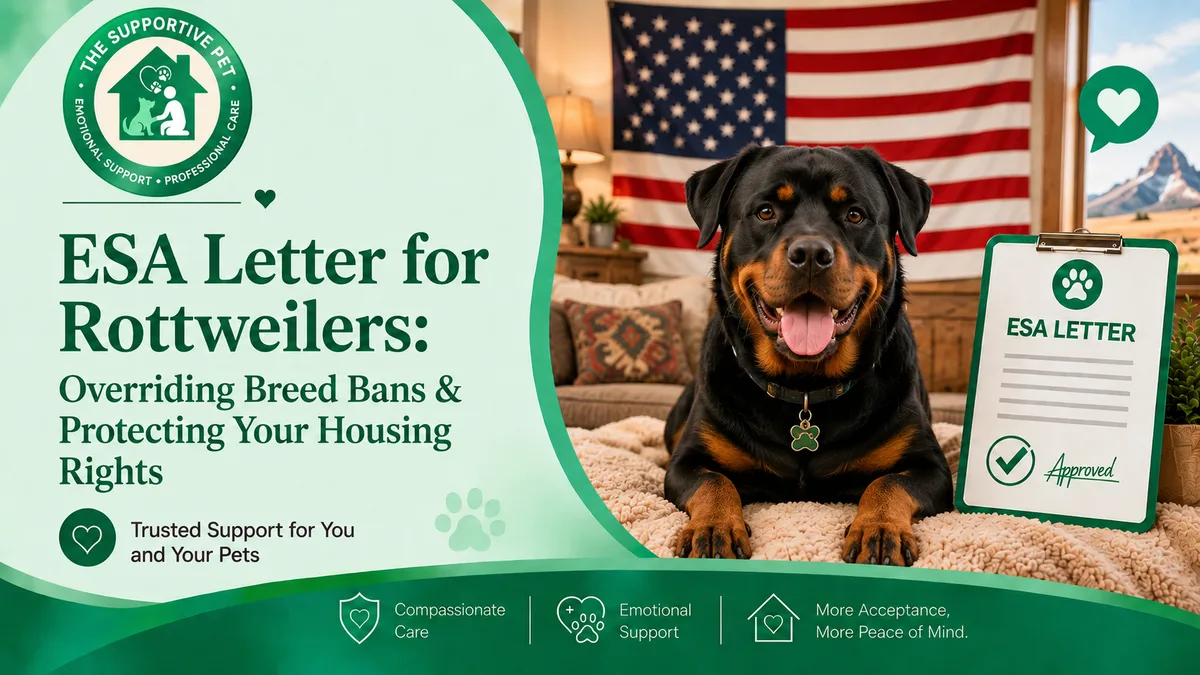
Rottweilers are one of the breeds most frequently listed on apartment breed restriction policies alongside Pit Bulls and German Shepherds. Many landlords and property management companies ban Rottweilers outright - often citing insurance requirements or liability concerns. However, under the Fair Housing Act (FHA), documented ESA owners have the legal right to keep their Rottweiler regardless of what the lease or building policy says.
Why Rottweilers Face Breed Restrictions
How Breed Restrictions Work
Breed restriction policies are set by private insurers and property managers - they carry no legal authority over Fair Housing Act rights. Rottweilers are commonly listed alongside Pit Bulls, German Shepherds, Dobermans, and Chow Chows on restricted breed lists. Insurers classify these breeds as higher liability, leading property managers to prohibit them preemptively. None of this changes your rights as a documented ESA owner.
What an ESA Letter Does for Your Rottweiler
Key Protections Under the FHA
- Exempts from breed bans - a valid ESA letter requires landlords to grant reasonable accommodation regardless of breed restrictions
- Eliminates all pet fees - pet deposits, monthly pet rent, and move-in fees are waived for documented ESA owners under the FHA
- Exempts from weight limits - Rottweilers (80–135 lbs) exceed most apartment weight caps; ESA status removes this restriction entirely
- Prevents housing denial - landlords cannot refuse to rent to you because you have a Rottweiler ESA
What Landlords Can and Cannot Do
Legal Obligations vs. Permitted Requests
Landlords can request documentation - specifically, a letter from a licensed mental health professional (LMHP) confirming your disability-related need for an ESA. They cannot ask about your specific diagnosis, require special ESA certification, charge pet fees, or deny housing based solely on your Rottweiler's breed. They may only deny an accommodation if the specific animal poses a direct, documented threat - not a general assumption based on breed.
Rottweilers vs. Psychiatric Service Dogs
Rights Comparison
Rottweilers are highly intelligent and trainable, making them excellent candidates for psychiatric service dog (PSD) work. If your Rottweiler is trained to perform specific disability-mitigating tasks - interrupting anxiety spirals, applying deep pressure therapy, or guiding during dissociative episodes - a PSD letter provides housing rights under the FHA plus public access rights under the ADA. See the full ESA vs. PSD comparison.
How to Get a Rottweiler ESA Letter
The Clinical Evaluation
The process focuses entirely on your mental health - not your Rottweiler's breed, training, or temperament. You need a licensed mental health professional to evaluate you for a qualifying condition (anxiety, depression, PTSD, bipolar disorder, and many others qualify) and write an ESA letter on their professional letterhead.
The Supportive Pet connects you with a state-licensed clinician for a genuine clinical evaluation. Most patients receive their letter the same business day - no unnecessary delays, no upfront charges if you don't qualify. Start your evaluation here.
Qualifying Mental Health Conditions for Rottweiler ESA Letters
Who Qualifies
To get an ESA letter for your Rottweiler, you need a mental health condition that substantially limits one or more major life activities. Common qualifying conditions include anxiety disorders, PTSD, major depression, panic disorder, bipolar disorder, OCD, ADHD, phobias, autism spectrum disorder, and schizophrenia. You don't need a severe diagnosis - moderate symptoms that affect your sleep, work performance, or daily functioning regularly qualify. What matters is that your condition is documented by a licensed clinician and that your dog provides genuine therapeutic benefit.
What the Clinical Evaluation Involves
A legitimate ESA letter comes from a real clinical evaluation - not a 2-minute online form. A licensed mental health professional (therapist, psychologist, psychiatrist, or LCSW) will evaluate your mental health history, current symptoms, and how an emotional support animal helps you manage your condition. The Supportive Pet conducts genuine evaluations by state-licensed clinicians via telehealth. Most patients receive their letter the same business day they complete their evaluation.
No Special Training Required for ESA Status
Unlike service dogs, ESAs do not need specialized training or certification. Your Rottweiler's ESA status comes entirely from your clinician's letter - not from the animal's training, a registration website, or any ID card or vest. Websites selling ESA certificates, registry memberships, or ID packages provide documents with zero legal standing under the FHA. Your landlord cannot require any of these.
How to Use Your ESA Letter in Rottweiler Housing
Submitting Your Accommodation Request
Once you have your ESA letter from a licensed clinician, submit a written reasonable accommodation request to your landlord. Include: your name, your unit address, a statement that you have a disability-related need for an emotional support animal, and a copy of your ESA letter. Send this in writing and keep copies. Your landlord must respond in a reasonable timeframe - HUD considers 10 business days a standard expectation.
What Your Landlord Can and Cannot Ask
Your landlord may ask for written documentation from a licensed mental health professional confirming your need for an ESA. They may verify the clinician's license and contact information. They may NOT demand your specific diagnosis, your full medical records, special ESA registration, or documentation from any particular provider. They also may not charge you a pet deposit, pet rent, or any other pet fee for your documented ESA - including your Rottweiler.
If Your Landlord Denies Your ESA
Most ESA denials are illegal. If your landlord refuses a valid ESA accommodation request without legal justification - denying based on breed, charging pet fees, or ignoring your request - you can file a fair housing complaint with HUD at hud.gov/fairhousing. Complaints are free, and successful complaints can result in the landlord being required to grant the accommodation and pay damages. The Supportive Pet provides free landlord dispute support to every client who receives a letter through our clinicians.
Rottweilers as Emotional Support Animals: The Case for the Breed
Rottweilers carry one of the most undeserved public relations problems in the dog world. Their working-dog heritage - cart-pulling, livestock herding, police work - created a breed that is fundamentally cooperative, task-driven, and deeply bonded to human handlers. When properly socialized, Rottweilers are calm, confident, and remarkably gentle with their family unit.
For ESA purposes, these traits translate directly into therapeutic value. Their steady temperament reduces the reactivity that makes anxious owners more anxious. Their physical presence - the weight of a Rottweiler leaning against you or resting a head on your lap - provides proprioceptive pressure that genuinely reduces anxiety. Their natural protectiveness, channeled appropriately, gives trauma survivors the security they need to relax and sleep.
Condition-Specific Therapeutic Benefits
- PTSD: Steady, non-reactive temperament models calm under stress; night-time security presence reduces hypervigilance that disrupts sleep
- Panic disorder: Deep pressure contact during episodes provides grounding and reduces episode duration
- Depression: High bonding drive means the dog is visibly invested in the owner's engagement - a daily motivational pull toward routine and interaction
- Agoraphobia: The confidence of a large, alert dog as a companion lowers the felt threat of public spaces
How an ESA Letter Overrides Rottweiler Breed Bans
Rottweilers appear on breed restriction lists alongside pit bulls in the majority of properties that maintain such lists. The Fair Housing Act creates a legal framework that supersedes these restrictions for documented ESAs. Your ESA letter does not just "make an exception" - it invokes a federal right that cannot be bargained away by lease clauses or HOA bylaws.
The legal standard a landlord must meet to deny a Rottweiler ESA is narrow: they must demonstrate that your specific dog poses a direct threat based on actual evidence. The breed's general reputation, insurance risk categories, or neighbor sentiment do not meet this standard under HUD enforcement guidelines.
Step-by-Step: Submitting Your ESA Accommodation Request for a Rottweiler
- Obtain your ESA letter: Letter must be from a licensed mental health professional (therapist, psychologist, psychiatrist) on official letterhead with license number and state
- Write your accommodation request: A brief letter stating that you are requesting reasonable accommodation under the FHA to keep your emotional support animal (name, species, breed) in your unit
- Submit in writing: Email or certified mail to your landlord or property manager; get a delivery confirmation
- Wait for response: Landlords have 10 business days to respond under HUD guidelines
- If denied: Request written reasons for denial; if the denial cites breed without citing direct threat, file with HUD (hud.gov/complaints) within one year
Insurance Restrictions and Your Rights
The most common reason landlords cite for denying Rottweiler ESAs is insurance restrictions. Many property insurance policies exclude Rottweilers from liability coverage. This is a real business challenge for landlords - but it is not a legal basis for denying your FHA right.
HUD's position is that insurance policy restrictions do not override FHA obligations. The landlord must explore insurance solutions (different policies, endorsements, umbrella coverage) rather than shifting the burden of their insurance choices onto you by denying your housing right. Landlords who deny ESA accommodations solely on insurance grounds face HUD enforcement exposure.
Frequently Asked Questions: ESA Letters for Rottweilers
Can my landlord require my Rottweiler to wear a muzzle as an ESA condition?
Only with documented basis. If your specific Rottweiler has exhibited dangerous behavior at the property, a landlord may propose additional conditions as part of a negotiated accommodation. A blanket muzzle requirement for all Rottweilers based on breed profile is not a reasonable accommodation condition - it is effectively a continuation of the breed restriction, which the FHA prohibits.
Does my ESA Rottweiler need liability insurance?
The FHA does not authorize landlords to require pet owners - including ESA owners - to carry personal liability insurance as a condition of accommodation. Some landlords request this, but it is not a legally enforceable condition under FHA guidelines. If you choose to carry renter's insurance with a pet liability rider, that protects you, but it is not a requirement for your ESA right.
My Rottweiler is over 100 pounds. Does weight affect my ESA rights?
No. Weight limits are treated identically to breed restrictions for ESA purposes. An ESA letter qualifies you for exemptions from weight restrictions. There is no size at which a dog becomes too large to qualify for ESA accommodation under the FHA.
Can I get an ESA letter if I'm currently renting and the lease has a no-pets clause?
Yes. Your ESA rights exist independently of your lease. The FHA is a federal civil rights law that cannot be contracted away in a lease. You can obtain an ESA letter and submit your accommodation request mid-lease, and your landlord must consider it under the same standards as if it had been submitted before the lease was signed.
If I move to a new apartment, do I need a new ESA letter?
Your ESA letter is valid for one year from issuance. If it is still current when you move, you can use the same letter for your new housing application. If it has expired, renew it before moving - landlords expect documentation that is current at the time of the accommodation request.
What should I document to protect myself in case of a lease dispute?
Keep copies of: your ESA letter, your written accommodation request, all landlord correspondence, any maintenance requests related to your unit, and your dog's vaccination and licensing records. If a dispute arises, your documentation timeline establishes that you submitted a proper accommodation request before the landlord took any adverse action.
Are Rottweilers allowed in all states as ESAs, or are there state-level breed bans?
There are no statewide ESA breed bans. Some municipalities have BSL (breed-specific legislation) that restricts Rottweilers in public spaces, but the FHA's protection applies to housing specifically and overrides local ordinances for rental housing purposes. In housing, your ESA letter provides protection even in municipalities with Rottweiler-related BSL.
Frequently Asked Questions
Can a landlord deny my Rottweiler ESA based on breed restrictions?
No. Under the Fair Housing Act, a valid ESA letter requires landlords to grant reasonable accommodation regardless of breed restrictions. A landlord can only deny accommodation if your specific Rottweiler poses a direct, documented threat - not a general breed assumption. Breed restrictions do not override Fair Housing Act rights.
Do I need to pay pet deposits for my Rottweiler ESA?
No. The Fair Housing Act requires landlords to waive all pet-related fees - deposits, monthly pet rent, and move-in fees - for documented ESA owners. You pay normal rent only. This applies even if the building has a non-refundable pet deposit policy.
Does my Rottweiler need to be trained or certified to be an ESA?
No. ESAs do not require specific task training or formal certification. ESA designation comes from a licensed mental health professional's letter based on your diagnosed condition and your need for emotional support - not your dog's training level. Websites selling ESA certificates or registrations provide documents with no legal standing.
What if my landlord refuses my Rottweiler ESA?
If a landlord refuses a valid ESA accommodation request, they may be violating the Fair Housing Act. You can file a complaint with the U.S. Department of Housing and Urban Development (HUD) at hud.gov/fairhousing. The Supportive Pet provides free landlord dispute support to all clients.
See our articles highlighted in Google Search
Add The Supportive Pet as a preferred source - your results, your way.