
Can someone with schizophrenia get an ESA letter?
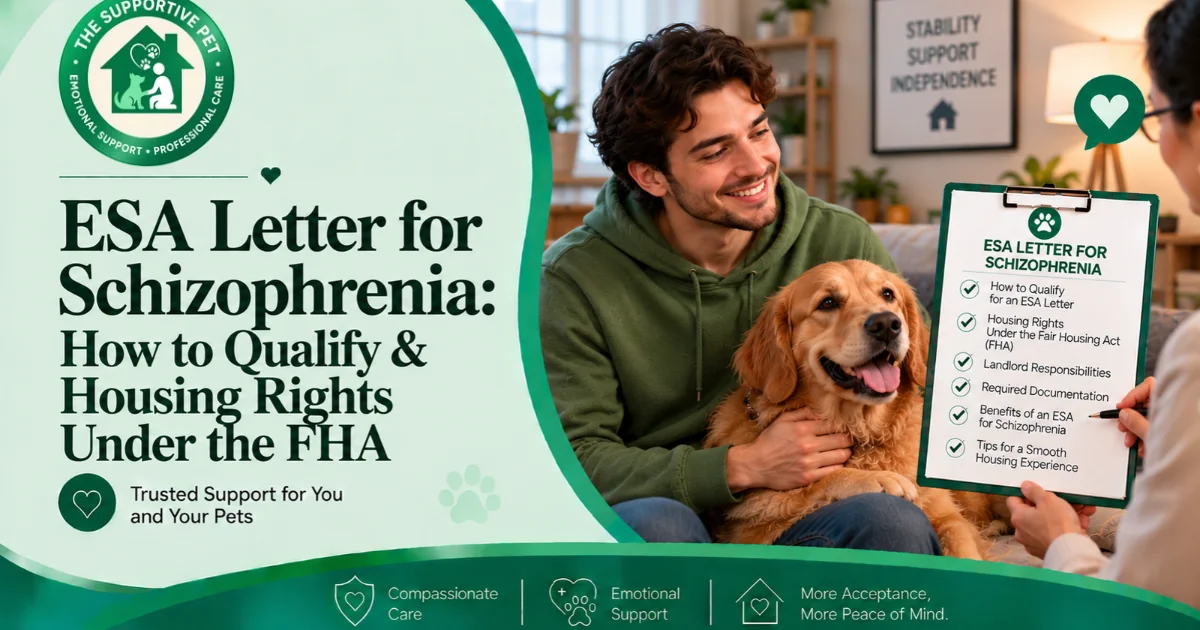
Yes. Schizophrenia is a recognized qualifying condition. The evaluation assesses whether your condition substantially limits daily functioning and whether you are able to care for an animal. Most people with stable schizophrenia who are managing their condition qualify for an ESA letter.
Medical Disclaimer: This article is for informational purposes only and does not constitute medical or legal advice. Consult a qualified mental health professional before making decisions about your care. If you or someone you know is in crisis, call or text 988 (Suicide & Crisis Lifeline, available 24/7).
Schizophrenia is a serious mental health condition characterized by disrupted thinking, perceptions, and behavior - including hallucinations, delusions, disorganized thought, and negative symptoms such as reduced emotional expression and social withdrawal. Schizophrenia affects approximately 1% of the U.S. population. It is a qualifying condition for ESA letters when it substantially impacts daily functioning, and emotional support animals are recognized as a beneficial complementary support for symptom management.
How Emotional Support Animals Help with Schizophrenia
Research on animal-assisted interventions for schizophrenia has documented several specific benefits:
- Social isolation reduction - negative symptoms of schizophrenia produce profound social withdrawal; an animal provides consistent, non-threatening interaction that maintains social engagement
- Reality grounding - during periods of positive symptoms (hallucinations, delusions), an animal's predictable, concrete behavioral responses can provide sensory grounding in observable reality
- Routine and structure - daily care requirements (feeding, exercise, medication schedule) support the medication adherence and daily routines that are critical for schizophrenia management
- Stress regulation - stress is a major trigger for psychotic episodes; animal interaction reduces cortisol and provides consistent calm that reduces episode frequency in some patients
- Medication adherence support - the responsibility and routine associated with pet ownership reinforces personal care routines, including medication schedules
A growing body of research supports animal-assisted therapy as a complement to antipsychotic medication and psychosocial rehabilitation for schizophrenia.
Does Schizophrenia Qualify for an ESA Letter?
Yes. Schizophrenia is a recognized DSM-5 condition that substantially impacts major life activities and qualifies for an ESA letter. The evaluation focuses on your diagnosis, current symptom management, and how your ESA provides therapeutic benefit. You do not need to be in a crisis state - stable schizophrenia managed with medication qualifies when the condition remains substantially limiting.
Important: The evaluation considers whether you are in a stable enough state to adequately care for an animal. A licensed clinician will assess this as part of your evaluation. Most people with schizophrenia who are stable on medication and seek an ESA letter qualify.
Housing Rights for Schizophrenia ESA Owners
Under the Fair Housing Act (42 U.S.C. § 3604), your landlord must allow your ESA, request exemptions from no-pets policies, and waive all pet fees. The FHA's protections are strong regardless of the nature of your qualifying condition - schizophrenia carries the same housing protections as any other qualifying mental health condition. See our housing rights guide.
How to Get Your ESA Letter for Schizophrenia
The Supportive Pet provides telehealth evaluations with state-licensed mental health professionals experienced in serious mental illness. The evaluation is conducted at your pace and is confidential. Most clients receive their letter the same business day. Start your evaluation here.
See also: Schizophrenia ESA condition page
Schizophrenia, Stability, and ESA Care Requirements
A common concern for people with schizophrenia considering an ESA is whether they can consistently care for an animal. This is a legitimate clinical consideration that your evaluating clinician will assess. For people with schizophrenia who are:
- Stable on medication - consistent medication adherence suggests reliable daily routines that support pet care
- Living independently or with supervised support - independent living demonstrates capacity for self-care and routine maintenance that extends to animal care
- In supported housing or group settings - some supported housing environments allow ESAs; others have different policies; check your specific housing situation
Many mental health professionals who work with schizophrenia patients actively recommend low-maintenance ESA species (cats, fish, or small animals) for patients earlier in their stabilization journey, reserving dogs for patients with more established routines.
Best ESA Species for Schizophrenia
For people with schizophrenia, the optimal ESA choice often depends on current functional level:
- Cats - require feeding and litter maintenance on a consistent schedule but tolerate irregular human routines better than dogs; suitable for patients with some routine disruption
- Dogs (calm breeds) - most therapeutic for social engagement and routine; best suited for stable patients; breeds with predictable, non-reactive temperaments are preferable
- Small animals - guinea pigs, rabbits, and fish provide sensory grounding and routine with lower care demands; appropriate during periods of reduced functional capacity
Frequently Asked Questions: Schizophrenia ESA Letters
Q: I'm on antipsychotic medication - does that affect my ability to get an ESA letter?
No. Being on antipsychotic medication does not disqualify you. Medication management of schizophrenia is itself evidence of active treatment engagement, which supports ESA evaluation. The evaluation assesses your current functional status, not whether you use medication.
Q: Can my psychiatrist write my ESA letter?
Yes. Psychiatrists are licensed medical professionals with prescribing authority who can write ESA letters. If you have an established treating psychiatrist, they may be the most appropriate provider to write your letter, as they know your history.
Q: I live in supported housing. Can I get an ESA letter for my current residence?
Supported housing and group homes are covered by the Fair Housing Act in most configurations. However, the specific accommodation request process may differ in supervised housing settings. Discuss your intent with your case manager and housing provider before submitting a formal request.
Q: What does "substantially limits major life activities" mean for schizophrenia?
Major life activities include working, maintaining relationships, communicating, sleeping, concentrating, and caring for oneself. Schizophrenia typically substantially limits multiple major life activities. Your clinician will assess which activities are affected and to what degree during your evaluation.
Practical Guidance for Housing With a Schizophrenia ESA
Securing and maintaining housing is a critical component of recovery for people with schizophrenia. An ESA letter can remove one common barrier - landlords who would otherwise enforce no-pets policies.
Working with your treatment team: Your ESA letter must come from a licensed clinician who has evaluated you. If you are already working with a psychiatrist, psychologist, or therapist, they may be able to provide this documentation directly. If not, The Supportive Pet can connect you with a licensed professional for an independent evaluation.
Medication management and routine: Caring for a pet introduces predictable daily structure - feeding, walks, play - which supports the medication adherence and routine regularity that are important for symptom management in schizophrenia.
Social support and isolation: Social withdrawal is a negative symptom of schizophrenia that is often as debilitating as positive symptoms. An ESA provides consistent social contact with a living being that is calm, predictable, and non-judgmental - qualities that many human social interactions do not reliably offer.
Caregiver considerations: If a family member or caregiver supports your housing, they can also benefit from understanding the FHA's ESA provisions. Landlords cannot charge fees or refuse housing based on the ESA when proper documentation is in place.
Frequently Asked Questions
Can someone with schizophrenia get an ESA letter?
Yes. Schizophrenia is a recognized qualifying condition. The evaluation assesses whether your condition substantially limits daily functioning and whether you are able to care for an animal. Most people with stable schizophrenia who are managing their condition qualify for an ESA letter.
Will my landlord be told I have schizophrenia when I submit my ESA accommodation request?
No. Your ESA letter states that you have a disability-related need for an emotional support animal - it does not name your specific diagnosis. Schizophrenia remains private health information that your landlord has no right to request.
Can a landlord use the nature of my mental health condition to deny my ESA accommodation?
No. The Fair Housing Act prohibits housing discrimination based on disability, which explicitly includes mental health conditions including serious mental illness. A landlord cannot deny an ESA accommodation based on the nature or severity of your diagnosis.
See our articles highlighted in Google Search
Add The Supportive Pet as a preferred source - your results, your way.