
Does Washington State have its own ESA housing law?
Yes. Washington's Law Against Discrimination (WLAD, RCW 49.60) provides state-level protections alongside the federal FHA. Seattle adds a third layer through its Open Housing Ordinance, which requires landlords to respond to accommodation requests in writing.
Medical Disclaimer: This article is for informational purposes only and does not constitute medical or legal advice. Consult a qualified mental health professional before making decisions about your care. If you or someone you know is in crisis, call or text 988 (Suicide & Crisis Lifeline, available 24/7).
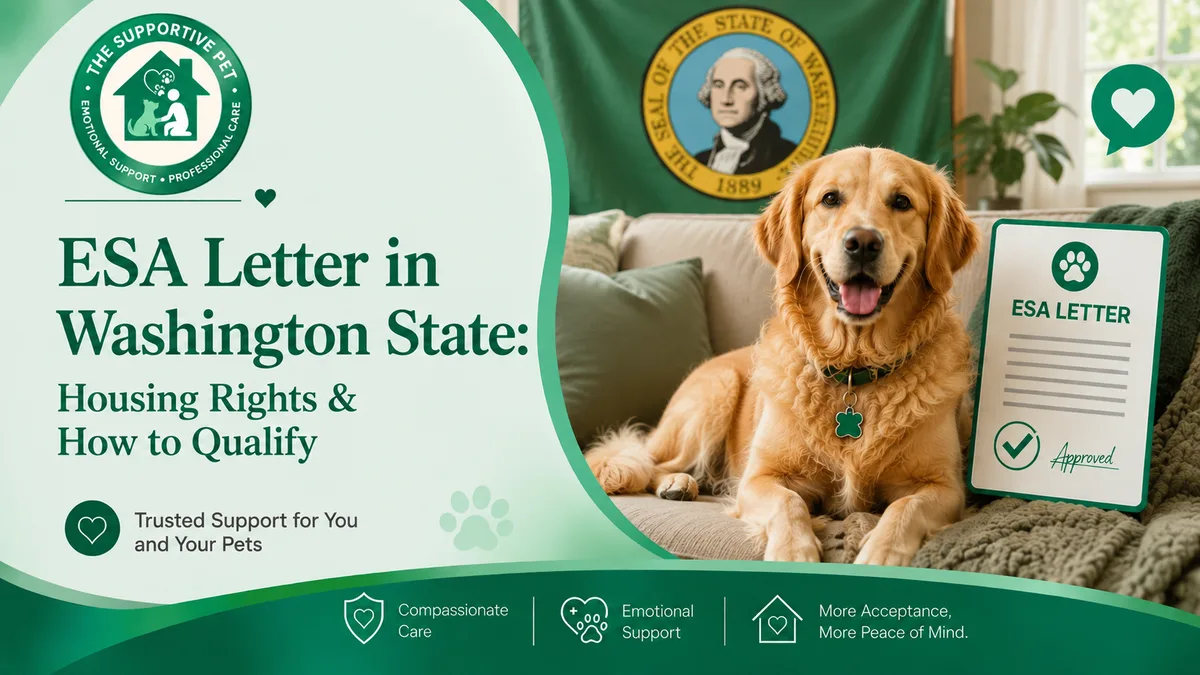
If you rent in Washington State and have an emotional support animal, you have some of the strongest housing protections in the country. Washington's Law Against Discrimination (WLAD) works alongside the federal Fair Housing Act to protect ESA owners statewide - from Seattle's tight apartment market to Spokane, Tacoma, and Bellevue. This guide explains your exact rights, what your landlord can and cannot do, and how to get a Washington ESA letter that holds up under scrutiny.
ESA Housing Rights in Washington State
Washington State ESA owners are protected by two overlapping legal frameworks:
- Federal Fair Housing Act (FHA): Applies in all 50 states. Requires landlords to grant reasonable accommodation for documented ESA owners regardless of no-pet policies, breed restrictions, or size limits.
- Washington Law Against Discrimination (WLAD) - RCW 49.60: Washington's state civil rights law extends FHA-equivalent housing protections and is enforced by the Washington State Human Rights Commission. WLAD protections apply to virtually all rental housing in Washington, including situations where federal coverage may be limited.
Washington has one of the largest renter populations in the western US. Seattle, Bellevue, Tacoma, Spokane, and Redmond have tight rental markets with high per-unit pet fees - making ESA documentation especially valuable for Washington renters managing mental health conditions.
Seattle-Specific Tenant Protections
Seattle renters have additional protections beyond state and federal law. Seattle's Open Housing Ordinance (SMC Chapter 14.08) prohibits housing discrimination based on disability and requires landlords to engage in a good-faith interactive process when reviewing accommodation requests. Seattle landlords must:
- Respond to ESA accommodation requests in writing within a reasonable timeframe
- Provide a written reason if denying an accommodation request
- Consider reasonable alternatives before issuing a denial
Seattle renters can file fair housing complaints with the Seattle Office for Civil Rights in addition to the state and federal options available statewide.
What Washington Landlords Must Do
Under WLAD and the FHA, Washington landlords - including apartment complexes, condo associations, HOAs, and private landlords - must:
- Grant reasonable accommodation for tenants who provide a valid ESA letter from a licensed clinician
- Waive pet fees, pet deposits, and monthly pet rent for documented ESAs
- Accept ESA letters from out-of-state licensed clinicians (though Washington-licensed clinicians are recommended for stronger compliance)
- Accept telehealth-issued ESA letters - online evaluations are fully valid under Washington law
- Respond to accommodation requests without unreasonable delay
What Washington Landlords Cannot Do
- Enforce breed, weight, or size restrictions against a documented ESA
- Charge pet deposits or ongoing pet rent for a documented ESA
- Require ESA certification, registration, or vest documentation - none of these have legal standing
- Ask for your specific psychiatric diagnosis or medical records
- Retaliate against you for making a reasonable accommodation request
- Deny accommodation solely because of a blanket no-pet policy
Washington's Tech Industry and ESA Demand
Washington's technology industry - concentrated in Seattle, Bellevue, and Redmond - has created one of the most competitive rental markets in the country. High rents and strict pet policies at many apartment complexes make ESA housing rights particularly relevant for Washington renters. Anxiety, depression, and ADHD are among the most common qualifying conditions for ESA letters in Washington, particularly among working professionals managing high-demand careers.
Washington also has a significant military population at Joint Base Lewis-McChord (JBLM) near Tacoma. Veterans and active-duty service members managing PTSD frequently use ESA letters for off-base housing. See our guide on ESA letters for veterans for JBLM-specific guidance.
If Your Washington Landlord Denies Your ESA
If your Washington landlord improperly denies your ESA accommodation, you have multiple complaint options:
- Washington State Human Rights Commission: hum.wa.gov - state-level enforcement under WLAD. File within 6 months of the denial.
- Seattle Office for Civil Rights (Seattle renters): seattle.gov/civil-rights - for Seattle-based housing discrimination complaints.
- HUD: hud.gov/fairhousing - federal enforcement option, available statewide.
The Supportive Pet provides free landlord dispute support for all letters we issue. Our team can help you draft a written response to an improper denial before escalating to a formal complaint.
How to Get Your Washington ESA Letter
Washington residents need an ESA letter from a licensed mental health professional (LMHP). Washington does not have California's mandatory 30-day clinician relationship requirement - a fast evaluation with a Washington-licensed LMHP is fully valid under state and federal law.
Your Washington ESA letter should include your clinician's Washington state license number, license type (LCSW, LPC, psychologist, etc.), and a statement of therapeutic nexus - confirming that your ESA is part of your treatment and provides relief related to your condition.
If your dog is individually task-trained to mitigate a psychiatric disability, a PSD letter may be the stronger option for Washington renters - it adds ADA public-access rights on top of the same FHA housing protections an ESA letter provides. Read the full ESA vs. PSD Letter comparison to see which fits your situation.
Frequently Asked Questions: Washington State ESA Letters
Does Washington State have its own ESA housing law?
Yes. Washington's Law Against Discrimination (WLAD, RCW 49.60) provides state-level fair housing protections for ESA owners that mirror the federal FHA. WLAD is enforced by the Washington State Human Rights Commission and covers virtually all residential rental housing in Washington. Seattle renters have additional protections under the Seattle Open Housing Ordinance (SMC Chapter 14.08).
Can my Washington landlord charge a pet deposit for my ESA?
No. Under the federal FHA and WLAD, Washington landlords must waive pet deposits, pet fees, and monthly pet rent for a documented ESA. This applies statewide - including in Seattle, Bellevue, Tacoma, Spokane, and Redmond. Your landlord may hold you responsible for any actual damage your ESA causes, but cannot charge a blanket pet deposit upfront.
Does my ESA letter need to come from a Washington-licensed clinician?
Washington does not have a strict state-licensing requirement equivalent to California's AB 468. However, Fair housing standards recommend that ESA letters come from a licensed mental health professional who has knowledge of your condition. Using a Washington-licensed LCSW, LPC, psychologist, or psychiatrist provides the strongest documentation for Washington landlords. The Supportive Pet connects Washington residents with Washington-licensed clinicians.
Do Seattle's additional tenant protections help ESA owners?
Yes. Seattle's Open Housing Ordinance requires landlords to respond to accommodation requests in writing and provide a documented reason for any denial - a higher procedural bar than state law alone. Seattle renters can also file fair housing complaints with the Seattle Office for Civil Rights, which often resolves disputes faster than state or federal channels.
Can a Washington HOA deny my ESA?
No. Homeowners associations in Washington must comply with the federal FHA and WLAD just as landlords do. A valid ESA letter qualifies you for exemptions from HOA no-pet rules, breed restrictions, and pet fee requirements. If your Washington HOA denies your accommodation, file a complaint with the Washington State Human Rights Commission or HUD.
Start your Washington ESA evaluation at The Supportive Pet. Our Washington-licensed clinicians conduct genuine clinical evaluations and most Washington patients receive their letter the same business day.
Frequently Asked Questions
Does Washington State have its own ESA housing law?
Yes. Washington's Law Against Discrimination (WLAD, RCW 49.60) provides state-level protections alongside the federal FHA. Seattle adds a third layer through its Open Housing Ordinance, which requires landlords to respond to accommodation requests in writing.
Can my Washington landlord charge a pet deposit for my ESA?
No. Under both the FHA and WLAD, Washington landlords must waive all pet deposits, monthly pet rent, and move-in pet fees for a documented ESA. This applies across Seattle, Bellevue, Tacoma, Spokane, and all of Washington.
How do I get an ESA letter in Washington State?
Complete an online assessment through a licensed mental health professional - in Washington, that means an LCSW, LPC, psychologist, or psychiatrist licensed in Washington State. A legitimate service like The Supportive Pet connects you with WA-licensed clinicians and delivers your letter the fast.
See our articles highlighted in Google Search
Add The Supportive Pet as a preferred source - your results, your way.