
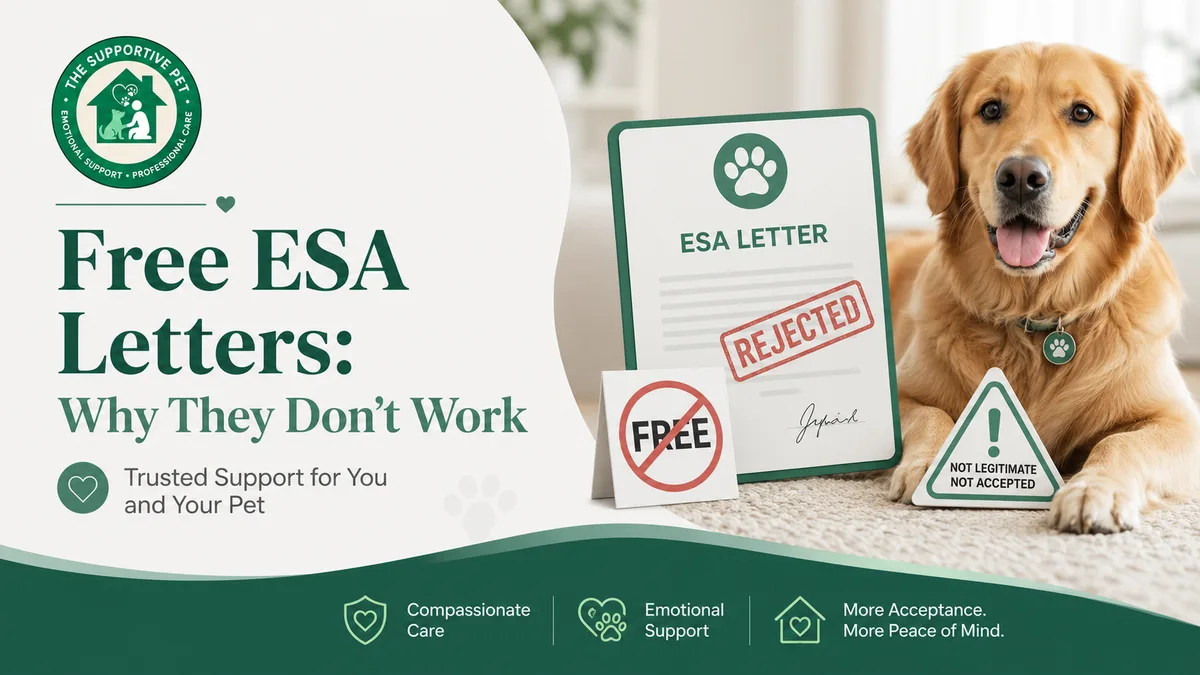
Are free ESA letters legal?
A letter can be issued for free by your own treating therapist, but services that advertise "free" or "instant" ESA letters online are almost always fraudulent. They generate template letters without a real clinical evaluation. HUD guidance explicitly states that landlords may require documentation showing an actual clinician-patient relationship, which these letters cannot demonstrate.
Medical Disclaimer: This article is for informational purposes only and does not constitute medical or legal advice. Consult a qualified mental health professional before making decisions about your care. If you or someone you know is in crisis, call or text 988 (Suicide & Crisis Lifeline, available 24/7).
What "free ESA letter" websites actually provide
A Google search for "free ESA letter" returns dozens of websites promising instant documentation with no evaluation required. Most work the same way: you fill out a form describing your symptoms, pay nothing (or a nominal fee for expedited processing), and receive a PDF within minutes. Some do not involve a licensed clinician at all. Others route your form to an out-of-state provider who reviews batches of submissions in bulk.
The result looks like a letter. It may appear on official letterhead with a license number printed in the footer. But it does not reflect the genuine clinical assessment that makes an ESA letter legally defensible - and landlords who verify letters know the difference immediately.
What HUD guidance actually requires
The U.S. Department of Housing and Urban Development issued guidance in January 2020 clarifying what landlords can require when evaluating ESA accommodation requests. This guidance is explicit on several critical points:
- Personal knowledge: The letter must come from a healthcare provider who has "personal knowledge" of your disability - meaning a genuine clinician-patient relationship, not a form submission reviewed by a stranger.
- Verifiable license: Landlords may verify the provider's license through the relevant state licensing board. If the clinician does not appear in the database - or their license has lapsed - the letter can be rejected.
- Rejecting mill letters: HUD guidance explicitly states that landlords may reject documentation that "appears to come from an Internet-based service that provides letters without a meaningful clinical assessment." This is a direct acknowledgment that these services exist and that their letters lack legal weight.
- Nexus requirement: The letter must establish a connection between your disability and your need for the emotional support animal - not just state that you have a condition.
Free or instant letters rarely meet these standards. When landlords reject them, the tenant loses their accommodation - and may have delayed the process by weeks while they scramble to get a legitimate letter.
Three categories of fraud in the "free ESA letter" market
The free ESA letter market has developed several distinct business models, each with its own failure mode:
- Template mills: Generate letters automatically based on a symptom questionnaire with zero clinical involvement. License numbers are sometimes fabricated, sometimes belong to real clinicians who have not reviewed your case, and sometimes belong to real clinicians who are signing in bulk without meaningful evaluation. Landlords and property management companies increasingly maintain lists of known mill services whose letters they automatically reject.
- Out-of-state signers: Route submissions to licensed clinicians in other states who sign batches of letters without any meaningful review. This is clinically and often legally problematic: in most states, a clinician must be licensed in the state where the patient resides to conduct a valid evaluation. A California clinician cannot legitimately evaluate and document a Texas patient's mental health condition.
- Registration and certification scams: Sell "ESA registration certificates," "ID cards," and vest packages alongside worthless letters. No federal ESA registry exists. No state government operates one. Registration has zero legal value under the FHA. The FHA recognizes exactly one thing: a letter from a licensed clinician. See our detailed guide on why ESA registration is a scam.
Why landlords are increasingly sophisticated about this
Five years ago, many property managers accepted any letter that looked official. That has changed significantly. Property management associations now train their staff to verify ESA letters, and several steps in that verification process will catch free letter services immediately:
- License verification: Searching the clinician's name and license number on the state licensing board website. A clinician who does not appear, or whose license is in another state, is an immediate red flag.
- Practice verification: Searching the practice address or phone number listed on the letter. Many mill services list virtual addresses or numbers that go to answering services.
- Volume patterns: Some property management companies track letters by clinician name. If the same "clinician" has signed letters for five different tenants in their portfolio, that pattern is noted.
- Letter language: Form letters use identical language across submissions. Experienced reviewers recognize templated phrasing immediately.
"A free letter that gets rejected costs you far more than the $129 a real evaluation costs - in time, stress, potential loss of housing, and the cost of a legitimate letter you still need to get. I have seen tenants spend months in limbo because they started with a fraudulent letter. The economics of 'saving money' on this do not work."
- Chetna Giri, Head of Legal & Compliance
The one scenario where a free letter is legitimate
There is one situation where a free ESA letter is entirely valid: when your own treating therapist, psychiatrist, or licensed counselor writes it for you as part of your ongoing care. If you already see a mental health professional, ask them directly. They have personal knowledge of your condition (exactly what HUD requires), they are verifiably licensed in your state, and their letter costs nothing beyond your regular appointment. This is actually the strongest ESA documentation available - stronger than any paid telehealth evaluation, because the established relationship is documented and verifiable.
See our guide on how to ask your therapist for an ESA letter for the exact conversation to have.
What a legitimate letter requires
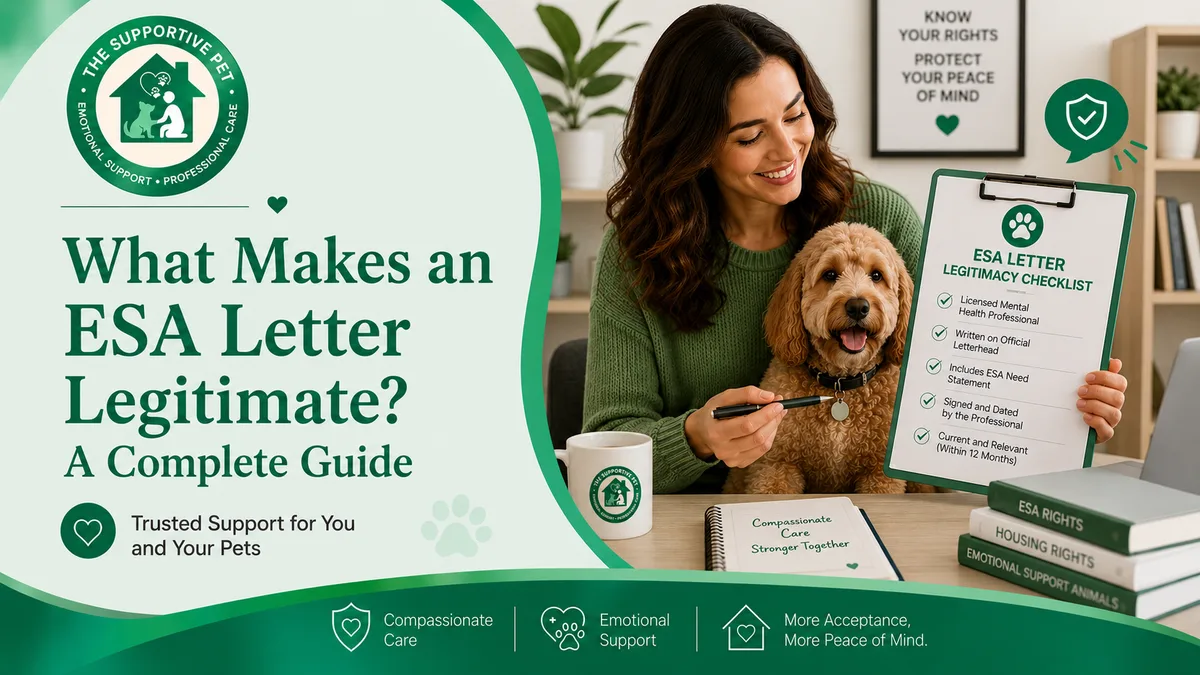
Whether it comes from your therapist or a telehealth platform, a valid ESA letter must include:
- The clinician's full name, professional credentials (LCSW, LPC, LMFT, PhD, MD, etc.), license number, and state of licensure
- Their practice address and contact information so the license can be independently verified
- A statement that you have a mental health disability that substantially limits a major life activity
- A nexus statement establishing the connection between your disability and your need for the emotional support animal
- A statement that the clinician has a professional relationship with you and has assessed your condition
- The clinician's original signature and the date (within the past 12 months)
What a legitimate ESA letter actually costs
Through reputable telehealth platforms like The Supportive Pet, a legitimate ESA letter from a verifiable, state-licensed clinician costs between $99 and $199. This covers:
- A genuine clinical evaluation by a licensed mental health professional
- Letter preparation on professional letterhead with verifiable credentials
- Same-day delivery on business days in most cases
- Landlord dispute support if the letter is challenged
- Annual renewal at a reduced rate
When your housing situation is at stake, the difference between a $0 letter that gets rejected and a $129 letter that works is not the money - it is the outcome. A rejected accommodation request means delays, potential loss of housing, and often weeks of stress that a small investment could have prevented entirely.
Ready to get a legitimate letter? View The Supportive Pet pricing or start your evaluation now.
Frequently Asked Questions
Are free ESA letters legal?
A letter can be issued for free by your own treating therapist, but services that advertise "free" or "instant" ESA letters online are almost always fraudulent. They generate template letters without a real clinical evaluation. HUD guidance explicitly states that landlords may require documentation showing an actual clinician-patient relationship, which these letters cannot demonstrate.
Why do landlords reject free ESA letters?
Experienced property managers know that legitimate ESA letters come from verifiable, licensed clinicians who have conducted a real evaluation. Free or instant letters typically use generic letterhead, lack verifiable license numbers, or come from out-of-state clinicians with no documentation of a patient relationship. Many landlords now routinely verify license numbers before accepting any ESA letter.
What does a legitimate ESA letter cost?
A legitimate ESA letter from a licensed mental health professional costs between $99 and $199 through reputable online platforms. This fee covers the clinician's time for evaluation, documentation, and follow-up. Your own treating therapist may write one at no extra charge if you already have an established clinical relationship with them.
Can I use a free ESA letter for housing?
Technically you can submit any document to a landlord, but if the letter cannot be verified or does not reflect a genuine clinical evaluation, the landlord may lawfully deny the accommodation. HUD guidance allows landlords to request "reliable documentation" - meaning a letter from a verifiable licensed professional who has assessed your disability and the nexus to your ESA.
See our articles highlighted in Google Search
Add The Supportive Pet as a preferred source - your results, your way.