
Can my landlord deny my ESA letter if they have a no-pet policy?
No. A no-pet policy does not override the Fair Housing Act's reasonable accommodation requirement. If you have a valid ESA letter from a licensed mental health professional, your landlord must grant your accommodation request regardless of their no-pet policy.
Medical Disclaimer: This article is for informational purposes only and does not constitute medical or legal advice. Consult a qualified mental health professional before making decisions about your care. If you or someone you know is in crisis, call or text 988 (Suicide & Crisis Lifeline, available 24/7).
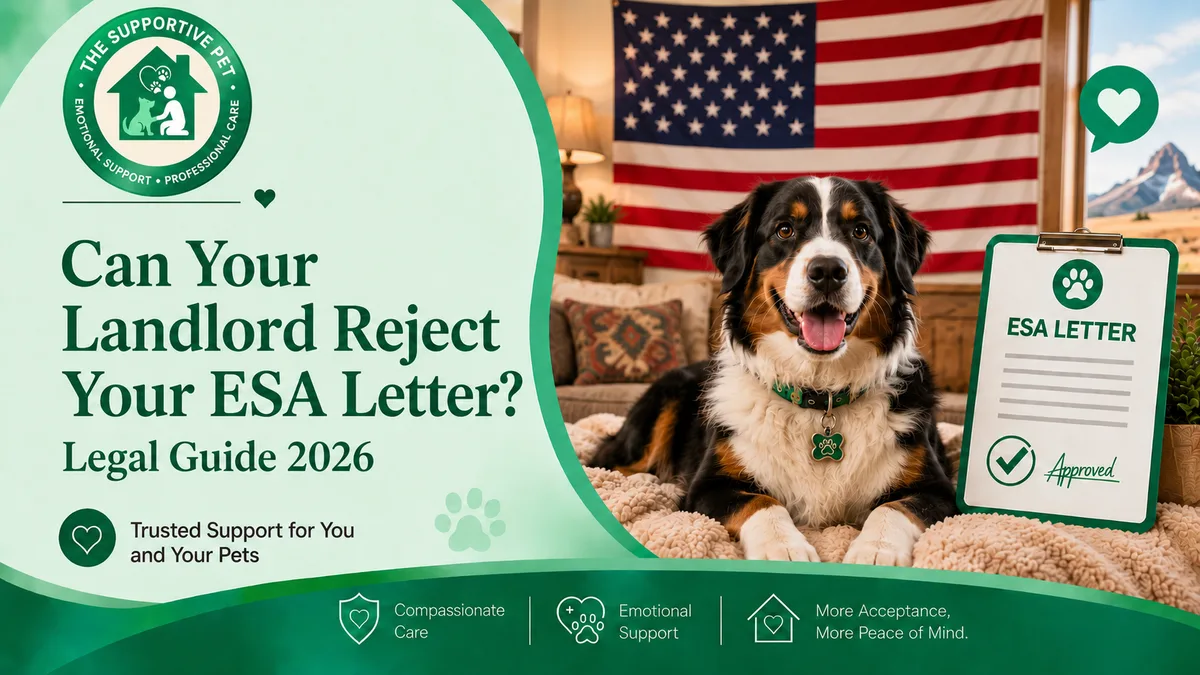
Your landlord received your ESA letter and denied your accommodation request. Is that legal? It depends. While most landlord denials of ESA requests are improper under the Fair Housing Act, there are a small number of situations where denial is legally permitted. This guide explains when denial is legal, when it isn't, and exactly what to do when your landlord denies your ESA letter illegally.
When a Landlord CAN Legally Deny Your ESA Letter
Landlord Obligations Under the FHA
Under the Fair Housing Act, a landlord may deny an ESA accommodation request in these specific circumstances:
- The ESA letter is fraudulent or from an unlicensed provider - Landlords can verify that your clinician holds a valid license in your state through publicly available licensing databases. Letters from "ESA registration" websites that issue letters without clinical evaluations are not valid.
- Your housing is owner-occupied with 4 or fewer units - Small landlords who live in the property and rent 3 or fewer units are partially exempt from the FHA's reasonable accommodation requirements.
- The ESA poses a direct threat - If your specific animal has a documented history of biting, attacking, or threatening others, the landlord may deny on direct-threat grounds - but must base this on individualized assessment, not breed assumptions.
- The animal would cause substantial physical damage - The landlord must show that your specific animal would cause damage that cannot be addressed by normal lease obligations (e.g., damage deposits).
- Single-family homes rented without an agent by the owner - An owner-occupied single-family home rented privately without a real estate broker is partially exempt from FHA requirements.
When a Landlord CANNOT Legally Deny Your ESA Letter
Landlord Obligations Under the FHA
The vast majority of ESA denials are unlawful. Your landlord cannot legally deny your ESA letter because:
- They have a no-pet policy or breed restriction (does not override FHA accommodation duty)
- Other tenants don't have pets (irrelevant to accommodation analysis)
- They think ESA letters are fraudulent (a valid clinical letter from a licensed clinician is legally sufficient)
- Your breed is on their restricted list (breed restrictions do not apply to ESAs)
- You didn't use their preferred form or process (landlords can ask questions but cannot require non-HUD-standard documentation)
- They require ESA certification, registration, or a vest (these have no legal standing)
What to Do If Your ESA Letter Is Denied
Key Points
If your landlord denies your ESA request improperly:
- Get the denial in writing - Request a written explanation for the denial. This creates a record.
- Respond in writing - Send a written letter citing the Fair Housing Act and explaining why the denial is improper. The Supportive Pet provides free landlord dispute letter templates for all ESA letters we issue.
- File a HUD complaint - File at hud.gov/fairhousing within one year of the denial. HUD investigations are free.
- File a state fair housing complaint - Your state's fair housing agency provides an additional enforcement avenue.
- Consult a fair housing attorney - Many work on contingency for FHA discrimination cases.
The Supportive Pet's Free Landlord Support
Landlord Obligations Under the FHA
The Supportive Pet provides free landlord verification and dispute support for all ESA letters we issue. If your landlord denies your ESA letter or threatens non-renewal, contact us and we'll provide a formal written response you can send. Our landlord verification line - (650) 300-4334 - is available Mon–Fri for landlord verification calls.
If you don't yet have an ESA letter, start your evaluation at The Supportive Pet. Most patients receive their letter the same business day.
Your Options When a Landlord Rejects Your ESA Letter
Understanding Your Legal Standing
When a landlord rejects a valid ESA letter, they are likely violating the Fair Housing Act. The FHA requires landlords to provide reasonable accommodation to tenants with documented disabilities. A refusal without legal justification - denying because of breed, species, size, or simply because they don't want animals - is an illegal denial. The burden of proof falls on the landlord to show an undue hardship, which is an extremely high bar that most landlords cannot meet.
Filing a HUD Complaint
File a complaint with HUD at hud.gov/fairhousing within one year of the discriminatory act. HUD investigates free of charge and can require the landlord to grant accommodation, pay civil penalties, and compensate you for damages. You can also file simultaneously with your state's fair housing enforcement agency for additional remedies under state law.
Private Lawsuit
You may also file a private lawsuit in federal or state court. If you win, the Fair Housing Act allows recovery of actual damages, punitive damages (up to $16,000 for a first offense), attorney's fees, and court costs. The Supportive Pet provides free landlord dispute support - template letters, documentation guidance, and referrals to fair housing attorneys - to every client who receives a letter through our clinicians.
Why Landlords Reject ESA Letters - And Which Reasons Are Legally Valid
Understanding why a landlord rejected your ESA letter is the first step to resolving the situation. There are legitimate reasons a landlord can decline or request more information, and there are illegitimate reasons that constitute fair housing violations. Knowing the difference determines your response strategy.
Potentially Legitimate Rejection Reasons
- The letter lacks the clinician's license number, state, or signature
- The clinician's license cannot be verified with the state licensing board
- The letter came from an online service that issues letters without a clinical relationship (HUD has published guidance that these are often insufficient)
- The landlord has no record of a prior existing condition for long-term tenants seeking new accommodation for the first time
- The accommodation would impose fundamental alteration of the housing program (rare)
Illegitimate Rejection Reasons
- The animal is a restricted breed (FHA exempts you from breed restrictions for ESAs)
- The building has a no-pets policy (ESAs are not "pets" under FHA)
- Other tenants object to the animal
- The landlord personally disagrees with ESA letters as a concept
- The property management company's corporate policy prohibits ESAs
- The animal exceeds a weight limit
Step-by-Step Response to an ESA Rejection
- Get the rejection in writing. Ask your landlord to confirm their reasons via email or letter. Verbal rejections are harder to document and easier for landlords to walk back.
- Identify the specific objection. Is it about the letter's documentation, the animal itself, or a blanket policy? The answer determines your next move.
- If the letter has a deficiency: Obtain a corrected letter from your clinician that addresses the specific gap. Common fixes include adding license number, state, and date; adding a statement that the clinician has an established therapeutic relationship with you; and clarifying that the animal is part of your treatment plan.
- If the rejection cites breed, size, or no-pets policy: Respond in writing with a one-paragraph explanation that under 42 U.S.C. §3604(f)(3)(B) (FHA reasonable accommodation), ESAs are not subject to pet restrictions, breed bans, or size limits, and that your letter and accommodation request meet HUD's documentation guidelines.
- Give the landlord a response deadline. Request a written response within 10 business days, which is HUD's standard response timeframe. This creates documentation if you later need to escalate.
Filing a Fair Housing Complaint
If your landlord continues to deny a valid accommodation request without a legally sufficient reason, you have two primary complaint pathways:
HUD Complaint
File at hud.gov/complaints. You have one year from the discriminatory act to file. HUD investigates for free and can impose civil penalties on landlords who violate the FHA. Many landlords reverse their denials once a HUD complaint is filed.
State Civil Rights Agency
Every state has a civil rights or fair housing agency that enforces state-level fair housing laws, which often provide broader protections than the federal FHA. These agencies may have shorter filing deadlines - check your state's specific statute of limitations.
Private Legal Action
You can also file a private lawsuit in federal district court under the FHA. If you prevail, you may recover actual damages, punitive damages, injunctive relief (forcing the landlord to accept your ESA), and attorney's fees. Fair housing attorneys often take these cases on contingency.
When an Online ESA Letter Gets Rejected
HUD released guidance in 2020 specifically addressing internet-based ESA certification companies that issue letters after a brief online questionnaire with no established clinical relationship. Landlords are increasingly aware of this guidance and more likely to reject letters from these services.
A legitimate ESA letter requires a genuine therapeutic relationship - your clinician must have assessed your mental health condition, have an understanding of your treatment needs, and be exercising professional judgment when they state that an ESA is part of your treatment. If your letter came from a site that sold you a certificate and letter for a flat fee without a real telehealth appointment, consider obtaining a new letter from a licensed clinician who can verify the relationship.
Frequently Asked Questions: ESA Letter Rejections
My landlord said they need to verify my mental health diagnosis. Can they ask that?
No. Landlords can verify that you have a disability and that the accommodation is connected to that disability, but they cannot require you to disclose your specific diagnosis. Your clinician's letter confirming that you have a qualifying condition and that the ESA is recommended as part of your treatment is the full extent of what is required.
My landlord said my ESA letter must be less than one year old. Is that a rule?
There is no federal rule requiring annual renewal, but landlords may reasonably request confirmation that your need is ongoing. Providing an updated letter is often the path of least resistance when the dispute is about letter currency rather than a fundamental objection to your ESA.
Can my landlord reject my ESA because they are allergic to animals?
A landlord's personal allergy is not a legally sufficient reason to deny an ESA accommodation unless there is no feasible accommodation that would allow both the landlord and the ESA to coexist. In multi-unit properties where the landlord does not live on site, their personal allergies are generally not a direct-threat consideration.
What if I am a new applicant and my ESA letter is rejected before I even move in?
The FHA protects prospective tenants as well as current tenants. A landlord cannot refuse to rent to you because you have an ESA, and cannot deny a reasonable accommodation request during the application process. If you are denied tenancy solely due to your ESA, that is a fair housing violation.
Frequently Asked Questions
Can my landlord deny my ESA letter if they have a no-pet policy?
No. A no-pet policy does not override the Fair Housing Act's reasonable accommodation requirement. If you have a valid ESA letter from a licensed mental health professional, your landlord must grant your accommodation request regardless of their no-pet policy.
What should I do if my landlord rejects my ESA letter?
Get the denial in writing, then respond in writing citing the Fair Housing Act. If the denial is improper, file a complaint with HUD at hud.gov/fairhousing (within one year) and your state's fair housing agency. The Supportive Pet provides free dispute support for all ESA letters we issue.
Can my landlord require an ESA certification or registration?
No. The Fair Housing Act explicitly provides that landlords cannot require ESA certification, registration cards, or vest documentation. These products sold online have no legal standing. A valid letter from a licensed mental health professional is the legally recognized documentation.
See our articles highlighted in Google Search
Add The Supportive Pet as a preferred source - your results, your way.