
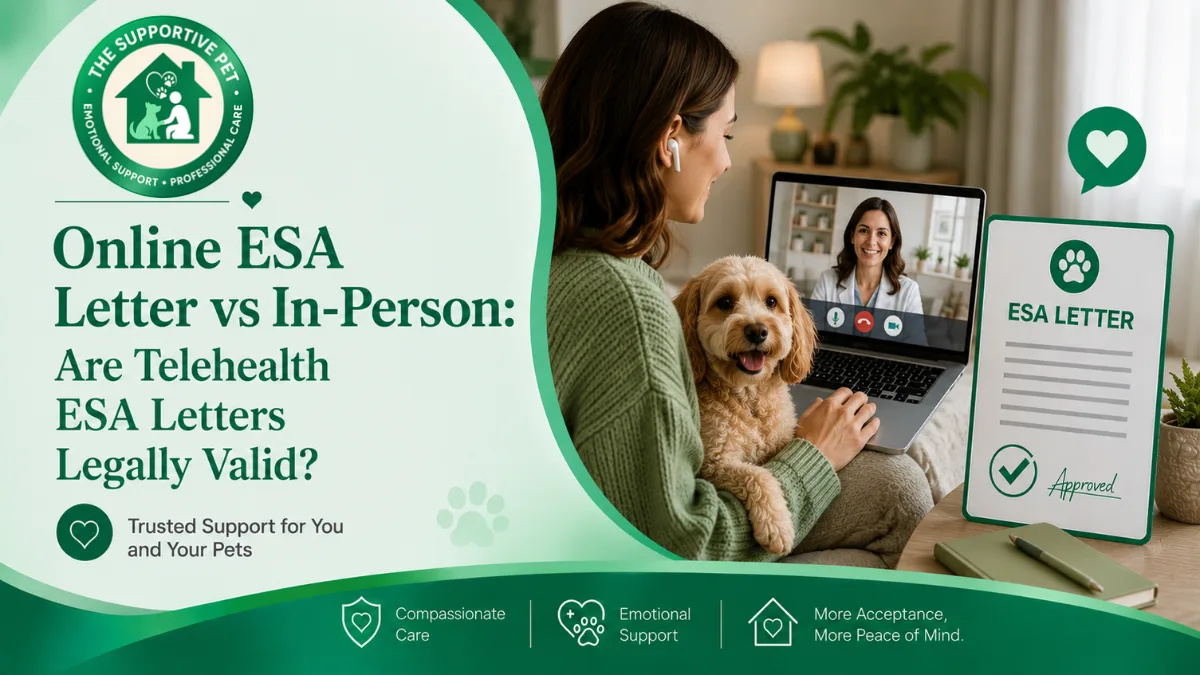
Are online ESA letters legally valid?
Yes. An ESA letter is legally valid when it is issued by a licensed mental health professional following a genuine clinical evaluation - whether that evaluation happens in person or via telehealth. The Fair Housing Act does not specify how the evaluation must occur; it requires that the documentation come from a licensed professional. Online ESA letters from credentialed telehealth providers are accepted by the vast majority of housing providers.
Key Takeaways
- A telehealth ESA letter is legally equivalent to an in-person letter when issued by a licensed provider in your state after a genuine clinical evaluation of your case.
- The key legitimacy marker is whether a real clinician evaluated your specific situation - not whether you met in person or online during the evaluation.
- Avoid platforms that promise instant approval, charge extra for landlord letters, or connect you with providers licensed in states other than yours.
Medical Disclaimer: This article is for informational purposes only and does not constitute medical or legal advice. Consult a qualified mental health professional before making decisions about your care. If you or someone you know is in crisis, call or text 988 (Suicide & Crisis Lifeline, available 24/7).
Telehealth ESA Letters: The Legal Framework
The Fair Housing Act requires that documentation of a disability and the therapeutic nexus with an assistance animal come from "a reliable third party, such as a physician, psychiatrist, social worker, or other mental health professional." Nothing in the FHA, in HUD guidance, or in state fair housing law specifies that this evaluation must occur in person.
Telehealth medicine has been recognized under both federal and state law as a legitimate form of clinical practice. A licensed clinician practicing via telehealth provides the same professional services as one working in an office. The evaluation is what matters - not the physical location where it occurs.
Landlords who refuse online ESA letters solely because they were obtained via telehealth are applying a standard not required by the FHA. If you face this situation, cite the FHA and note that the letter was issued by a licensed clinician following a clinical evaluation - the method of delivery does not diminish its validity.
How The Supportive Pet's Online Evaluation Works
Here is exactly what happens when you apply for an ESA letter through The Supportive Pet:
- Intake questionnaire: You complete a detailed assessment of your mental health history, current symptoms, how your condition affects your daily functioning, and the specific therapeutic relationship between you and your animal. This is not a checkbox form - it is a clinical intake designed to give the evaluating clinician sufficient information to make an informed assessment.
- Clinical review: A licensed mental health professional in your state reviews your intake. They may contact you with follow-up questions if clarification is needed. This review takes real time - it is not instant, because instant review is not real review.
- Clinical determination: The clinician makes an independent decision about whether an ESA recommendation is clinically appropriate for your situation. If it is, they issue your letter. If it is not, you are not charged. There is no guarantee of approval - that is what makes the letter legitimate.
- Letter delivery: If approved, your letter is delivered digitally. It includes the clinician's name, license type, license number, and state - everything a housing provider would need to verify its authenticity.
Online vs In-Person: The Real Differences
| Factor | Online (Telehealth) | In-Person |
|---|---|---|
| Legal validity | ✅ Fully valid | ✅ Fully valid |
| Accepted by housing providers | ✅ Yes | ✅ Yes |
| Cost | $99–$200 | $200–$500+ |
| Turnaround | Fast | Days to weeks |
| Accessibility | All 50 states, no travel required | Requires local provider |
| Prior relationship required | No | Varies by provider |
For most people, the online option is strictly superior in cost, speed, and accessibility - with no difference in legal validity. The main scenario where an in-person letter might be preferable is if you already have an ongoing therapeutic relationship with a therapist who knows your history well and can write a particularly detailed, contextual letter.
What to Look for in an Online ESA Provider
Not all online ESA providers are equally legitimate. Look for:
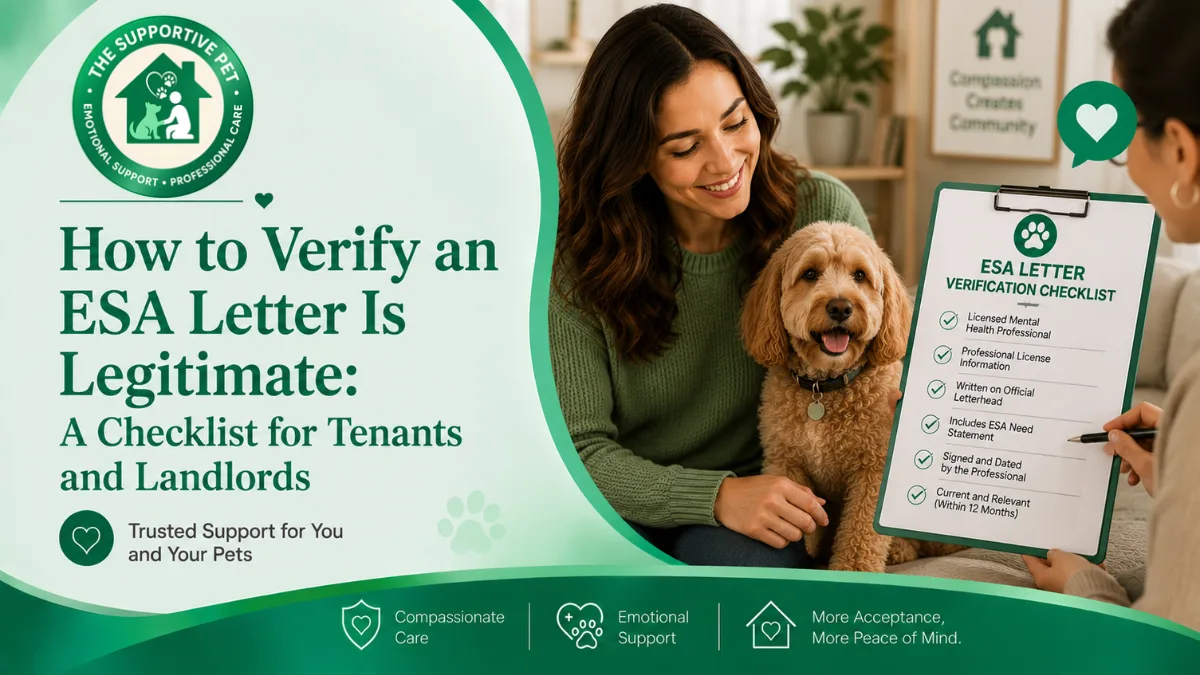
- Licensed clinicians (psychiatrist, psychologist, LCSW, LPC, LMFT) named in the letter
- State-specific licensure matching the state where your housing is located
- A real evaluation process - not instant, not automated
- No charge if not approved (guarantees of approval are a red flag)
- No sale of "registration certificates" or ID cards alongside the letter
From the Housing Specialist
I work with clients every day who delayed getting an ESA letter for months or years because they assumed they needed an existing therapist. The reality is that federal law - and the HHS-endorsed expansion of telehealth that followed the COVID-19 public health emergency - made it easier than ever to access a licensed clinician for this purpose. The evaluation is real, the clinician is licensed, and the letter carries the same legal weight regardless of whether you drove to an office or completed the intake from your phone. What matters is that a real clinician made a real determination - not how you got to them.
Client scenario: A client in a rural area of Montana had been living with untreated anxiety for years and had never seen a mental health professional - the nearest therapist was over an hour away. When their apartment complex threatened to evict them over their cat, they came to us. After completing a telehealth evaluation, they received an ESA letter issued by a Montana-licensed LCSW the fast. Their landlord accepted the letter, dropped the eviction threat, and the client told us the evaluation itself was the first time they had discussed their anxiety symptoms with a professional. They went on to establish ongoing telehealth therapy through a separate provider.
State-Specific Rules That Affect Online ESA Letters
Federal FHA law governs ESA housing rights nationwide, but a handful of states have added requirements that affect how online ESA letters must be issued. The most significant is California:
- California (AB 468, effective 2022): California law requires that an ESA letter be issued only by a licensed healthcare professional who has established a professional relationship with the client before issuing the letter. This relationship can be established via telehealth - a genuine intake and evaluation by a California-licensed clinician satisfies the requirement. What the law prohibits is the "instant approval" model where no real clinician review occurs. A letter from an out-of-state clinician does not satisfy AB 468.
- All other states: Follow the federal FHA standard. A telehealth ESA letter from a clinician licensed in your state, following a genuine evaluation, is fully valid.
The practical implication for all states: always confirm that the clinician named on your ESA letter is actively licensed in the state where your housing is located. A licensed provider from another state does not satisfy the state licensure requirement, regardless of whether the evaluation was legitimate.
What to Do If Your Landlord Questions Your Online Letter
Most landlords accept valid ESA letters without issue. When questions do arise, they typically fall into two categories:
"We do not accept online letters." This position has no basis in the FHA. The law does not distinguish between online and in-person evaluations - only between letters from licensed professionals following genuine clinical assessments and letters issued without real review. If your landlord takes this position, send a written response citing the FHA and noting that HUD guidance requires accommodation of properly documented ESA requests regardless of the evaluation method used. If they persist in denial, file a complaint with HUD or your state's fair housing agency.
"We need to verify the clinician's license." This is a reasonable and legitimate request. Every legitimate telehealth ESA letter includes the clinician's name, license type, and license number. Direct your landlord to the state licensing board's public lookup tool - active, verifiable credentials from a licensed clinician are the strongest evidence of legitimacy, online or in-person. What landlords cannot require: specific forms from particular registries, notarized documents, in-person evaluation records, or disclosure of your specific diagnosis.
Questions to Ask Before Choosing an Online ESA Provider
Before paying for any online ESA service, get clear answers to these questions:
- Is a licensed clinician actually reviewing my case? Ask specifically whether a named, licensed mental health professional evaluates each applicant - not an automated system or an intake coordinator passing questionnaires without clinical review.
- Is the clinician licensed in my state? Letters must come from a clinician licensed where your housing is located.
- What is the turnaround time? Legitimate evaluations take hours, not seconds. An "instant approval" promise means no real evaluation occurred.
- Is there a no-approval refund policy? Reputable providers do not charge if you do not qualify clinically. A guaranteed approval is a scam signal, not a feature.
- Does the letter include the clinician's license number? This is the detail landlords and housing courts use to verify authenticity. A letter without a verifiable license number is nearly worthless in a dispute.
A Fair Look at the Other Side
Some landlord attorneys advise their clients to scrutinize telehealth ESA letters more carefully than in-person letters, on the grounds that online evaluations are easier to fake and are more common among scam providers. This skepticism has some basis - the "instant approval" telehealth model is the dominant vector for fraudulent letters. The best counter is documentation that explicitly names the clinician's state license number, which any landlord or attorney can verify in under two minutes through the state's public license lookup board.
Related: How to verify an ESA letter is legitimate · ESA letter scam red flags · ESA letter cost
Frequently Asked Questions
Are online ESA letters legally valid?
Yes. An ESA letter is legally valid when it is issued by a licensed mental health professional following a genuine clinical evaluation - whether that evaluation happens in person or via telehealth. The Fair Housing Act does not specify how the evaluation must occur; it requires that the documentation come from a licensed professional. Online ESA letters from credentialed telehealth providers are accepted by the vast majority of housing providers.
Do I need to see a therapist in person to get an ESA letter?
No. There is no legal requirement for an in-person evaluation to obtain an ESA letter. Telehealth evaluations by licensed mental health professionals are recognized under federal and state law and are fully valid for FHA accommodation purposes. In-person visits add no legal weight to the letter - the clinician's license and the quality of the evaluation are what matter.
How does an online ESA evaluation work?
At legitimate telehealth ESA providers like The Supportive Pet, the process involves completing a detailed intake questionnaire about your mental health symptoms, how they affect your daily life, and the therapeutic relationship with your animal. A licensed mental health professional in your state then reviews your intake, conducts further assessment if needed, and makes an independent clinical determination. If appropriate, they issue your letter.
What makes an online ESA letter illegitimate?
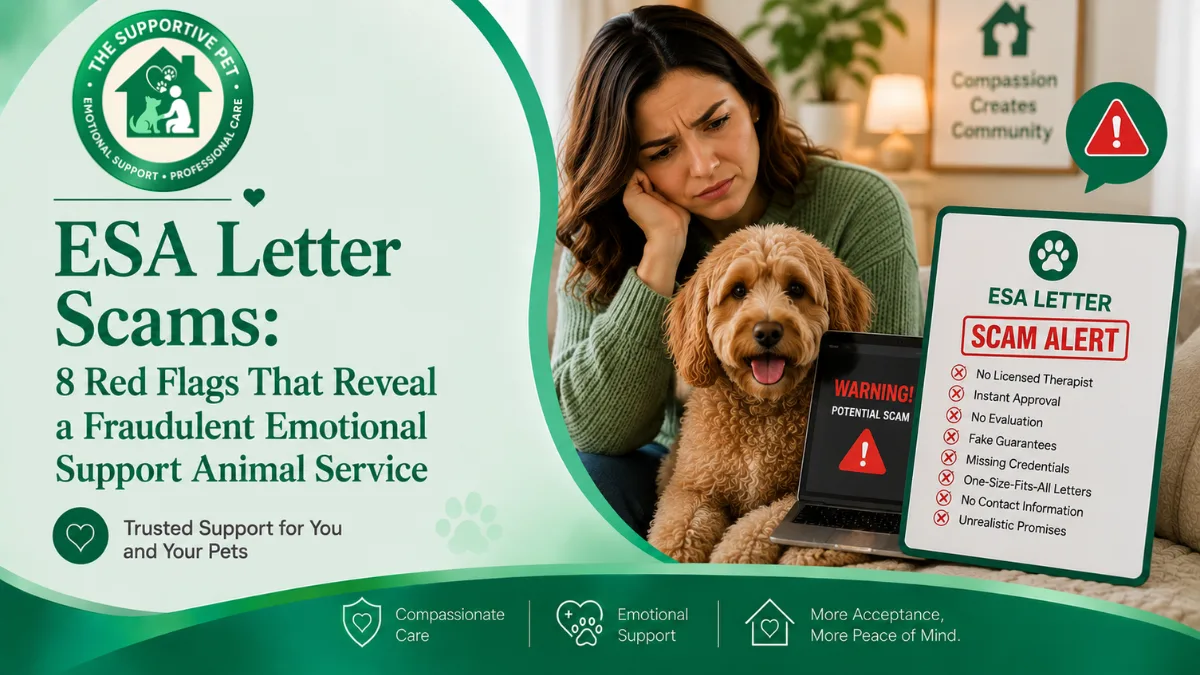
An online ESA letter is illegitimate when no real clinical evaluation occurs. Red flags include: instant automatic approval without any review time; no licensed clinician named in the letter; letters issued without a consultation or assessment; very low prices ($30–$50) that don't reflect the cost of a real clinician's time; and letters offered alongside registry certificates, vests, and ID cards (which have no legal value). A legitimate telehealth ESA letter requires real clinician review and takes more than a few minutes to issue.
See our articles highlighted in Google Search
Add The Supportive Pet as a preferred source - your results, your way.