
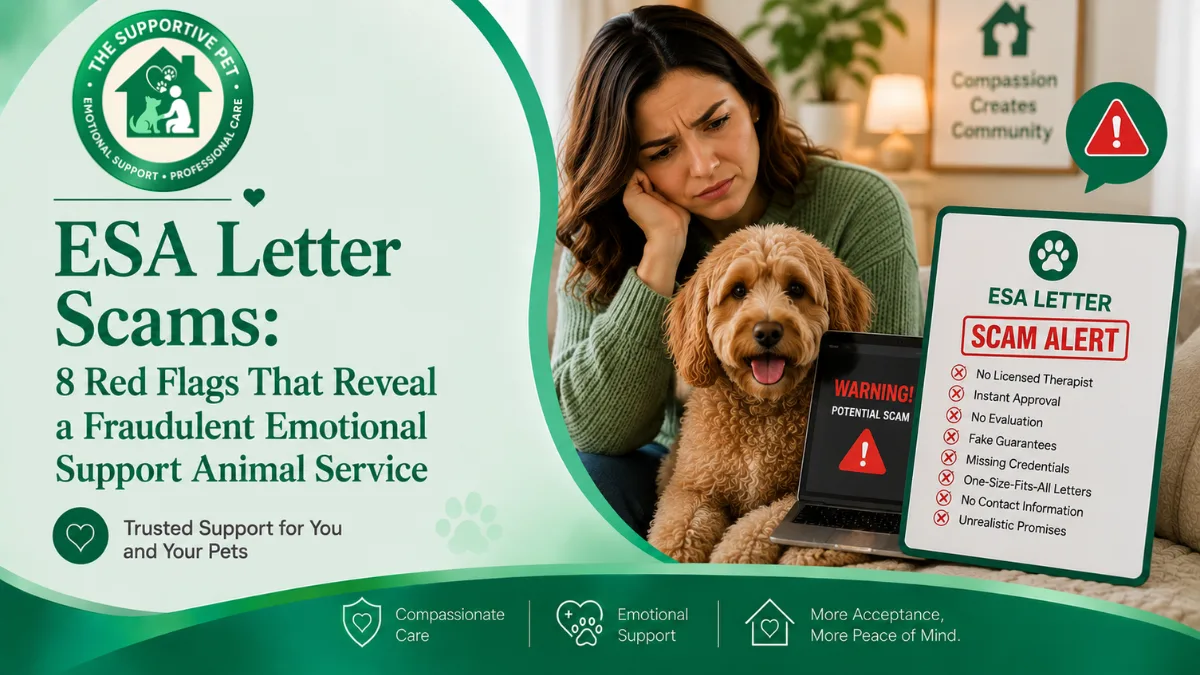
How do I know if an ESA letter service is a scam?
Look for these red flags: guaranteed approval before any evaluation; instant letter delivery (within seconds or minutes); very low prices ($30–$79); no clinician name or license number on the letter; bundled registry certificates, vests, or ID cards; no state-specific licensing; and no clinical intake process. Any one of these is a warning sign; multiple together strongly suggest a fraudulent service.
Key Takeaways
- Red flags include: guaranteed approval with no evaluation, ESA registration or certification IDs, vest or badge upsells, and providers not licensed in your state.
- Scam letters often fail landlord scrutiny because the issuing provider cannot be verified through a state license board - leaving tenants unprotected at the worst moment.
- A legitimate ESA provider will conduct a real clinical assessment, discuss your specific condition and needs, and issue a letter tied to their verifiable state license.
Medical Disclaimer: This article is for informational purposes only and does not constitute medical or legal advice. Consult a qualified mental health professional before making decisions about your care. If you or someone you know is in crisis, call or text 988 (Suicide & Crisis Lifeline, available 24/7).
The ESA Letter Scam Problem
The market for ESA letters online has attracted fraudulent providers who exploit demand and confusion to sell worthless documentation. The FTC has issued consumer guidance on spotting fake ESA documentation services. These services charge $30–$79 for PDFs that have never been reviewed by a licensed clinician and will not hold up to any scrutiny. Meanwhile, people who genuinely qualify for ESA accommodations end up with documentation that fails them when they need it most.
Here are the 8 red flags to look for:
Red Flag 1: Guaranteed Approval Before Your Case Is Reviewed
No legitimate mental health professional can guarantee approval before evaluating a patient. Clinical determinations are made after assessment - not before. If a service promises you will be approved regardless of your case, they are not conducting real evaluations. Legitimate services like The Supportive Pet explicitly state that approval is not guaranteed - because it isn't, and that's what makes the letter meaningful.
Red Flag 2: Instant Letter Delivery
If your letter arrives within seconds or minutes of completing a form, a licensed clinician did not review your case. Real clinical reviews take time - typically fast, but after actual review. "Instant" delivery means automation, not clinician review.
Red Flag 3: Very Low Prices ($30–$79)
A licensed mental health professional's time costs money. Legitimate ESA letters reflecting real clinical work typically cost $99–$200. Services offering letters for $30–$79 are not paying a licensed clinician to review cases - they are operating an automated mill. You get what you pay for, and for housing accommodation, what you need is clinician time.
Red Flag 4: No Clinician Name or License Number on the Letter
A legitimate ESA letter must include the clinician's full name, professional title, license type, and license number. If the letter does not include a verifiable license number, it cannot be confirmed as legitimate by any housing provider. This is the single most important element to check.
Red Flag 5: Bundled Registry Certificates, ID Cards, or Vests
ESA registries, certification programs, ID cards, and vests have no legal standing under the FHA or any other federal law. Services that bundle these items with ESA letters are selling the appearance of legitimacy - not actual legal protection. If a service prominently markets these add-ons, they are not a clinical service; they are a novelty shop.
Red Flag 6: No State-Specific Licensing
Mental health professionals must be licensed in the state where their client resides to practice there. A provider that uses one clinician for all 50 states is likely not practicing with proper state-specific licensure. Check that the clinician named on your letter holds an active license in your state.
Red Flag 7: No Real Clinical Intake Process
Legitimate evaluations require you to provide meaningful clinical information about your symptoms, functioning, and animal relationship. If the process consists of checking a few boxes and submitting your name and payment, no real evaluation is occurring. A genuine intake asks detailed questions because the clinician needs real information to make a clinical determination.
Red Flag 8: No Refund Policy If Not Approved
Legitimate services that conduct real evaluations do not charge if they cannot approve you - because the clinical evaluation may conclude you do not qualify. Scam services charge upfront regardless, because they are selling a document, not a service. The Supportive Pet does not charge if your case is not approved - this is the standard for a legitimate clinical provider.
How to Protect Yourself
If you need an ESA letter, use a provider that: employs licensed clinicians with state-specific licenses; conducts a real intake evaluation; does not guarantee approval; does not sell registries or ID cards; and does not charge unless your case is approved. All of these criteria are easy to verify before you pay anything.
From the Clinician
The pattern I see most often in fraudulent letters is automation masquerading as evaluation. As Head of Legal & Compliance, I review our own letters carefully - but I also keep an eye on what fraudulent providers are producing. The FTC's consumer guidance on ESA fraud is accurate: these services are selling worthless PDFs. The most reliable tell is the license number. Every state maintains a publicly searchable database of licensed mental health professionals. If the license number on an ESA letter returns no results, or returns a lapsed or invalid license, the letter is fraudulent. This takes under two minutes to check, and informed landlords increasingly do check.
Client scenario: A prospective client called us after their ESA letter was flagged by their landlord's property management company, which had begun running license number verifications on all ESA letters after receiving three fraudulent letters from the same cheap online service in one month. The client's letter named a real psychologist - but one licensed in Texas, when the client's housing was in New York. The license was real; the letter was still invalid because ESA letters must be issued by clinicians licensed in the state where the patient resides. After completing an evaluation with a New York-licensed LCSW, the client received a valid letter and was approved the same week.
A Fair Look at the Other Side
The proliferation of scam ESA services has made landlords broadly more suspicious of all ESA letters - including completely legitimate ones. This is one of the most concrete harms caused by the scam industry: it increases friction for every tenant with a genuine qualifying disability. This reality means that documentation quality and provider verifiability matter more than ever, and legitimate holders who know how to present their documentation clearly are less likely to face unnecessary challenges.
Related: What makes an ESA letter legitimate · How to verify an ESA letter is legitimate · Online vs in-person ESA letters · ESA registration scams
How to Identify a Legitimate ESA Letter Provider
After so many scam services have flooded the market, understanding what legitimate ESA documentation looks like is essential. Here is the complete checklist for evaluating any ESA letter provider or clinician:
What Every Legitimate ESA Letter Must Have
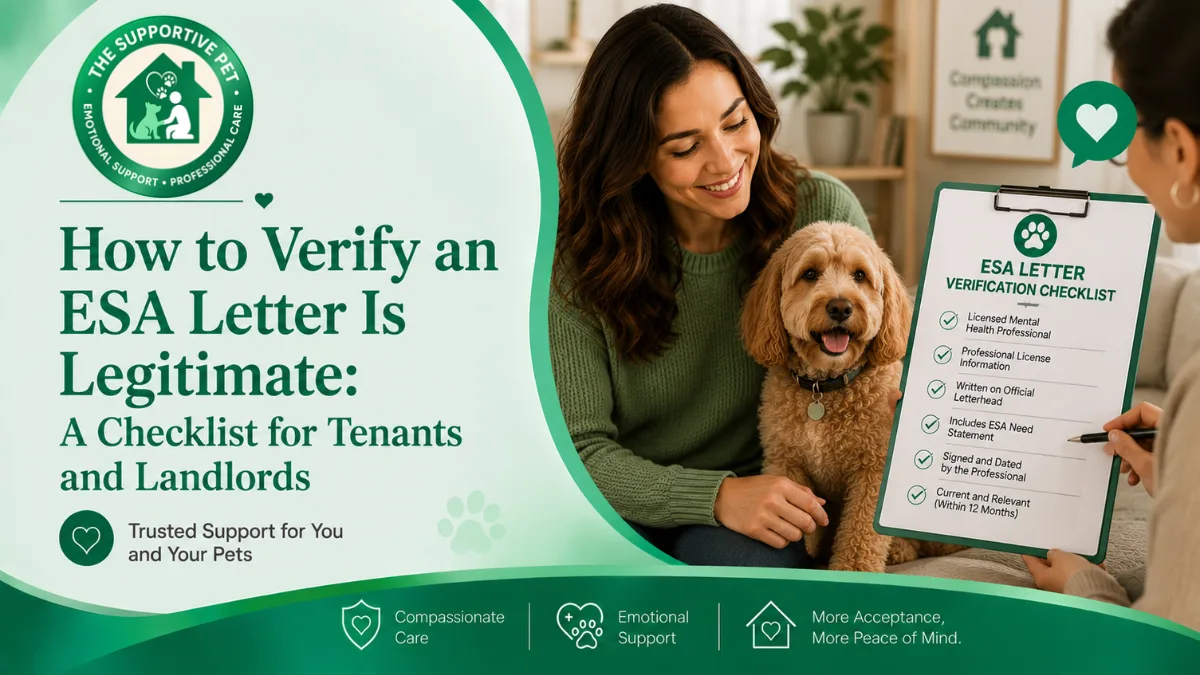
- Clinician's full name and professional title (LMFT, LCSW, LPC, PhD, Psy.D, MD/psychiatrist)
- License number and state of licensure — verifiable with the state licensing board
- Official letterhead (clinician's practice name or organization)
- Date of issuance
- Statement that you have a qualifying disability under the FHA
- Statement that the ESA is recommended or is part of your treatment
- Clinician's wet or electronic signature
What a Legitimate Provider Requires From You
- A real intake assessment (not just a checkbox form)
- A telehealth appointment with an actual licensed clinician (video or phone)
- Discussion of your mental health history and how the animal helps
The Complete Scam Red Flag Checklist
| Red Flag | Why It Matters |
|---|---|
| Instant letter delivery with no appointment | No legitimate clinician issues an ESA letter without a clinical assessment. Instant letters are rubber-stamped without evaluation. |
| "Register your ESA" language | There is no official ESA registry. Any service charging you to "register" your animal is taking money for nothing — ESA status comes from the letter, not from registration. |
| A certificate or ID card as the primary product | ESA certificates and ID cards have no legal standing under FHA. Housing providers are not required to accept them. Only the letter from a licensed clinician matters. |
| Promise of airline access | Airlines stopped accepting ESAs in 2021. A service promising airline ESA access is lying to you. |
| Lifetime or multi-year letters | Legitimate clinicians issue letters valid for one year because your mental health status can change. Lifetime letters reflect no ongoing clinical relationship. |
| Guaranteed approval language | No ethical clinician "guarantees" an ESA letter before a clinical assessment. Guarantee language reveals that the service is issuing letters without genuine evaluation. |
| The clinician is not licensed in your state | HUD guidance supports letters from clinicians licensed in the client's state of residence. Out-of-state letters may be challenged by housing providers. |
| Unusually low prices (under $50) | A legitimate telehealth consultation with a licensed professional costs more than this. Extremely cheap letters reflect shortcuts that undermine their credibility. |
What Landlords Know About Scam Letters
Property managers and landlords have become sophisticated about ESA documentation quality. HUD's 2020 guidance specifically noted that letters from "internet-based ESA certification companies" may lack the clinical basis required for valid documentation. Many landlords now:
- Verify clinician licenses directly with state licensing boards
- Ask follow-up questions when the letter lacks a clear therapeutic relationship
- Require the letter to state that the clinician has personally assessed the tenant
- Request the clinician's contact information for verification purposes
A scam letter caught by a thorough landlord can result in your accommodation request being denied, and in some jurisdictions, knowingly submitting fraudulent medical documentation can have legal consequences beyond just losing the accommodation.
Recovering From a Scam Letter
If you realize you obtained a letter from a scam service:
- Stop using it immediately
- Seek a new assessment from a licensed mental health professional — your regular therapist, a telehealth platform with verifiable licensed clinicians, or a psychiatrist who manages your medication
- When submitting to a new housing provider, use only the legitimate letter
- If you submitted the scam letter to a current landlord, consider proactively offering updated documentation from a legitimate clinician — this can resolve concerns before they escalate
Frequently Asked Questions: Spotting ESA Scams
I received an ESA letter from an online service. How do I verify it's legitimate?
Look up the clinician's name and license number with your state's professional licensing board (most states have online license verification). Confirm the license type is a mental health professional category (LMFT, LCSW, LPC, PhD, Psy.D, or MD in psychiatry). If the license cannot be verified or the licensee is not a mental health professional, the letter is not legitimate.
Are ESA vest and ID products worth buying?
For housing purposes, no. Vests, ID cards, and "certificates" have no legal significance under the FHA. Housing providers are not required to accept them and most do not. They may have practical value in other contexts (reducing public challenges when traveling), but they provide no legal protection and should never substitute for an ESA letter from a licensed clinician.
Can I get in legal trouble for using a scam ESA letter?
Potentially. Knowingly submitting fraudulent documentation to obtain housing accommodation could expose you to civil liability and, in some states, criminal consequences under laws against misrepresentation to obtain housing benefits. The risk varies by state but the safest course is always to use legitimate documentation.
Frequently Asked Questions
How do I know if an ESA letter service is a scam?
Look for these red flags: guaranteed approval before any evaluation; instant letter delivery (within seconds or minutes); very low prices ($30–$79); no clinician name or license number on the letter; bundled registry certificates, vests, or ID cards; no state-specific licensing; and no clinical intake process. Any one of these is a warning sign; multiple together strongly suggest a fraudulent service.
Is ESA registration real?
No. There is no official government ESA registry. Private ESA registries, certifications, and ID card programs have no legal value under the Fair Housing Act or any other law. A landlord cannot require registration, and a registry certificate does not make your ESA more legal. Services selling ESA registration are selling something that has zero legal standing - the only document that matters is a letter from a licensed clinician.
Can I get in trouble for using a fraudulent ESA letter?
Yes. Presenting a fraudulent ESA letter to a landlord to obtain a housing accommodation can constitute housing fraud or misrepresentation. Beyond the legal risk, a fraudulent letter can be identified and rejected by an informed landlord, leaving you in a worse position than if you had not submitted it. If you genuinely qualify for an ESA, there is no reason to use a fraudulent service - a legitimate letter is the same price range and takes only slightly longer to obtain.
What should I do if I already bought a fraudulent ESA letter?
Do not submit the letter to your landlord - presenting fraudulent documentation is a legal risk. If you believe you genuinely qualify for an ESA, go through a legitimate provider to get a real clinical evaluation and a valid letter. Some people have used fraudulent letters without issue because their landlord did not verify the credentials - but this is luck, not protection.
See our articles highlighted in Google Search
Add The Supportive Pet as a preferred source - your results, your way.