
Does depression qualify me for a psychiatric service dog?
Yes, if your depression substantially limits major life activities such as self-care, mobility, or daily routines, you may qualify. The evaluation focuses on your functional limitations and whether a trained dog can perform tasks that reduce them.
Medical Disclaimer: This article is for informational purposes only and does not constitute medical or legal advice. Consult a qualified mental health professional before making decisions about your care. If you or someone you know is in crisis, call or text 988 (Suicide & Crisis Lifeline, available 24/7).
Major depressive disorder affects more than 21 million adults in the United States each year. For many people, depression goes beyond persistent low mood - it disrupts the ability to get out of bed, maintain routines, leave the home, or complete basic self-care. When depression reaches this level of functional impairment, a psychiatric service dog (PSD) may provide meaningful daily support through trained tasks that an emotional support animal cannot.
What Is a Psychiatric Service Dog?
A psychiatric service dog is a dog trained to perform specific tasks that mitigate the symptoms of a mental health disability. Under the Americans with Disabilities Act (ADA), PSDs are classified as service animals - meaning they have full public access rights and housing protections beyond what an emotional support animal receives.
The critical distinction: a PSD must be trained to perform work or tasks directly related to your disability. For depression, qualifying tasks include:
- Deep pressure therapy (DPT) - the dog applies body weight to interrupt dissociation, grounding episodes, or immobilization from severe depression
- Medication reminders - trained cuing behaviors that prompt the handler to take scheduled medications
- Initiating morning routines - trained nudging or pawing behaviors that prompt the handler to get up and begin the day
- Tactile interruption - breaking rumination cycles or self-harm urges through physical contact on command
- Safety checks - trained room-clearing behavior for handlers with paranoia or hypervigilance comorbid with depression
- Emotional crisis response - trained behaviors during depressive episodes, such as alerting a third party or retrieving a phone
Does Depression Qualify for a PSD?
Depression qualifies for a PSD when it meets the ADA's definition of a disability - meaning it substantially limits one or more major life activities. For most people with moderate to severe major depressive disorder, recurrent depressive disorder, or treatment-resistant depression, this threshold is met. The qualifying question is not whether you have been diagnosed, but whether the condition substantially limits your functioning and whether a trained dog can perform tasks that reduce that limitation.
Conditions that commonly co-occur with depression and may strengthen the case for a PSD include:
- Generalized anxiety disorder
- Post-traumatic stress disorder
- Bipolar disorder (depressive episodes)
- Persistent depressive disorder (dysthymia)
- Seasonal affective disorder with significant functional impairment
PSD Letter vs. ESA Letter for Depression
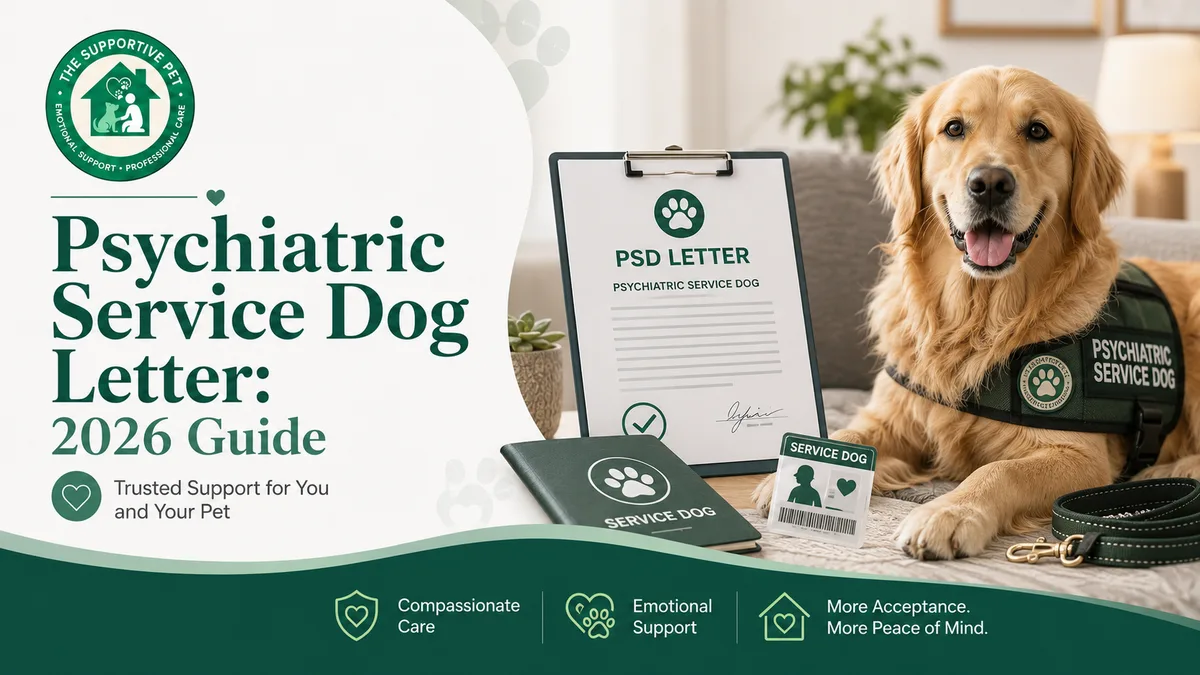
An emotional support animal (ESA) letter and a psychiatric service dog letter are different documents serving different legal functions. Here is what each covers:
- ESA letter - covers housing under the Fair Housing Act (42 U.S.C. § 3604); your ESA can live with you in rental housing regardless of no-pets policies, and all pet fees are waived. ESAs have no public access rights and since the 2021 DOT rule change, U.S. airlines are no longer required to accept them in cabin.
- PSD letter - documents your disability and the dog's training for housing (Fair Housing Act, 42 U.S.C. § 3604), public access (ADA), and air travel (DOT Air Carrier Access Act for trained service animals). PSDs can go virtually anywhere you go.
If your depression primarily affects your ability to live independently in housing, an ESA letter may be sufficient. If your depression significantly limits your ability to work, travel, or participate in public life, a PSD with verified task training provides broader legal protection.
Getting a PSD Letter Through The Supportive Pet
The Supportive Pet connects you with state-licensed mental health professionals who conduct genuine telehealth evaluations. The evaluation for a PSD letter is more comprehensive than for an ESA - the clinician will assess your diagnosis, functional limitations, and whether a trained service dog is an appropriate clinical recommendation.
To get started: Schedule your evaluation here.
Training Requirements for a Depression PSD
Unlike ESAs, PSDs must be trained - either by a professional trainer or by you as the owner (owner-training is legal under the ADA). The dog must reliably perform its trained tasks in a variety of environments. For depression tasks, this typically means:
- The dog responds to a consistent command or naturally initiated cue to perform the task
- The behavior occurs reliably at least 90% of the time in training conditions
- The dog is calm, non-reactive, and under handler control in public settings
There is no ADA-mandated training program or certification for PSDs. However, documentation of training is helpful when housing providers or businesses question the dog's status. See our guide to owner-training a psychiatric service dog for a full breakdown.
Housing Rights With a PSD for Depression
Under the Fair Housing Act (42 U.S.C. § 3604), housing providers must make reasonable accommodations for people with disabilities who use service animals. This means your PSD can live with you in rental housing regardless of no-pets policies, breed restrictions, or weight limits, and you are exempt from all pet fees.
Unlike ESAs, PSDs also have public access rights under the ADA. Your landlord cannot require your PSD to wear a vest, carry ID, or demonstrate its tasks on demand - though they can ask two questions: (1) is this a service animal required because of a disability, and (2) what work or task has the dog been trained to perform.
Frequently Asked Questions About PSD Letters for Depression
Q: My depression is managed with medication. Does that disqualify me?
No. The ADA evaluates whether your condition substantially limits major life activities without mitigating measures like medication. Even if your depression is partially controlled, if it still limits functioning or if you need the medication itself to function, you may still qualify.
Q: Can I use my existing dog as a PSD for depression?
Yes, as long as your dog can be trained to perform specific tasks related to your depression. Any dog of any breed can be a PSD. The key is genuine task training - not simply being a comforting presence. See our task training resources to assess whether your dog is a good candidate.
Q: How long does the PSD letter evaluation take?
Through The Supportive Pet, most telehealth evaluations are completed within a single session, and letters are typically issued the same business day or within 24 hours.
Taking the Next Step
If your depression significantly limits daily functioning and you believe a trained service dog could help mitigate those limitations, a PSD evaluation is a worthwhile step. The process begins with a clinical assessment - the same kind of conversation you would have with any licensed therapist about how depression affects your life.
Ready to find out if you qualify? Begin your free assessment with a licensed clinician today.
Related Resources
Frequently Asked Questions
Does depression qualify me for a psychiatric service dog?
Yes, if your depression substantially limits major life activities such as self-care, mobility, or daily routines, you may qualify. The evaluation focuses on your functional limitations and whether a trained dog can perform tasks that reduce them.
What is the difference between a PSD and an ESA for depression?
A psychiatric service dog is trained to perform specific tasks and has full public access rights under the ADA. An emotional support animal provides comfort through presence but has no public access rights. For housing, both are protected under the Fair Housing Act (42 U.S.C. § 3604).
Do I need a PSD letter or an ESA letter for my depression?
If your primary need is housing accommodation, an ESA letter may be sufficient. If you need your dog to accompany you in public places, at work, or on flights (as a trained service animal), a PSD letter with verified task training provides broader protections under the ADA.
See our articles highlighted in Google Search
Add The Supportive Pet as a preferred source - your results, your way.