
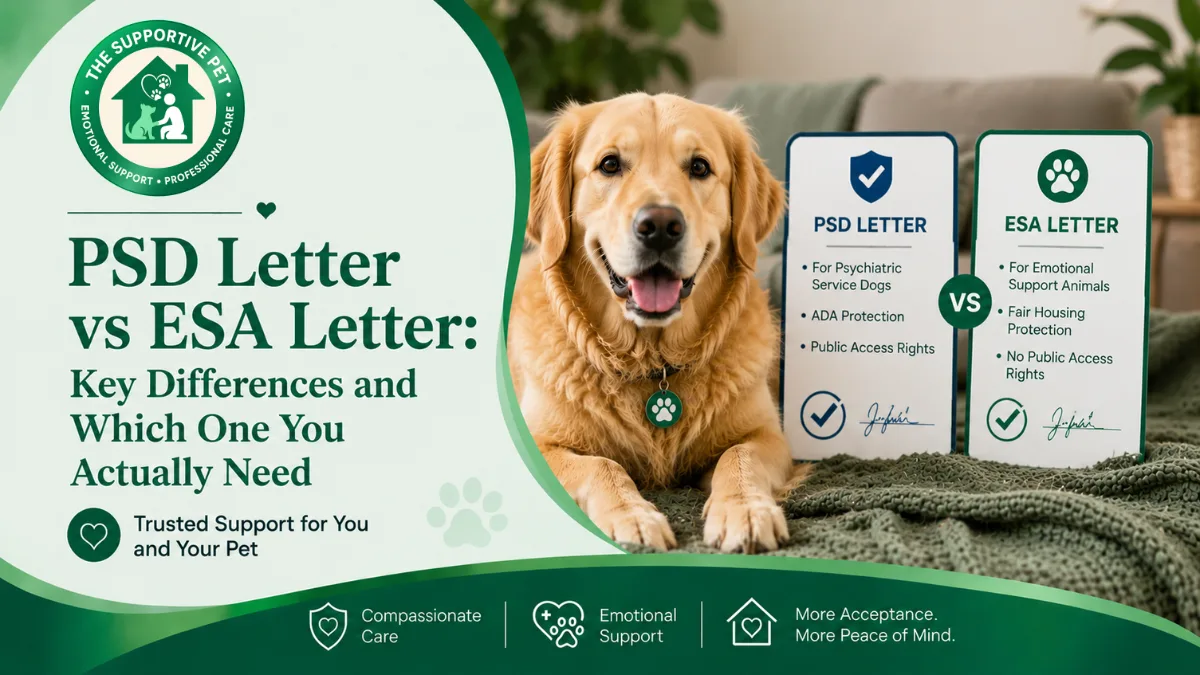
What is the difference between a PSD letter and an ESA letter?
An ESA letter covers housing rights under the Fair Housing Act. A PSD (Psychiatric Service Dog) letter covers both housing rights (FHA) and public access rights (ADA) for a dog trained to perform specific psychiatric tasks. The key distinction: ESAs provide comfort and companionship; PSDs perform trained tasks that mitigate a psychiatric disability. Task training is required for PSD status; it is not required for ESA status.
Key Takeaways
- A PSD letter authorizes a dog to perform specific trained tasks that mitigate a psychiatric disability; an ESA letter provides housing accommodation without requiring trained tasks.
- PSDs have broader public access rights under the ADA; ESAs are limited to housing (FHA) and some employer accommodation contexts.
- The right choice depends on your lifestyle - if you need your dog with you in public spaces, PSD training is worth the investment; for housing-only needs, an ESA letter suffices.
Medical Disclaimer: This article is for informational purposes only and does not constitute medical or legal advice. Consult a qualified mental health professional before making decisions about your care. If you or someone you know is in crisis, call or text 988 (Suicide & Crisis Lifeline, available 24/7).
The choice between an ESA letter and a psychiatric service dog letter is one of the most important decisions you'll make about your animal's legal status - and the right choice depends entirely on your needs, your animal's training, and where you need protection. This guide cuts through the confusion with a clear, factual comparison of what each type of documentation actually provides, what it costs, and what it requires.
The Fundamental Legal Difference
Both ESA letters and PSD letters are issued by licensed mental health professionals and both provide housing protection under the Fair Housing Act. The critical difference is the additional legal coverage a PSD letter provides under the Americans with Disabilities Act.
| Feature | ESA Letter | PSD Letter |
|---|---|---|
| Housing rights (FHA) | ✅ Yes | ✅ Yes |
| Public access (ADA) | âÂÅ’ No | ✅ Yes |
| Airline in-cabin access | âÂÅ’ No (since 2021) | ✅ Yes (DOT rules) |
| Task training required | âÂÅ’ No | ✅ Yes (at least 1 task) |
| Species covered | Any species | Dogs only |
| Starting cost at TSP | $129 | $149 |
What Makes an Animal an ESA
An emotional support animal is any animal - dog, cat, rabbit, bird, or other species - that provides therapeutic benefit to a person with a mental health disability through companionship. No specific training is required. The animal simply needs to provide genuine emotional support that is part of the person's mental health treatment plan.
ESAs are protected under the Fair Housing Act, which means your landlord must allow your ESA regardless of no-pet policies, breed restrictions, or size limits. ESAs do not have public access rights - they cannot accompany you to restaurants, stores, or other public places that do not otherwise allow pets.
What Makes a Dog a Psychiatric Service Dog
A Psychiatric Service Dog is a dog trained to perform at least one specific task that directly mitigates a handler's psychiatric disability. The task must be a trained behavior - something the dog performs on cue or in response to a specific trigger - not simply the calming effect of the dog's presence.
Examples of qualifying PSD tasks include:
- Deep pressure therapy during a panic attack (trained behavior on cue)
- Waking the handler from nightmares using a trained tactile cue
- Interrupting self-harming or repetitive behavior
- Performing a room check before the handler enters a space
- Creating a physical barrier in crowded spaces
- Medication reminders at scheduled times
- Tactile grounding during dissociation or flashback states
Because PSDs have ADA public access rights, they can accompany their handler anywhere the public is allowed - including restaurants, stores, hotels, taxis, and most workplaces. For a full list of qualifying tasks, see our psychiatric service dog tasks guide.
Air Travel: ESA vs PSD
This is where the difference is most consequential for many pet owners. Since the 2021 DOT rule change, airlines are no longer required to accommodate emotional support animals in the cabin. ESAs are now treated as pets under airline pet policies - subject to carrier fees (typically $100–$125 each way) and size restrictions.
Psychiatric Service Dogs, however, still have in-cabin access rights on US airlines under DOT regulations. Airlines must accommodate a PSD in the cabin at no charge, provided the handler submits the airline's DOT Service Animal Air Transportation Form in advance. See our full guide: PSD letter for flying.
Which Should You Get?
The decision comes down to what you need the animal for:
- Choose an ESA letter if: You primarily need housing protection; your animal is not a dog; your animal provides general emotional support without specific task training; or you want the simpler, lower-cost option
- Choose a PSD letter if: You need public access rights; you fly frequently and want your dog in the cabin; your dog performs specific trained tasks that mitigate your psychiatric disability; or you need broader legal coverage
- Consider both if: You want the flexibility of different documentation for different situations
Getting Either Letter Through The Supportive Pet
The Supportive Pet offers both ESA letters (starting at $129) and PSD letters (starting at $149). The evaluation process for a PSD letter is more detailed - the clinician will need to assess both your psychiatric disability and your dog's specific trained tasks. For ESA letters, the evaluation focuses on your disability and the therapeutic nexus with your animal. Both are delivered fast when clinically appropriate.
From Legal & Compliance
In my compliance work, I regularly review housing disputes involving ESA vs PSD documentation confusion. The most common mistake I see is people using an ESA letter when they actually need a PSD letter - typically because they have a task-trained dog but didn't realize they qualify for the broader legal protection. If your dog does something specific in response to your distress - not just sits near you, but performs a distinct, trained behavior - you likely have a PSD, not just an ESA. The ADA's definition of service animals is broader than most people realize, and an owner-trained dog with a single reliable task qualifies under federal law.
Client scenario: A client who had held an ESA letter for two years discovered that their dog - which they had inadvertently taught to apply pressure to their lap during panic attacks - actually qualified as a Psychiatric Service Dog. After switching to a PSD letter, they were able to bring their dog to their workplace under ADA accommodation, which significantly reduced their daily anxiety load during long commutes and high-stress project periods.
A Fair Look at the Other Side
The ESA system has faced legitimate criticism for enabling documentation without genuine clinical evaluation, which has created broader skepticism toward both ESA and PSD holders across the country. This is ultimately an argument for documentation quality, not against the rights themselves. When your letter comes from a licensed clinician who evaluated your specific case and documented your actual therapeutic need, it stands in clear contrast to mill-produced letters - and informed landlords, airlines, and housing administrators can typically tell the difference.
Related guides: PSD letter cost · PSD letter guide · ESA vs service animal
PSD vs ESA: Decision Matrix
Choose an ESA Letter If...
An ESA letter is the right choice if your primary need is housing accommodation - waiving pet deposits, pet rent, and no-pet restrictions under the Fair Housing Act. ESA letters work for any species of animal (not just dogs), require no training, and are less expensive than PSD letters. If you rent an apartment with a strict no-pet policy and want to keep your cat, rabbit, or dog without paying pet fees, an ESA letter accomplishes this fully. ESA letters do not provide public access rights - your ESA is not permitted in restaurants, stores, or other non-pet-friendly public spaces.
Choose a PSD Letter If...
A PSD letter is the right choice if you need public access rights in addition to housing protections, if you need workplace accommodation documentation, or if you want the stronger legal framework of the ADA to back your accommodation requests. PSDs must be dogs (or miniature horses in some circumstances), must perform at least one trained task that mitigates your psychiatric disability, and require more detailed clinical documentation. PSD letters cost more than ESA letters but provide significantly broader legal protection. For people with severe PTSD, panic disorder, or agoraphobia who need their dog with them in public, a PSD letter is often essential.
Can You Have Both?
Yes - you can have both an ESA letter (for any additional animals or for the same dog's status as an ESA separately) and a PSD letter for your trained dog. Some people obtain a PSD letter for their dog and an ESA letter for a second animal (a cat, for example) to cover both animals under the FHA. Others obtain both types of documentation for the same dog to have maximum flexibility for different situations. There is no legal prohibition against holding both types of documentation, and many licensed clinicians who evaluate for PSD letters can also issue ESA letters for the same evaluation fee.
Related: ESA vs. PSD Letter comparison · PSD letter for housing
Frequently Asked Questions
What is the difference between a PSD letter and an ESA letter?
An ESA letter covers housing rights under the Fair Housing Act. A PSD (Psychiatric Service Dog) letter covers both housing rights (FHA) and public access rights (ADA) for a dog trained to perform specific psychiatric tasks. The key distinction: ESAs provide comfort and companionship; PSDs perform trained tasks that mitigate a psychiatric disability. Task training is required for PSD status; it is not required for ESA status.
Do I need a PSD letter or an ESA letter?
If you primarily need housing protection for any animal - any species, with no task training required - an ESA letter is the right choice. If you need your dog to have public access rights (restaurants, stores, transportation, hotels) in addition to housing rights, and your dog is trained to perform at least one specific task that mitigates your psychiatric disability, a PSD letter is more appropriate.
Can I have both an ESA letter and a PSD letter?
Yes. Some people obtain both an ESA letter and a PSD letter for the same dog - using the ESA letter for housing situations where landlords are more familiar with ESA documentation, and the PSD letter for public access and air travel. However, the PSD letter alone provides FHA housing rights for your dog in addition to ADA public access rights, so you may not need both.
Is a PSD letter more expensive than an ESA letter?
Typically yes. PSD letters require a more detailed evaluation of both your psychiatric disability and your dog's specific trained tasks. At The Supportive Pet, PSD letters start at $149 compared to $129 for ESA letters. The difference reflects the additional clinical documentation required.
Can any dog be a psychiatric service dog?
Any dog can be owner-trained as a psychiatric service dog under the ADA - no breed, size, or certification requirement applies. What matters is whether the dog reliably performs a specific trained task that mitigates the handler's psychiatric disability in varied environments, including distracting public settings.
See our articles highlighted in Google Search
Add The Supportive Pet as a preferred source - your results, your way.