
Can my landlord deny my Beagle ESA because Beagles bark?
Not preemptively. A landlord must base ESA denials on actual documented incidents involving your specific dog - not on breed stereotypes or anticipated behavior. Anticipated barking is not a legal basis for denial under the Fair Housing Act.
Medical Disclaimer: This article is for informational purposes only and does not constitute medical or legal advice. Consult a qualified mental health professional before making decisions about your care. If you or someone you know is in crisis, call or text 988 (Suicide & Crisis Lifeline, available 24/7).
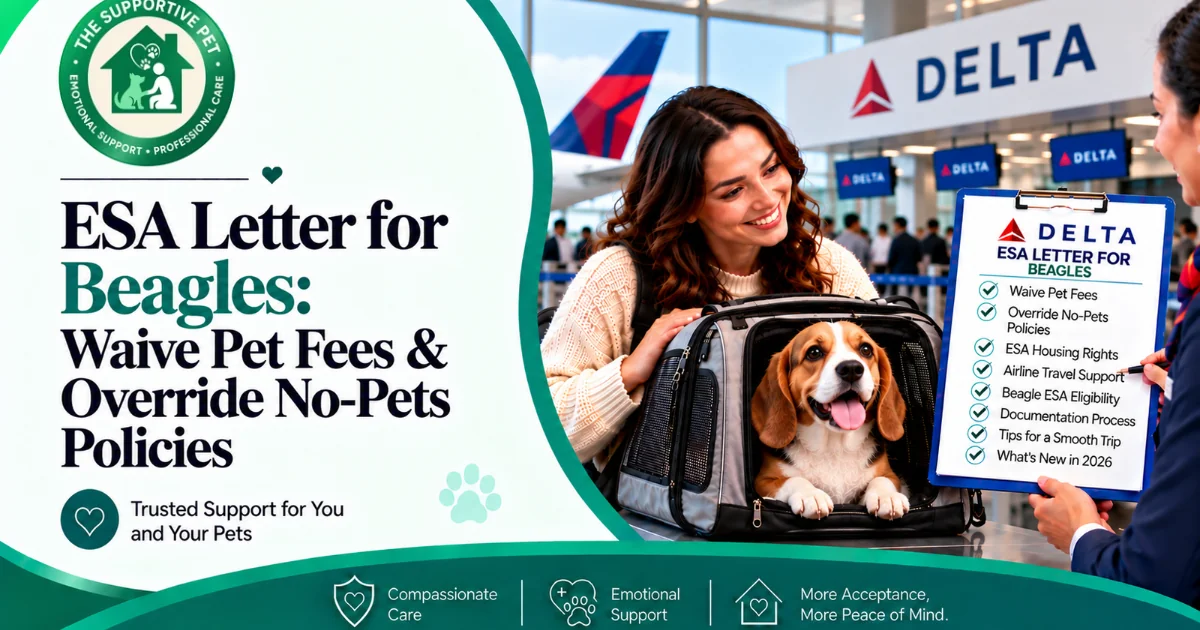
Beagles are among the most popular family dogs in America - and increasingly, one of the most commonly recommended breeds for emotional support roles. Their social nature, loyalty, and sensitivity to human emotion make them effective therapeutic companions. Under the Fair Housing Act (42 U.S.C. § 3604), a valid ESA letter gives your Beagle full housing protections, including the elimination of all pet fees.
Why Beagles Make Effective Emotional Support Animals
Beagles were bred as pack animals, which means their core behavioral drive is social connection. In a domestic setting, this translates into:
- Constant companionship - Beagles dislike being alone and seek consistent proximity to their owner, reducing isolation in people experiencing depression
- Emotional mirroring - their expressive faces and body language reflect and validate their owner's emotional state
- Routine anchoring - Beagles are strongly food- and schedule-driven, which naturally imposes daily structure beneficial for depression management
- Tactile grounding - their smooth coats and medium size make them ideal for lap contact during anxiety episodes
Beagles commonly serve owners with generalized anxiety disorder, major depressive disorder, PTSD, and panic disorder.
Fair Housing Act Protections for Your Beagle ESA
The Fair Housing Act is a federal civil rights law that cannot be overridden by lease clauses. With a valid ESA letter, your Beagle is protected in virtually all rental housing:
- No pet deposits - refundable or non-refundable
- No monthly pet rent
- No enforcement of no-pets clauses
- No weight limit application
Note: Beagles can be vocal. If a landlord raises noise concerns, document your Beagle's typical behavior. Only actual, documented noise incidents creating genuine disturbance - not anticipatory concerns - provide potential grounds for conditional accommodations.
How to Get Your Beagle ESA Letter
Your ESA evaluation focuses on your mental health needs, not your Beagle's characteristics. A licensed clinician will assess your qualifying condition and write an ESA letter on their professional letterhead. The Supportive Pet provides same-day telehealth evaluations. Start your evaluation here.
Beagle Size and Weight: What ESA Owners Need to Know
Standard Beagles weigh 20-30 lbs; miniature Beagles 10-20 lbs. Many apartment complexes set weight limits between 20 and 25 lbs, meaning even a mid-size Beagle may exceed them. Under the Fair Housing Act, your ESA letter allows you to request an exemption from these restrictions. The exemption applies to both the weight limit and to any breed restrictions - some properties prohibit scent hounds or "working breeds," which could include Beagles despite their family-friendly reputation.
Beagle-Specific Housing Considerations
Beagles are well-suited to apartment living in terms of space requirements, but owners should understand a few practical considerations:
- Vocality - Beagles are known for baying (a distinctive, melodic howl). This is a breed trait that consistent training can reduce but rarely eliminate entirely. If your landlord raises noise concerns, focus on documented training efforts and your Beagle's actual behavior history
- Exercise needs - Beagles require 60-90 minutes of exercise daily to stay calm indoors; under-exercised Beagles bay more and are harder to manage in housing
- Escape instinct - their scent-driven instincts mean Beagles can be skilled escape artists; ensure any outdoor space is securely fenced and your lease allows for dog-proofing measures
These are management considerations, not disqualifying traits. Many Beagle ESA owners successfully maintain their animals in apartments through consistent training and exercise routines.
Making Your Accommodation Request Step by Step
- Get your ESA letter from a licensed mental health professional via telehealth evaluation
- Write your accommodation request - a brief letter to your landlord stating your disability-related need and attaching your ESA letter
- Send it in writing - email with delivery confirmation or certified mail creates documentation
- Wait for a response - landlords have a reasonable timeframe (typically 10-14 business days) to review and respond
- Follow up - if no response, send a follow-up in writing after two weeks
Frequently Asked Questions: Beagle ESA Letters
Q: My lease has a strict "no dogs" policy. Can my Beagle ESA still be approved?
Yes. "No dogs" policies are lease terms that do not eliminate Fair Housing Act reasonable accommodation rights. A valid ESA letter qualifies you to request an exemption from the no-dogs policy, and your landlord is required to grant it absent a narrow lawful basis for denial.
Q: Does the Fair Housing Act apply to condos and HOAs?
Yes. The Fair Housing Act covers HOA-governed communities, condominiums, and cooperative housing. The accommodation process is the same as standard rental housing.
Q: Can my landlord charge a higher security deposit for my Beagle ESA?
No. Landlords cannot increase the standard security deposit because you have an ESA. They also cannot charge any pet-specific fees. If actual pet-caused damage occurs at move-out, they may deduct from the standard security deposit - but that is true of any resident-caused damage.
Q: I have an existing letter from a previous residence - is it still valid?
An older ESA letter may still be valid, but many landlords expect documentation dated within the past 12 months. If your letter is more than a year old, consider renewing it. See our ESA letter renewal guide.
What Landlords Are Allowed to Ask - and What They Are Not
Understanding the interactive accommodation process helps you advocate for yourself and your Beagle with confidence.
Landlords may ask:
- Whether you have a disability (they cannot ask for the specific diagnosis)
- Whether the ESA provides a disability-related benefit
- For documentation from a licensed health professional confirming both
Landlords may not:
- Charge a pet deposit or pet fee for an approved ESA
- Require your ESA to be certified, trained, or wear a vest
- Deny the request solely because of a breed restriction or weight limit in the lease
- Retaliate against you for making the request
If your landlord denies your request without engaging in the interactive process, you may file a fair housing complaint with HUD or pursue a private right of action under the FHA.
Get your Beagle's ESA letter from a licensed clinician today.
Your Beagle has the right to live with you. Take the first step, get your documentation in order, and move forward with confidence. Begin your free assessment at The Supportive Pet today. The process is straightforward, the clinicians are experienced, and your rights under the Fair Housing Act are clear.
Frequently Asked Questions
Can my landlord deny my Beagle ESA because Beagles bark?
Not preemptively. A landlord must base ESA denials on actual documented incidents involving your specific dog - not on breed stereotypes or anticipated behavior. Anticipated barking is not a legal basis for denial under the Fair Housing Act.
Does my Beagle ESA qualify for a no-pet-fee waiver even if my building charges all tenants?
Yes. The Fair Housing Act requires landlords to waive all pet-related fees for documented ESA owners, regardless of what other tenants pay. ESA owners pay only standard rent and security deposit.
My Beagle is a rescue with unknown history. Does that affect ESA status?
No. ESA status is based on your mental health needs, not the animal's history, training, or documentation. A rescued Beagle qualifies identically to a purchased purebred.
See our articles highlighted in Google Search
Add The Supportive Pet as a preferred source - your results, your way.