
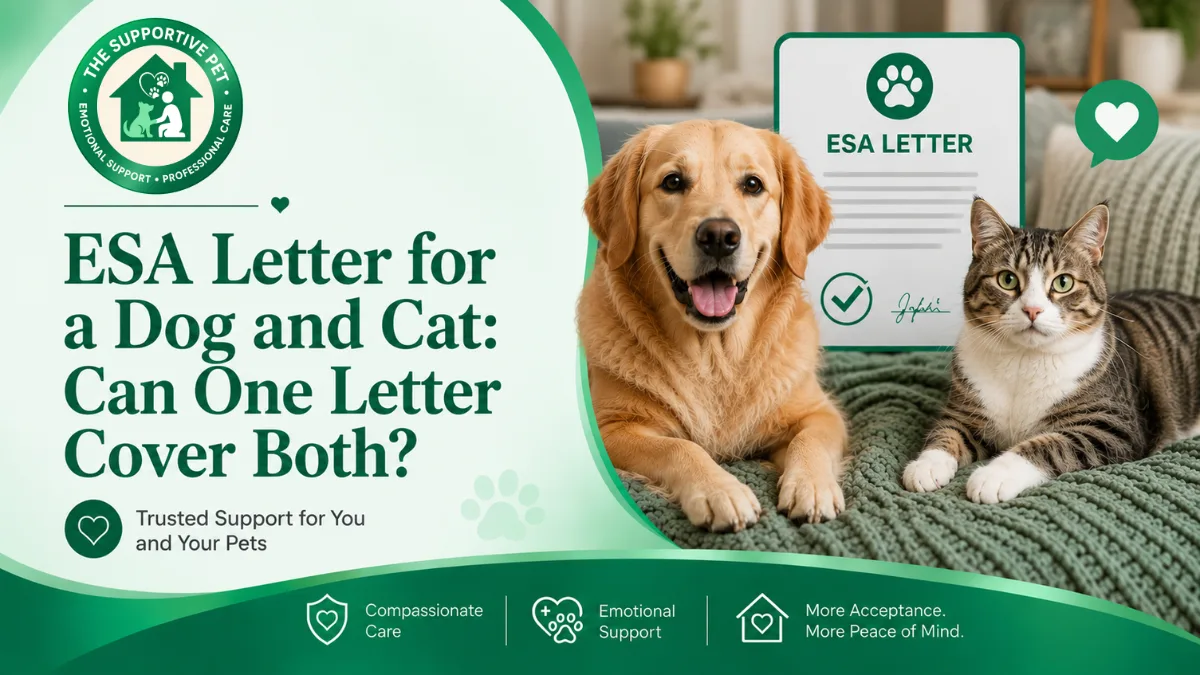
Can a dog and a cat both be on the same ESA letter?
Yes. The Fair Housing Act has no species restriction on emotional support animals. A licensed clinician can include animals of different species on one ESA letter, provided both are clinically appropriate for your situation. Many pet owners with a dog and a cat have both documented on one letter through The Supportive Pet.
Medical Disclaimer: This article is for informational purposes only and does not constitute medical or legal advice. Consult a qualified mental health professional before making decisions about your care. If you or someone you know is in crisis, call or text 988 (Suicide & Crisis Lifeline, available 24/7).
Can Different Species Be on the Same ESA Letter?
Yes. The Fair Housing Act does not restrict emotional support animals by species. A dog and a cat can both be documented as emotional support animals on the same ESA letter, provided the evaluating clinician determines that both animals are therapeutically appropriate for your individual mental health situation.
There is also no FHA requirement that each species needs a separate letter. One letter that clearly identifies both animals - including their names, species, and the therapeutic nexus each provides - satisfies the documentation requirement for housing accommodation purposes.
Why Dog-and-Cat Households Often Have a Strong Clinical Case
Dog-and-cat households are one of the most common multi-pet situations in the US. Many people with mental health conditions find that a dog and a cat serve genuinely different therapeutic functions:
- Dogs provide structure and routine, require outdoor activity, offer high-contact physical interaction, and can be trained to interrupt harmful behaviors
- Cats provide calm companionship, require less routine management, offer comfort during low-energy periods, and can reduce anxiety through proximity and purring
When both animals serve clearly distinct therapeutic roles, the clinical case for including both on one letter is often quite strong - sometimes stronger than two dogs performing similar functions.
Do You Need Two Separate ESA Letters for a Dog and a Cat?
No - not legally. But in practice, this depends on the service you use. Many ESA providers issue one letter per animal. If you use one of those services, you would need to complete two evaluations and pay two separate fees.
The Supportive Pet's evaluation covers up to two animals of any species. If the clinician determines both your dog and your cat are clinically appropriate, both are included on one letter at no additional per-pet charge. See our two-pet ESA letter page for full details.
How to Describe Your Dog and Cat in Your Intake
Your intake assessment is where you make the clinical case for both animals. For each animal, include:
- Name, species, breed, and age
- How long you have had them - a longer established relationship carries more clinical weight
- The specific role each plays in your mental health management - concrete situations rather than general statements about companionship
For example: "My dog Ranger interrupts anxiety episodes by nudging me and redirecting my attention - I have managed generalized anxiety disorder for four years and he has been central to my management strategy for two of those years. My cat Mochi provides calming companionship during depressive periods when I struggle to leave bed - her presence measurably reduces the frequency of my worst depressive episodes."
That level of specificity helps the clinician make a thorough, defensible determination for both animals.
How Your Landlord Must Handle a Dog-and-Cat ESA Request
When you present an ESA letter identifying both a dog and a cat, your landlord must evaluate the accommodation request for both animals. They cannot:
- Apply a no-pets policy to either animal
- Charge a pet deposit for either the dog or the cat
- Apply breed or weight restrictions to your dog
- Selectively accept the dog but deny the cat (or vice versa) based on species preference
They can ask reasonable questions about each animal's behavior and direct threat history. A well-written ESA letter naming both animals and documenting their therapeutic roles addresses those questions directly.
If your landlord denies your request or attempts to split the accommodation between your animals without lawful reason, you can file a complaint with HUD. For your full FHA rights, see our ESA letter for housing guide.
Can a Cat Qualify as an Emotional Support Animal?
Yes. The FHA imposes no species restriction on emotional support animals. Cats have a strong evidence base for therapeutic benefit - research has associated feline companionship with reduced cortisol levels, lower blood pressure, and decreased symptoms of anxiety and depression.
A licensed clinician can make a credible clinical determination for a cat as an ESA. What they are evaluating is not the species but the therapeutic relationship: does this specific animal provide genuine benefit related to your diagnosed condition? For many people, the answer with a cat is clearly yes.
For more on qualifying conditions: qualifying conditions guide.
What About Adding a Second Pet to an Existing ESA Letter?
If you already have an ESA letter for one animal and have recently acquired a second, you will typically need a new evaluation to include the second animal. Most providers treat this as a new letter rather than a modification.
The ideal time to add a second animal is at your annual renewal. When the clinician reassesses your case for renewal, they can include both animals on the renewed letter if both are clinically appropriate at that time. For renewal details: ESA letter renewal guide.
ESA Letter vs. PSD Letter: Does This Apply to My Dog?
If your dog performs specific trained psychiatric tasks for you - not just providing companionship, but executing trained behaviors that directly mitigate your disability - a Psychiatric Service Dog (PSD) letter may be more appropriate for that dog. PSD letters carry full ADA public access rights (restaurants, stores, hotels) in addition to FHA housing rights.
If your dog provides general emotional support without specific trained tasks, an ESA letter is the right choice. ESA letters cover any species, require no task training, and provide housing protection under the FHA.
Related Guides
For the main guide on multiple-pet ESA letters: Do You Need Two ESA Letters for Two Pets?
For two-dog households: ESA Letter for Two Dogs.
To start your assessment: ESA Letter for 2 Pets - The Supportive Pet.
For pricing: pricing page. For your housing rights: ESA letter for housing.
Can You Have Both a Dog and a Cat as ESAs?
Yes. There is no limit in the Fair Housing Act on the number of species or animals you can have as ESAs. A person can have multiple ESAs if each is part of a documented treatment plan supported by a licensed clinician. Having both a dog and a cat as ESAs is a common scenario, particularly when each animal provides different therapeutic functions.
How a Clinician Documents Multiple ESAs
For two or more ESAs to receive FHA protection, your licensed clinician should document why each animal is necessary. A single letter can cover both animals, but the letter should address:
- Your qualifying disability or disabilities
- How each animal contributes to your treatment or symptom management
- Why both animals together constitute a reasonable accommodation
The standard is reasonable accommodation, not minimum accommodation. If having both a dog (providing grounding during dissociation) and a cat (providing sleep support through purring and co-sleeping) is documented as part of your treatment plan, a landlord must make a reasonable assessment of that combination — not simply limit you to one animal.
The Direct Threat Assessment for Multiple ESAs
Landlords can deny accommodation if multiple animals create an undue burden or direct threat — but this requires an individualized assessment, not a blanket policy. Factors considered include:
- Whether the specific combination of animals has caused problems
- The size and layout of the unit
- Impact on other tenants (documented, not hypothetical)
A blanket "one ESA per unit" policy is not compliant with FHA requirements, which mandate individualized assessment.
Practical Considerations for Dog-Cat ESA Households
Beyond the legal framework, having a dog and cat together requires practical planning:
Introduction and Coexistence
- Introduce dog and cat gradually — a slow introduction with separate spaces initially prevents territorial conflict
- Provide cat-only zones (high perches, closed rooms) where the cat can retreat from the dog
- A calm dog is far easier to introduce to a cat than a high-prey-drive dog — discuss your dog's prey drive with your vet before adding a cat
Landlord Documentation
- Submit a single accommodation request that covers both animals with documentation from your clinician
- Provide vaccination and licensing records for both animals when requested
- If the landlord requests separate documentation for each animal, obtain a letter that explicitly addresses each
Can Your Dog and Cat Share the Same ESA Letter?
Yes. A single ESA letter from your clinician can cover multiple animals. The letter should name or describe each animal and explain the therapeutic necessity of each. Many clinicians include both animals in a single letter for convenience, while some prefer separate letters per animal. Both formats are valid.
Frequently Asked Questions: Dog and Cat ESAs Together
My landlord says I can only have one ESA. Is there a legal one-animal limit?
No. There is no one-animal-per-unit rule in the FHA. A landlord must engage in an individualized assessment of your specific accommodation request. If your clinician has documented the therapeutic need for both a dog and a cat, a blanket one-animal policy cannot be applied without evaluating your specific circumstances.
Do I need to pay pet fees for both if one is an ESA and one is a pet?
If both animals are documented ESAs, neither is subject to pet fees. If one is a pet (not documented as an ESA), the landlord can charge standard pet fees for the pet only. Keep your ESA documentation clear about which animals are covered so there is no ambiguity about which fees apply.
What if my dog and cat have an incident in my unit — does that affect my ESA rights?
Normal inter-animal behavior within your unit (play, minor squabbles) does not affect your ESA rights. If an animal causes documented damage to the property or harm to another person, the landlord can pursue that specific issue, but cannot use it to revoke your broader accommodation unless the specific animal meets the direct threat standard.
Can a landlord ask for separate verification for my dog and my cat?
Yes. A landlord may request documentation confirming that both animals are part of your treatment plan. Providing documentation that addresses both animals specifically is the clearest way to meet this request and prevent future challenges.
Frequently Asked Questions
Can a dog and a cat both be on the same ESA letter?
Yes. The Fair Housing Act has no species restriction on emotional support animals. A licensed clinician can include animals of different species on one ESA letter, provided both are clinically appropriate for your situation. Many pet owners with a dog and a cat have both documented on one letter through The Supportive Pet.
Do I need separate ESA letters for a dog and a cat?
No - not legally. One letter that identifies both animals and documents their therapeutic roles satisfies the FHA requirement. Whether you receive one letter or two depends on the service you use. The Supportive Pet allows eligible clients to include up to two animals of any species on one ESA letter.
Can a cat qualify as an ESA?
Yes. The FHA imposes no species restriction on emotional support animals. Cats - along with dogs, rabbits, birds, hamsters, and many other animals - can qualify. All that is required is a genuine clinical determination that the animal provides therapeutic benefit related to a qualifying mental health condition.
Can my landlord refuse my cat but accept my dog, or vice versa?
If both animals are identified on a properly written ESA letter, your landlord must consider the accommodation request for both. They cannot selectively accept one animal while denying the other based on species preference. Any denial must be based on a lawful reason - such as a direct documented threat to other residents.
Can I add a second pet to my existing ESA letter?
Typically, adding a second animal requires a new evaluation rather than a modification to your existing letter. The best time to include a second animal is at renewal, when the clinician reassesses your case and can include both animals on the renewed letter if clinically appropriate.
See our articles highlighted in Google Search
Add The Supportive Pet as a preferred source - your results, your way.